
5 Free Alpaca Sock Knitting Patterns

I’d choose Rye Light for thin socks, Rye for thicker pairs, or the Universal Toe-Up Sock Formula for custom sizing. For socks you’ll wear in shoes, I’d use an alpaca blend with wool or nylon and check the washed gauge before casting on.
These five free patterns cover different yarn weights, knitting methods, and fit options. Only Basic Sock was designed specifically for alpaca; the other four need a yarn substitution check.
Quick Comparison
| Pattern | Main feature | Construction | Yarn and fit |
|---|---|---|---|
| Basic Sock by Alpaca Cashmere | Alpaca-specific design | Check the PDF | Multiple yarn weights; limited sizing with enlargement notes |
| Rye Light by Tin Can Knits | Lightweight socks | Cuff-down | Fingering weight; baby through adult sizes |
| Universal Toe-Up Sock Formula by Amy Swenson | Measurement-based sizing | Toe-up | Any gauge; sized from your foot measurements |
| Rye by Tin Can Knits | Thick, beginner-friendly socks | Cuff-down | Worsted weight; seven sizes |
| Thuja by Bobby Ziegler | Textured socks | Cuff-down | Thick fabric; confirm sizing in the pattern |
I’d measure both feet, follow the pattern’s ease guidance, and try the socks inside the shoes I plan to wear. If you're looking for pre-made options instead, consult an alpaca sock buying guide to find the right fit. About 10% negative ease is a common starting point - not a rule for every alpaca blend.
Free means the pattern only. <u>Check the current download and yarn care instructions</u> before buying supplies or starting your pair.
Changing Sock Patterns To Fit Your Foot + Free Giveaway
Choose Alpaca Yarn and Measure Your Feet
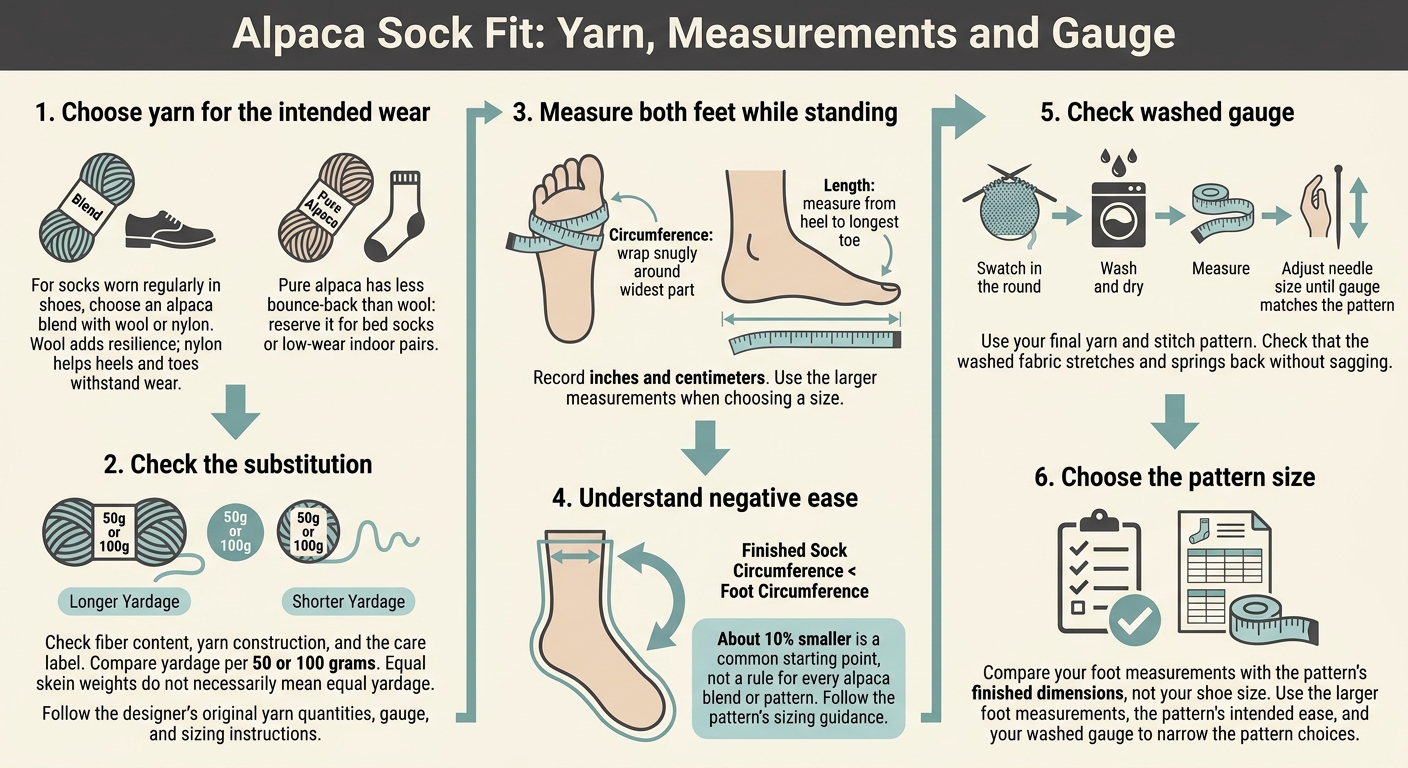
Alpaca Sock Fit: Yarn, Measurements and Gauge
Alpaca Blends for Stretch and Wear
Pure alpaca doesn’t bounce back as well as wool. Wool adds resilience, while nylon helps heels and toes hold up to wear. Save pure alpaca for bed socks or indoor pairs that get little wear, rather than socks you’ll wear regularly in shoes.
Look beyond softness: check the fiber content, yarn construction, and care label. For more project inspiration, see our alpaca guide for knitters. When substituting yarn, compare yardage per 50 or 100 grams. Two skeins can weigh the same but have different yardage. Follow each designer’s original instructions for yarn quantities, gauge, and sizing.
Measure Your Feet and Check Gauge
With your yarn chosen, measure both feet while standing. Wrap a flexible tape snugly - but not tightly - around the widest part, usually the ball of the foot. Then measure from the back of the heel to the longest toe. Record inches and centimeters, and choose a size using the larger measurements. Compare those numbers with the pattern’s finished dimensions, not your shoe size.
Socks need negative ease, meaning the finished circumference is smaller than your foot’s circumference. About 10% smaller is a common starting point, but it doesn’t suit every yarn or pattern. Follow the pattern’s sizing guidance, and check that the washed fabric stretches and springs back without sagging.
Swatch in the round using your final yarn and stitch pattern. Wash and dry the swatch, then measure it. Adjust your needle size until your gauge matches the pattern.
Use these measurements to narrow down the pattern choices below.
Sock Pattern Comparison
Compare construction, gauge, and fit below. Check the current pattern instructions before relying on any unverified details.
| Pattern, source, and access | Construction and skill* | Original yarn weight | Suggested alpaca substitution | Needles: US / mm | Gauge | Fit and sizing | Fit | Heel and toe |
|---|---|---|---|---|---|---|---|---|
| Basic Sock - Alpaca Cashmere; free Ravelry download | Check current pattern PDF; skill unverified | Weight unverified | Alpaca blend matching your chosen weight and gauge | Unverified | Unverified | One main size with enlargement notes; exact dimensions unverified | Limited fixed sizing; check enlargement instructions | Unverified |
| Rye Light - Tin Can Knits; official free pattern page | Cuff-down; beginner to intermediate | Sock/fingering weight; adult sizes need about 320, 380, or 480 yards | Fingering-weight alpaca blend | US 1 / 2.25 mm and US 2 / 2.75 mm | 32 stitches and 46 rounds per 4 inches in stockinette on larger needles | Adult cuff/foot: about 7.25, 8, or 8.75 inches; adjustable leg and foot length | Multiple sizes; choose by finished circumference | Heel flap, short-row turn, gusset; grafted/Kitchener toe |
| Universal Toe-Up Sock Formula - Amy Swenson; free Ravelry download | Toe-up; confident beginner to intermediate | Sock, sport, DK, or worsted; gauge-based recipe | Alpaca blend in your chosen weight | Choose needles that match gauge | Sock: 7–8 stitches/inch; sport: 6.5–7; DK: 5.5–6.5; worsted: 5–6 stitches/inch | Measurement-based; no fixed finished-size chart | Customize using your measurements and gauge | Short-row heel; short-row toe with provisional cast-on |
| Rye - Tin Can Knits; official free pattern page | Cuff-down; beginner to intermediate, with tutorials | Worsted weight | Worsted-weight alpaca blend | US 3 / 3.25 mm and US 5 / 3.75 mm | 22 stitches and 30 rounds per 4 inches in stockinette on larger needles | Adult cuff/foot: about 7.25, 8, or 8.75 inches; adjustable leg and foot length | Multiple sizes; thicker fabric than Rye Light | Heel flap confirmed; check current instructions for heel-turn and toe-finishing methods |
| Thuja - Bobby Ziegler; check current pattern PDF | Check current pattern PDF; skill unverified | Unverified | Choose after confirming weight and gauge | Unverified | Unverified | Unverified | Unverified | Unverified |
Unverified details weren’t listed in the current source.
Skill ratings are editorial guidance based on the required techniques.
Next, compare fit and care needs to narrow your choice for wear and durability.
1. Basic Sock by Alpaca Cashmere
Find Basic Sock by Alpaca Cashmere on Ravelry and open the free download. It’s the most alpaca-specific pick in this list, but you’ll need the PDF for the technical details. The listing doesn’t confirm construction, heel style, or toe shaping. Check the download for those details and the required techniques before knitting. This pattern is best suited to knitters who prefer to read the instructions closely before starting.
The pattern offers multiple yarn weights, with sizing based on yarn weight rather than standard foot-size ranges. The listing doesn’t confirm gauge, needle size, or yardage. Swatch before choosing your yarn weight, then measure the widest part of your foot. Compare that measurement with the intended circumference in the PDF, and follow the size-up notes if needed.
Try the sock on as you knit. The cuff should stretch comfortably, and the instep should feel snug - not tight. If you’d prefer clearer sizing and construction details, the next entry spells out more.
2. Rye Light by Tin Can Knits
Rye Light is the lighter, more fitted sock option from Tin Can Knits.
Construction and Shaping
Knit from the cuff down, this fingering-weight sock has a garter-stitch leg and instep, a heel flap and turn, a gusset, and a grafted toe.
Skills and Techniques
This pattern suits knitters who can knit small circumferences in the round. It offers practice with ribbing, stitch patterns, picking up stitches, decreases, and Kitchener stitch.
Yarn, Gauge, and Needles
Use fingering-weight yarn with US 1 (2.25 mm) and US 2 (2.75 mm) needles. Choose one of the best alpaca yarn blends for socks, then swatch, wash, and remeasure before casting on.
Finished Size and Fit
Sizes range from baby to adult large. Choose your size using actual foot circumference and ease - not shoe size. The fine gauge keeps bulk low, making these socks a good fit for sneakers or loafers. Try them on after the heel and again before starting the toe decreases.
3. Universal Toe-Up Sock Formula by Amy Swenson
Use this formula to make a toe-up sock sized to your own measurements.
Construction and Shaping
Amy Swenson’s free Knitty worksheet starts with a provisional cast-on and short-row toe. You then knit the foot in the round and work a short-row heel. To position the heel, the worksheet subtracts 1.5 inches from your full foot length.
Skills and Techniques
You’ll need to know a provisional cast-on and wrap-and-turn short rows, and be comfortable knitting small circumferences in the round. Adding texture? Adjust the stitch count to fit the pattern repeat. For k2, p2 ribbing, you’ll need a multiple of four.
Yarn, Gauge, and Needles
The formula works at any gauge. Choose a durable alpaca blend with wool or nylon, then swatch for a firm fabric that feels comfortable. Let that fabric guide your needle size, and enter your measured stitches per inch in the worksheet.
Finished Size and Fit
Record your ball-of-foot circumference, toe-to-heel length, desired leg length, and gauge. Multiply the circumference by 0.9 for about 10% negative ease, then multiply that result by your stitches per inch to get the working stitch count. Adjust the count to suit your stitch repeat.
Try the sock on after the toe, during the foot, and after the heel turn. Look for a snug fit around the ball of your foot, a correctly placed heel, and an instep that doesn’t pinch. Knit the leg to your chosen length, then finish with elastic ribbing and a stretchy bind-off.
4. Rye by Tin Can Knits
Construction and Shaping
For a warmer, thicker cuff-down sock, try Rye. This free, beginner-friendly pattern from Tin Can Knits’ Simple Collection uses worsted-weight yarn and has a wedge toe finished by grafting.
Skills and Techniques
Rye makes a good first sock project once you’re comfortable knitting in the round. You can use DPNs or magic loop - just follow the stitch counts for your chosen size.
Yarn, Gauge, and Needles
Choose worsted/aran-weight yarn - not DK. Depending on the size, you’ll need 70 to 340 yards. The suggested needles are US 3 (3.25 mm) for the cuff and US 5 (3.75 mm) for the main fabric. Aim for 22 stitches and 30 rounds per 4 inches on the larger needles. A wool-blend alpaca yarn helps the fabric recover its shape.
Finished Size and Fit
The seven unstretched cuff circumferences are 4.25, 5, 5.75, 6.5, 7.25, 8, and 8.75 inches. You can adjust the leg and foot lengths.
The warm, cushioned fabric works well for lounging, boots, and roomy shoes, though it can feel bulky in snug shoes. The next pattern shifts that balance again.
5. Thuja by Bobby Ziegler
Construction and Shaping
Thuja is the textured, roomier-fit option in this roundup. Knit cuff-down, it has texture along the leg and instep, a heel flap and gusset, and a toe shaped with decreases and closed at the end. Follow the pattern for the exact cast-on, round repeats, and finishing steps.
Skills and Techniques
This pattern suits knitters comfortable with small-circumference knitting, heel turns, picking up stitches, and decreases. The texture is simple, but track your stitches carefully where the leg meets the instep to keep it aligned.
Yarn, Gauge, and Needles
The pattern calls for Manos del Uruguay Wool Classica, 1 skein/138 yards, US 10 (6 mm) needles, and a gauge of 14 stitches and 20 rows per 4 inches. If you’re using alpaca, choose a resilient blend and wash your textured swatch before checking gauge.
Finished Size and Fit
Sources don’t confirm a size range or finished circumference, so refer to the pattern’s measurements. The thicker, textured fabric works best with roomy footwear, house shoes, and boots. Use the fit checks below to check length, heel placement, stretch, and how the socks fit inside your shoes.
Check Fit and Care for Your Socks
Before checking the final fit, confirm your size using your washed gauge and foot measurements. Match the pattern’s finished circumference to your foot, allowing for the pattern’s intended ease. Alpaca blends vary, so follow the pattern’s sizing notes.
When to Try On Your Socks
For cuff-down socks, try them on after finishing the heel and again before starting the toe decreases. For toe-up socks, check the fit after finishing the toe, at the pattern’s heel-start point - not after completing the full foot - and after finishing the heel.
If the sock feels tight, review your needle size, stitch count, or chosen size. Blocking won’t add lasting circumference. Once the heel and foot fit, check how the fabric feels inside your shoes.
Match Sock Thickness to Footwear
Try the socks in the shoes you’ll actually wear. Crowded toes or pressure across the instep may mean the sock is too bulky, even when its circumference is right. A thin sock can wrinkle inside a roomy boot and cause friction. Fabric thickness helps you choose a pattern that suits your footwear.
| Sock choice | Fabric bulk | Footwear space | Intended use |
|---|---|---|---|
| Lightweight | Low bulk | Close-fitting everyday shoes | Daily wear, office shoes, and sneakers |
| Thicker | Higher bulk | Roomy boots | Boot wear where extra space allows |
| Thicker, home-wear socks | Higher bulk | Slippers or relaxed home wear | Comfortable wear at home |
Check Cuff Stretch, Wear, and Washing Instructions
Stretch the cuff enough to pass over your heel, then let go. It should return toward its original size and stay up without digging in. Check that recovery again after washing. After several wears, look for thinning, fuzzing, or holes at the heel, ball, and toe.
Follow the yarn label. If it calls for hand washing, use cool water and mild detergent. Machine wash only if the label allows it. Press out water with a towel, reshape the socks, and lay them flat to dry. Don’t hang wet socks by their cuffs.
Also check skill level, gauge, and yarn when making your final choice.
Conclusion: Choose by Fit, Skill, and Yarn
For lightweight socks, go with Basic Sock by Alpaca Cashmere or Tin Can Knits’ Rye Light. Pick Rye for a thicker sock or Thuja for texture and a roomier fit.
Need custom sizing? Use Amy Swenson’s Universal Toe-Up Sock Formula.
Before picking a pattern, compare its construction, yarn weight, gauge, and fit. Look for a match for your foot, your yarn, and your knitting comfort level.
FAQs
What alpaca blend ratio works best for socks?
For everyday socks, choose an alpaca blend with nylon, wool, or other technical fibers. These blends help socks last longer and hold their shape through repeated washing and wear.
100% alpaca can work for low-friction house or boot socks. But it doesn’t have the elasticity and spring-back of blended yarns, so socks may sag or lose their shape over time.
How can I reinforce sock heels and toes?
Carry a strand of reinforcement thread alongside your main yarn as you knit heels and toes. It makes these high-friction areas more durable and helps keep the fabric from thinning.
If the fabric wears thin, repair it with duplicate stitch using reinforcement yarn. A darning egg or mushroom provides a firm, curved surface, helping you make a smooth patch without accidentally sewing through both layers of the sock.
How can I prevent alpaca socks from stretching out?
Choose an alpaca blend with nylon, wool, or technical fibers for better elasticity and shape retention than plain alpaca.
Aim for a dense gauge of about 8 stitches per inch. Smaller needles can help create a tighter fabric, while ribbing or cables help socks hold their shape.
Block gently and dry flat away from heat. Avoid hanging wet socks by the cuff.