
DPNs vs. 9-Inch Circulars vs. Magic Loop for Socks

Choose sock needles by hand comfort and how they handle heels and toes. DPNs work through changing stitch counts, 9-inch circulars keep rounds continuous but need backup needles for small sections, and magic loop handles the whole sock on one long circular.
All three methods knit socks without seams. The trade-off? More needle tips, a smaller grip, or more cable movement.
Quick Comparison
| What matters | DPNs | 9-inch circulars | Magic loop |
|---|---|---|---|
| Setup | 4–5 double-pointed needles | One short circular, plus backup needles | One 32–40-inch circular for one sock |
| Learning curve | Handling several needles | Holding short tips | Moving cable loops |
| Hand comfort | Multiple tips can feel awkward | Compact grip may cramp hands | Longer tips; repeated cable adjustments |
| Heels and toes | Move stitches between needles | Switch when stitches no longer slide freely | Adjust loops as stitch counts change |
| Travel | Protect tips and secure loose needles | Compact, but backups add pieces | One connected needle; cable may tangle |
| Laddering | Possible at needle changes | Fewer transition gaps | Possible at cable transitions |
| Two socks at once | Separate sets | Not generally suitable | Use a 40- or 47-inch circular |
Test the grip before starting a full pair. Hands should stay relaxed, and stitches should slide without tugging. For 9-inch circulars, judge when to switch by the fabric’s fit - not a fixed stitch count.
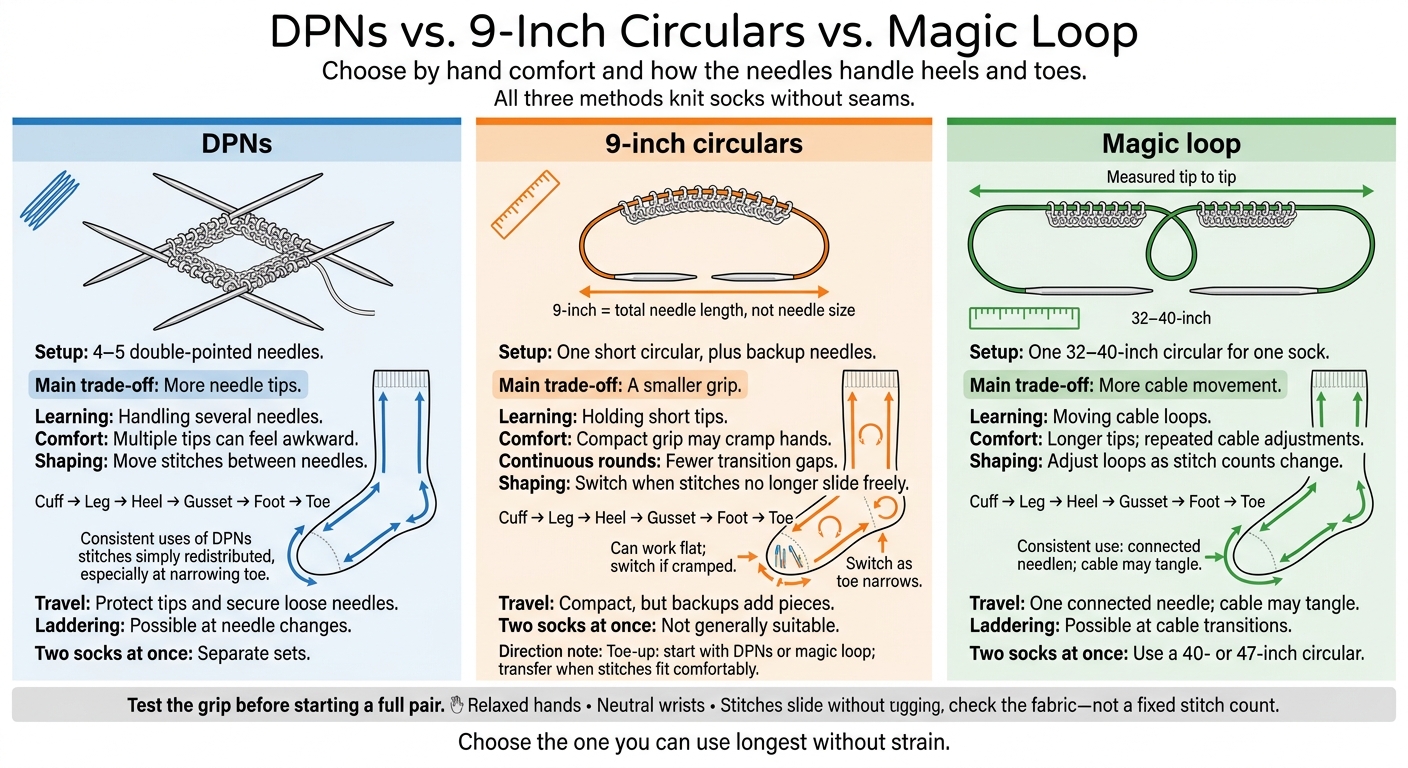
Sock Needles Compared: DPNs vs. 9-Inch Circulars vs. Magic Loop
Knitting Socks on DPNs
Learning to Handle Multiple Needles
After you work each group of stitches, the empty needle becomes your next working needle. Keep idle needle tips clear of the yarn, and mark the start of the round with a removable stitch marker or a short strand of contrasting yarn.
To reduce laddering, snug the first one or two stitches after each needle change without pulling the fabric tight. If gaps remain, move a few stitches between needles every few rounds, keeping the pattern repeat intact. Shorter DPNs leave less overhang. Bamboo or wood offers more grip, while metal lets stitches slide faster.
Once needle changes feel comfortable, give some attention to protecting your project in your bag.
DPN Equipment and Travel
DPNs have loose points, so pack them with care. Bring the correct DPN size, sock yarn, and stitch markers. Use tip protectors and a small pouch to keep exposed points and loose needles contained.
Secure live stitches before packing. A crowded bag can pull a needle out of its stitches.
Working Heels, Gussets, and Toes
For a flap-and-gusset heel, work the heel stitches back and forth while the instep stitches rest on the other needles. After turning the heel, pick up stitches along both flap edges and redistribute them before beginning the gusset decreases. Keep decrease locations tied to the heel and instep - not just to whichever needle happens to hold them.
As toe decreases shrink the circumference, move stitches onto fewer needles. Continue shaping at the sides specified in your pattern, then finish as directed. Unlike a fixed-length circular, DPNs let you keep knitting as the toe narrows without changing tools. The next section covers the short-circular option and when you’ll need to switch setups.
Knitting Socks on 9-Inch Circulars
Learning to Use Short Tips
A 9-inch circular holds stitches in one continuous round. Its short tips call for a compact grip, so casting on may feel awkward. Work several cuff rounds with your hands close to the tips. Look for relaxed thumbs, neutral wrists, and stitches that slide freely.
Tight tension can make the small working space feel cramped. Pay attention as the sock gets smaller or your hands begin to tense.
Short-Circular Equipment and Travel
Choose a needle size that gives you the pattern gauge. The 9-inch label describes the needle’s total length, not its size.
Pack a start-of-round marker, DPNs or a long circular for Magic Loop, yarn, your pattern, a tapestry needle, and a measuring tool. The short circular is compact and stays with your work. But adding backup needles can make the full kit just as bulky as a DPN-only kit.
As the sock changes shape, check whether the fabric still moves comfortably around the needle.
When to Switch to Another Setup
Check the fabric, not the stitch count. Gauge, yarn elasticity, and fabric stretch all affect whether the sock fits the fixed-length needle. After a few rounds, check that stitches slide easily to the tips. If you have to tug them into place, switch setups.
You can work a heel flap flat while the instep stitches rest on the circular. If the heel feels cramped, use DPNs or a longer circular for that section. Keep gusset stitches on the short circular as long as they fit comfortably, and check again after decrease rounds.
For cuff-down socks, move to DPNs or Magic Loop when toe decreases make the tube too small for the short circular. For toe-up socks, start with DPNs or Magic Loop, then transfer when the stitches fit comfortably around the short circular.
How To Knit The Magic Loop for perfectly fitting socks
Knitting Socks with Magic Loop
Magic loop divides sock stitches into two sections on one long circular needle. The adjustable cable lets you use the same needle as the sock’s circumference changes. Once you understand the setup, the main skill is keeping the cable loops tidy.
Learning to Handle Cable Loops
Check that your stitches aren’t twisted, divide them into two equal groups, and pull a cable loop out between them. Slide the stitches you’re about to knit onto the front tip, leaving the other group on the cable. Use the back tip as your working needle. Rotate the work, reposition the cable, and repeat. Before working with fine sock yarn, practice on a larger, less slippery swatch.
Snug the first stitch or two after each transition - but don’t pull too hard. Loose joins leave ladders, while tight joins make the next round harder to knit. A smooth cable helps it slide into place, so your needle setup matters.
Magic Loop Equipment and Travel
Use the needle size listed in your pattern. For one sock, choose a 32–40-inch circular needle, measured tip to tip. Look for a flexible, low-memory cable that lies flat, with smooth joins between the needles and cable.
One connected needle means fewer loose pieces to track than DPNs. Alpaca Direct’s YouTube tutorials show how to move the cable. You’ll use the same setup for heel work and toe decreases.
Shaping and Knitting 2 Socks at Once
Leave the instep stitches on the cable while you work the heel. Then redistribute the stitches as the gusset narrows the sock.
For two socks at once, use a 40- or 47-inch circular needle. You’ll work both socks in parallel. If you’re still learning the cable changes, start with one sock before trying two.
When comparing magic loop with DPNs and 9-inch circulars, consider comfort, portability, and how each option handles narrowing stitches.
Comparing and Choosing Your Sock Needles
Now that you know the three methods, compare how each feels in your hands, fits in your travel kit, and handles changing stitch counts.
Side-by-Side Needle Comparison
| Criterion | DPNs | 9-Inch Circulars | Magic Loop |
|---|---|---|---|
| Learning curve | Several tips and joins to manage | Short tips take practice | Cable loops and tension take practice |
| Equipment | Four or five short needles | One short circular; DPNs usually handle very small sections | One long circular with a flexible cable |
| Travel security | Exposed tips need protection | Connected needle keeps work contained | Stitches can rest on the cable, but loops may tangle |
| Laddering | Possible at needle joins | Fewer transition gaps | Possible at cable transitions |
| Portability | Compact, but loose needles can get misplaced | Compact; backup needles add bulk | Fewer pieces, more cable |
| Hand comfort | Multiple tips may feel awkward | Short tips may strain fingers or thumbs | Longer tips, but repeated cable adjustments |
| Shaping and size changes | Redistribute stitches for heels, gussets, and toes | Handles heels and gussets while stitches fit; tiny circumferences need another needle setup | Adjust loops for shaping and tiny circumferences |
| Two-at-a-time suitability | Requires alternating between separate sets | Not generally suitable | Supports two socks on one long circular |
Choose by Comfort, Shaping, and Travel
Start with your grip, then consider shaping and travel. Short circulars keep rounds continuous while the stitches fit. DPNs let you redistribute stitches as the sock changes shape. Magic loop lets you adjust the circumference without switching setups.
For travel, weigh the loose needles of DPNs against the backup needles you may need with 9-inch circulars - or the extra cable of magic loop.
Key Takeaways and Learning Resources
A setup needs to fit both the sock and your hands. Choose the one you can use longest without strain.
- DPNs: Move stitches between needles as needed for shaping.
- 9-inch circulars: Knit continuous rounds in a compact setup at a suitable fixed circumference; keep DPNs handy for tiny sections.
- Magic loop: Adjust the circumference and knit two socks at a time.
Test your yarn and needle size before committing to a textured alpaca socks pattern. Check for relaxed hands, even tension, and stitches that stay securely on the needles.
Find tools and educational resources at Alpaca Direct, and knitting instruction on its YouTube channel.
FAQs
Can I use DPNs with a magic loop sock pattern?
No - not at the same time. Double-pointed needles (DPNs) and Magic Loop are two separate ways to hold stitches.
Magic Loop uses one long circular needle, typically 32 to 47 inches, with cable loops dividing the stitches. DPNs use four or five separate needles arranged in a triangle or square, with no cable.
Your choice comes down to what you’d rather manage: separate needles or cable loops.
How do I transfer stitches from 9-inch circulars to DPNs?
Use an empty double-pointed needle (DPN) to knit stitches off your 9-inch circular needle. Spread the stitches evenly across three or four DPNs, based on your pattern or preferred setup.
If you’re transferring stitches to check the fit or prepare to knit the heel, move only the stitches your pattern calls for. For more technique tips, visit the Alpaca Direct YouTube channel.
Will switching needle setups change my sock gauge?
Switching between DPNs, 9-inch circulars, and Magic Loop can change your gauge. Needle material, surface friction, and how you hold each setup all affect tension. Even a small shift can change the fabric’s density or the size of your socks.
Swatch in the round with the setup and needle size you plan to use. Check your gauge whenever you switch needles or yarn to help your socks fit correctly.