Your Cart is Empty



If I want textured alpaca socks to fit well, I keep the texture on top, knit the sole smooth, and use a firm gauge.
That’s the short answer. Alpaca is soft, warm, and lanolin-free, but it has less stretch than wool, so socks can loosen with wear if I use the wrong yarn or too-loose stitches. For most pairs, I get the best result with a fingering-weight alpaca blend, about 350–450 yards, worked at around 8–9 stitches per inch.
Here’s what matters most:
A heel flap and gusset is often the safer pick for fit, and a smooth toe keeps the front of the sock comfortable in shoes. In other words: soft yarn is only part of the job - structure, gauge, and placement are what make textured alpaca socks look good and wear well.
The guide below walks through those choices in plain terms, from yarn and needles to heel, toe, blocking, and care.
Use fingering-weight yarn for textured alpaca socks. A good choice is a blend with alpaca for softness, wool for stretch, and nylon for wear. Most adult pairs take about 350–450 yards (75–100 g), though taller cuffs or larger sizes may need more.
For needles, fingering-weight alpaca sock yarn usually works best on US 1 to US 3 (2.25–3.25 mm). Many knitters get a firm fabric that works well for socks on US 1 or US 1.5 (2.5 mm). If you knit very tightly, US 2 (2.75 mm) may suit you better. If you knit loosely, you may need to drop to US 0 (2.0 mm). Alpaca blends can slip a bit on metal needles, so many knitters like wood or lightly coated tips for extra control.
As for needle style, use whatever feels best in your hands:
Before you cast on, keep these four tools nearby: stitch markers for pattern repeats, a tapestry needle for weaving in ends, a flexible measuring tape for leg and foot length, and a row counter to help track rounds so both socks match. Once your yarn, needles, and tools are ready, swatch before you settle on the stitch pattern.
Swatch in the round, not flat. Tension changes when you knit in the round, and that difference matters for socks.
Make one stockinette swatch and one texture swatch. Then wash and dry both the same way you plan to care for the finished socks. Alpaca tends to relax after washing, so if you measure too soon, your numbers can be off.
When the swatches are dry, count stitches and rounds over 2 inches, then divide by 2 to get your per-inch gauge. For fingering-weight alpaca sock yarn, aim for about 8–9 stitches and 11–13 rounds per inch in stockinette. Then compare the two swatches. If the textured pattern pulls in, you may need to add stitches to the sock circumference. If it opens up more than stockinette, try a smaller needle.
"I like a smooth, close-fitting foot, so I usually go down a needle size for the foot section of the sock." - Kathleen Cubley
A slightly firmer gauge than you'd use for a sweater helps alpaca socks keep their shape. It also keeps textured stitches looking clean instead of soft and blurry. After the swatch dries, use that gauge to line up the texture repeat with your cast-on count.
Color changes the look of texture more than many knitters expect. Solid, heathered, or subtle tonal mid-tones - like forest green, denim blue, or soft gray - make the stitch pattern easier to see. Light hits the raised stitches, while the purl valleys fall into shadow. Natural alpaca shades such as oatmeal or fawn also work nicely because alpaca has a soft sheen that shows off the surface pattern.
Very dark yarns and highly variegated colorways can hide texture. If you love a busy skein, go with a bold and simple pattern, like wide ribs, instead of a detailed motif.
With yarn, gauge, and color sorted out, the next step is to match the stitch repeat to your cast-on count.
Before you start the leg, make sure your stitch count fits the pattern repeat exactly. If the repeat is 4 stitches, 64 stitches works cleanly. But 70 stitches leaves extra stitches behind, which throws the pattern off.
That’s the whole point: the repeat has to line up with your stitch count. If it doesn’t, you have two simple options. Adjust the total stitch count up or down by a few stitches, or pick a pattern that already fits what you have. For example, k1, p1 rib works with any even number, so it’s a safe backup when the math gets awkward.
Once the repeat and stitch count line up, the next step is picking a texture that still shows up well in alpaca.
Soft alpaca can blur finer details, so it helps to choose stitch patterns with enough texture to stand out. Here are the most useful options:
| Texture Type | Stitch Repeat | How It Behaves in Alpaca | Best Placement |
|---|---|---|---|
| Broken Rib | Even number | Simple stretch and visible texture. | Leg and instep |
| Mock Cable Rib | Multiples of 4 | Adds depth without extra bulk. | Leg and instep |
| Waving Rib | Multiples of 6 | Decorative and flowing; works best in a wool blend. | Leg |
Avoid heavy cables in 100% alpaca. The added yarn weight, along with alpaca’s low memory, can make the fabric sag.
After you’ve picked the stitch pattern, think about placement. Some parts of the sock show texture well. Others just wear it down.
Work your chosen texture across all stitches on the leg. Then, once the heel is done, keep that pattern only on the instep stitches, which are usually the top half of your total stitch count. Knit the sole in plain stockinette the whole way through.
This makes a big difference in wear and fit. Stockinette keeps the sole flatter and less bulky, which helps the sock sit better inside shoes. You still get texture where people can see it, without adding thickness where your foot puts the most pressure.
"I always knit the entire foot in stockinette stitch, no matter what the pattern says!" - Kathleen Cubley, Editor
Textured top, smooth sole. More pattern where it shows, less bulk where it doesn’t.
Once the stitch pattern and repeat are set, you can cast on and work the cuff, leg, heel, and foot.
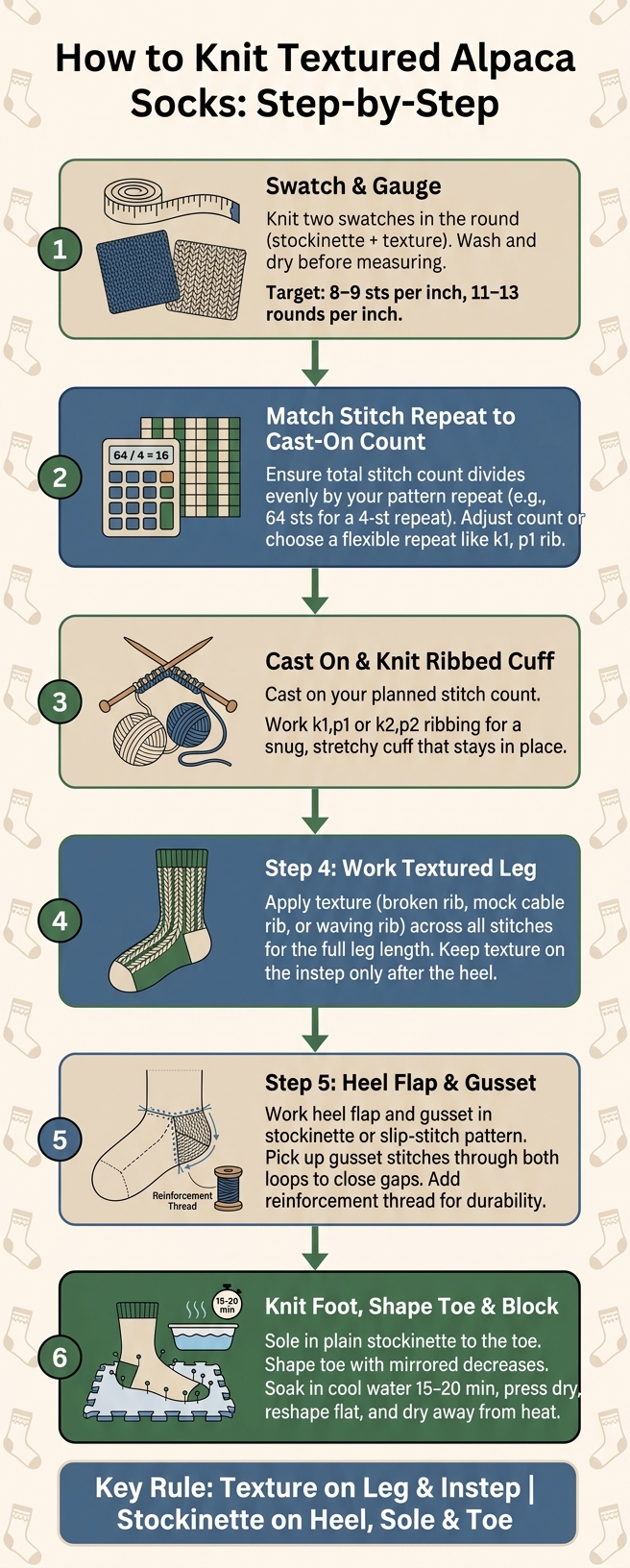
How to Knit Textured Alpaca Socks: Step-by-Step Guide
Start the cuff once your stitch count matches the pattern repeat. Cast on the number of stitches you planned, then work ribbing: k1, p1 for any even stitch count, or k2, p2 if your count is divisible by 4. Ribbing helps the cuff stay snug instead of sliding down.
"Rib patterns are great for socks because they provide lots of stretch." - Alpaca Direct
As you move from the cuff to the textured leg, double-check that your stitch count still works with the repeat. If it doesn’t, fix the count before you begin the leg. Then knit the textured leg to the height you want and move on to the heel shaping.
When the leg is long enough, start the heel and keep the instep texture in place. For alpaca socks, a heel flap and gusset gives the best fit and stronger structure. Keep the texture on the instep, where the sock shows most, and work the heel in stockinette or a simple slip-stitch heel.
To help avoid holes at the join, pick up gusset stitches through both loops of the heel flap edge. That gives you a firmer connection and closes gaps more cleanly. If you want the heel to last longer, hold a strand of reinforcement thread together with the alpaca yarn while you knit the heel flap.
A heel flap and gusset usually gives the best wear and fit. Short-row heels sit flatter, but they often need extra reinforcement.
After the gusset decreases, keep working the instep pattern and knit the sole straight in stockinette to the toe. That smooth sole makes the sock more comfortable and helps with wear. Keep going until the foot reaches the length you want.
For the toe, use rounded decreases. Space them farther apart at the start, then work them more often as you get closer to the tip. Shape the toe with mirrored decreases, then close the remaining stitches.
Soak the socks in cool water with a small amount of wool wash for 15–20 minutes. Then press out the water, roll them in a towel, and reshape them flat. This helps the texture open up a bit so it shows more clearly before you measure against your target size.
Once the socks are fully dry, place them on a hard, flat surface and measure them. Check foot length from the back of the heel to the tip of the toe, and measure width across the ball of the foot. A well-blocked sock should show clear texture without distortion, rippling, or sagging.
After the socks are dry and measured, use that same gentle handling in your regular wash routine.
Wash by hand in cool water, or use a cool wool cycle in a mesh bag if the label allows it. Then dry flat, away from heat or direct sunlight. If you hang wet alpaca socks by the cuff, the leg can stretch out and the texture can soften over time.
Pay close attention to the heels and toes after a few wears. If you spot thinning fabric, darn it early before it turns into a hole.
Rotating between multiple pairs also helps cut down wear on any one pair. A firmer gauge and a durable alpaca blend - especially one that includes nylon or wool - help the socks keep their shape and keep textured stitch patterns crisp after repeated washing and blocking.
Firm gauge, clear stitch choice, and gentle care are what keep alpaca texture sharp.
Each choice in this guide points to the same result: texture that stays visible and socks that hold their shape. Start with an alpaca sock yarn that has enough structure. A blend with nylon or wool adds durability without giving up softness. Swatch in the round, match your stitch repeat to your cast-on count, keep texture on the leg and instep, and finish with a simple toe that stays comfortable inside a shoe.
Together, those choices - and careful blocking and steady care - help the socks stay polished and wearable. For blocking and heel demos, see Alpaca Direct's blog and YouTube channel.
Yes, but 100% alpaca works best for house socks or boot socks, where friction stays fairly low.
The tradeoff is that it has less stretch and spring-back than blended yarns. Over time, that means socks can sag, and they're also more likely to felt or shrink in the wash. For everyday wear, Alpaca Direct recommends blends with nylon, wool, or technical fibers because they hold up better, stretch more, and keep their shape longer.
Knit a swatch in the round with the same yarn, needles, and stitch pattern you plan to use for your sock. For a sock that holds up well, aim for 8 stitches per inch. That gives you a dense fabric that can handle regular wear.
If your gauge is too loose, your socks can sag or slip down. If the fabric feels stiff or tight, you’ve probably gone too far the other way. And one more thing: always block the swatch before you measure it. Alpaca can grow after washing, so measuring too soon can throw everything off.
If your stitch pattern doesn't line up with your total cast-on count, you have two simple options: change the stitch count so it fits the pattern repeat, or switch to a stitch pattern that already works with the number of stitches you have.
If you'd rather leave the stitch count alone, k1, p1 rib is an easy fix because it works with any even number of stitches. Just make sure your stitch count fits the pattern's requirements so the texture stays even all the way across.

Comments will be approved before showing up.