
Free PDF Alpaca Shawl Patterns: Why Does Knitting Curl?

Knitting curls because stockinette’s knit and purl sides pull differently - not because it needs more blocking. Before starting a free PDF alpaca shawl pattern, check its border instructions and finished size, then wash and dry a body-and-border swatch.
Three checks help prevent problems:
- Curl or tight edge? Curl needs a balanced border with enough depth; a gathered edge may need a looser cast-on or bind-off.
- Will the shawl grow? Compare swatch measurements before washing and after drying. A 10-inch swatch that dries at 11 inches has grown 10%.
- Will blocking help? Gentle blocking can smooth stitches and shape lace, but it cannot permanently remove stockinette curl or reliably reverse stretched alpaca. Support wet fabric and dry it flat.
Choose the pattern and yarn based on the washed fabric, not the photo alone.
Quick Knit Baby Blanket Ideas + CDD Center Double Decrease Knitting Tutorial
Check Borders in Free PDF Patterns
Read the PDF, not just the photograph. Photos rarely show how a border is built. Open the pattern and check the edge instructions before you swatch.
Review Construction and Finished Size
Record the yarn weight, fiber content, yardage, needle size, and gauge for both the body and border. Note the blocked finished measurements, too: wingspan, center depth, and diagonals. If you’re substituting alpaca, compare washed gauge and yardage per skein - not just the yarn-weight label.
Follow the shawl from cast-on to bind-off. Check the edge stitches, shaping, repeat counts, and whether the border is worked with the body or added later. Note the border’s stitch count and width. Don’t widen it without recalculating shaping, repeats, and yardage. The bind-off also needs enough give to let the edge spread.
Compare Border Stitches
Judge the edge by its stitch structure, not its label. Some borders help fabric lie flat; others are meant to roll.
| Border method | Likely behavior | Best use | Limitation |
|---|---|---|---|
| Garter stitch | Generally lies flat and adds texture | Can help stabilize an edge | A narrow band may not control a large stockinette field |
| Seed or moss stitch | Balanced texture resists rolling | Works well for a textured border | Needs enough width and consistent tension |
| Reserved edge stitches in a balanced stitch pattern | Can help resist rolling | Helps stabilize an edge worked with the body | Reserving a few stitches alone won’t prevent curl |
| Reverse stockinette | Rolls in the opposite direction from stockinette | Works for an intentional rolled finish | Won’t produce a flat border |
Check how much balanced fabric surrounds the stockinette center and whether the edge stitch count stays constant as the shawl grows. Use the written instructions to assess the border, then test its behavior with a swatch.
Swatch Before Starting Your Shawl
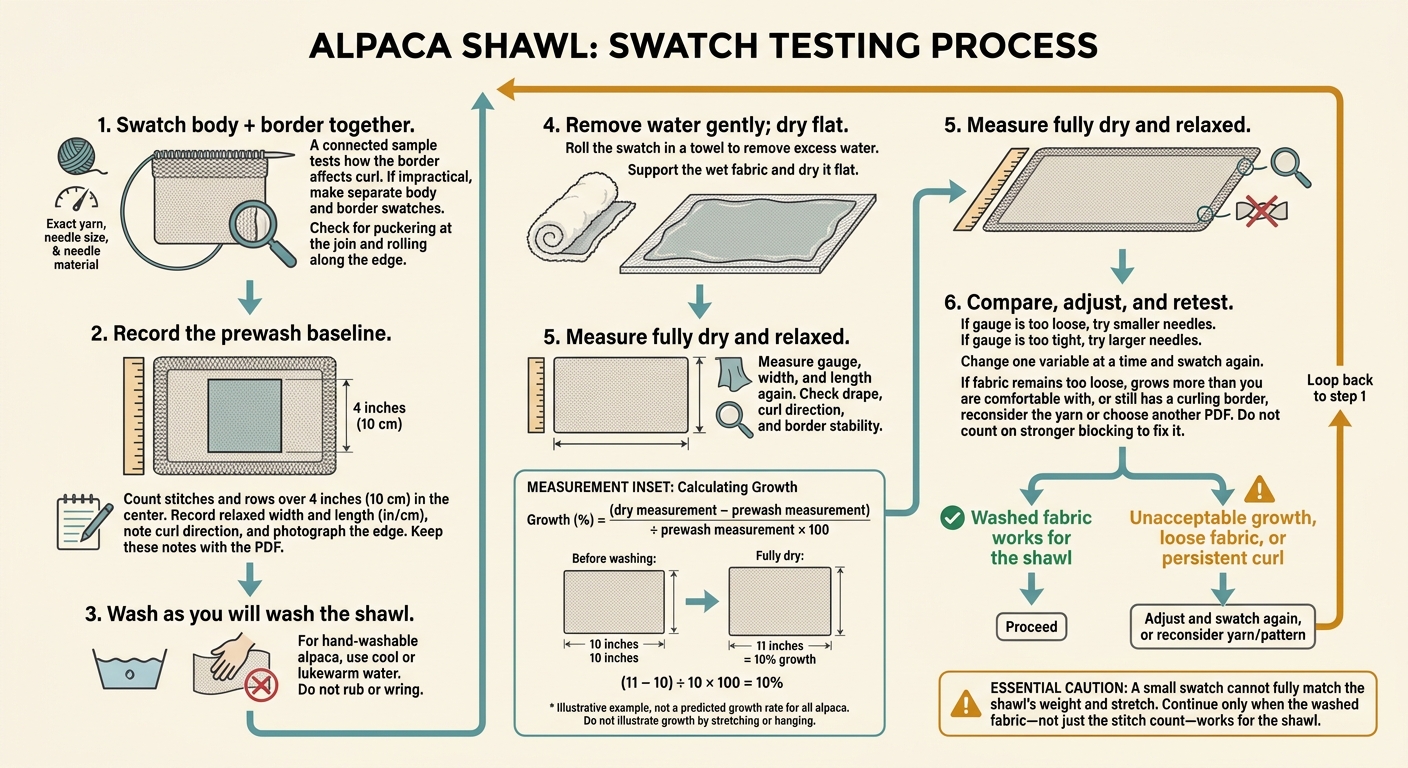
Alpaca Shawl Swatching: Check Curl and Growth
Swatch the Body and Border Together
A border can behave differently once attached to the body. Use the exact yarn, needle size, and needle material listed in the PDF. Swatch the body and border together to check curl and growth, since the border’s structure affects how the edge curls. If a full sample isn’t practical, make separate body and border swatches. Check for puckering at the join and rolling along the edge.
Before washing, count stitches and rows over 4 inches (10 cm) in the center. Record the sample’s relaxed width and length in inches (centimeters), note the curl direction, and photograph the edge. Keep these notes with the PDF.
Measure the Fully Dry Swatch
Wash the swatch the same way you’ll wash the shawl. For hand-washable alpaca yarn, use cool or lukewarm water without rubbing or wringing. Roll the swatch in a towel to remove excess water, then support it as it dries flat.
Once the swatch is fully dry and relaxed, measure its gauge, width, and length again. Calculate growth as (dry measurement − prewash measurement) ÷ prewash measurement × 100. Check the drape, curl direction, and border stability, too. Washed gauge gives the best estimate of finished size, but a small swatch can’t fully match the shawl’s weight and stretch.
If the gauge is too loose, try smaller needles. If it’s too tight, try larger needles. Change one variable at a time and swatch again. If the fabric remains too loose, grows more than you’re comfortable with, or still has a curling border, reconsider the yarn or choose another PDF. Don’t count on stronger blocking to fix it. Continue only when the washed fabric - not just the stitch count - works for the shawl.
Wash and Block Without Overstretching
If the swatch held its shape, block the shawl using the same method you tested.
Support the Wet Shawl and Dry Flat
Check the yarn label and the pattern’s care instructions before soaking, or consult a guide to knitting with alpaca for specific fiber tips. If wet blocking is allowed, use cool or lukewarm water and the recommended wool wash. Avoid agitation and sudden temperature changes.
Support the entire shawl when lifting it. Gently press out water without twisting, then roll it in a clean towel and press evenly. Never hang it wet - the weight can stretch the edges and distort the outline.
Lay the shawl on a blocking mat or clean towels. As you ease it into shape, measure the wingspan, center depth, and border width. Treat the PDF’s dimensions as targets, not measurements you must reach by pulling harder. Pin corners or points gently, with just enough tension to define them. Leave the shawl flat until fully dry, checking thicker border sections before removing the pins.
If the shawl still changes shape after drying, the fabric structure - not the blocking method - may be the problem.
What Blocking Can Fix - and What It Cannot
After washing, aim to set the shape without forcing the fabric. Blocking can refine alpaca’s shape, but it won’t restore its spring.
| Blocking can do | Blocking cannot do |
|---|---|
| Even out stitches and open lace | Permanently eliminate stockinette’s structural curl |
| Settle mild edge irregularities | Replace a well-designed border |
| Refine the outline toward intended measurements | Guarantee exact dimensions when yarn or gauge differs |
| Help fabric relax into its finished shape | Restore lost elasticity or guarantee reversal of overstretching |
If reaching the PDF’s size takes strong pulling, aim for smaller dimensions. If an edge still rolls after drying, change the border rather than blocking it again with more tension.
Fix Problems and Plan Your Next Shawl
If blocking didn’t solve the problem, choose a fix based on what you see.
Choose a Fix for Each Problem
A rolling edge points to curl; a shawl that gets larger after washing points to growth. Before changing a rolled edge, check whether it’s part of the design.
For curling, try a deeper border with tested stitch counts and pickup counts. Or choose a PDF with a deeper garter, seed, or moss border.
For a rippling border, check for overstretching, loose edge tension, needles that are too large, or too many picked-up stitches. Test your corrections on a swatch before reworking the shawl.
If the care instructions allow it, resoak uneven lace points and gently reshape them. Growth after washing may not fully reverse.
Before casting on again, compare your washed gauge, border behavior, and finished-size targets with the PDF.
Find Yarn and Knitting Resources
Put what your swatch taught you to work on your next shawl. Find alpaca yarn at Alpaca Direct, and use its YouTube technique videos for help with your next project.
FAQs
Can I add a border to a finished shawl?
Yes. A garter or seed stitch border can help stabilize the fabric, add structure, and keep the edges from curling.
If the edge is uneven or too tight, undo only the bind-off row, pick up the live stitches, and bind off again with a stretchier technique.
For more tips, check out Alpaca Direct’s knitting resources or YouTube tutorials.
Will an alpaca blend reduce stretching?
Yes, an alpaca blend can reduce stretching and give your shawl more structure than pure alpaca. Pure alpaca drapes beautifully, but it has little natural memory and can grow by 10% to 15% when wet. Wool adds resilience and elasticity, while silk adds strength and helps the fabric hold its shape.
For more tips on fiber behavior and choosing yarn, check out Alpaca Direct’s educational resources and YouTube tutorials.
How wide should my shawl border be?
Follow your pattern’s border rows or motifs - there’s no single width that works for every project. If you’re customizing the border, garter stitch or seed stitch can help steady the fabric and reduce curling. A broader border will use more yarn.
Swatch the lace and border together, then wet block the swatch to see how the edge lies. If it still rolls, try a more elastic bind-off or a different needle size. Set aside enough yarn for both the border and the bind-off.