
5-Inch vs. 6-Inch DPNs for Knitting Socks

Choose 5-inch DPNs for less overhang and 6-inch DPNs for more stitch and grip space. Both work for sock cuffs, heels, and toes. Match the needle diameter to the required gauge first, then choose the length that keeps stitches secure without straining the hands. This ensures a proper fit, especially when knitting socks for wide or narrow feet.
The difference is just 1 inch, but stitch placement matters: a 64-stitch sock may have 16 stitches on each of four holding needles, while a heel flap may put 32 on one needle. Check the straight shaft space, yarn thickness, needle material, and grip - not hand size alone.
Quick Comparison
| Factor | 5-inch DPNs | 6-inch DPNs |
|---|---|---|
| Stitch space | Less room; check for crowded tips | More room for heel stitches and gusset pickups |
| Handling | Less overhang during heel turns and toe decreases | More shaft for fingers, but ends may bump nearby needles |
| Grip fit | Often suits a compact grip | Often suits a grip farther from the tips |
| Cuffs, heels, and toes | Works when stitches fit securely | Works when extra length stays out of the way |
Test both lengths with the same yarn and needle diameter. The better fit needs less squeezing, hand shifting, and stitch repositioning.
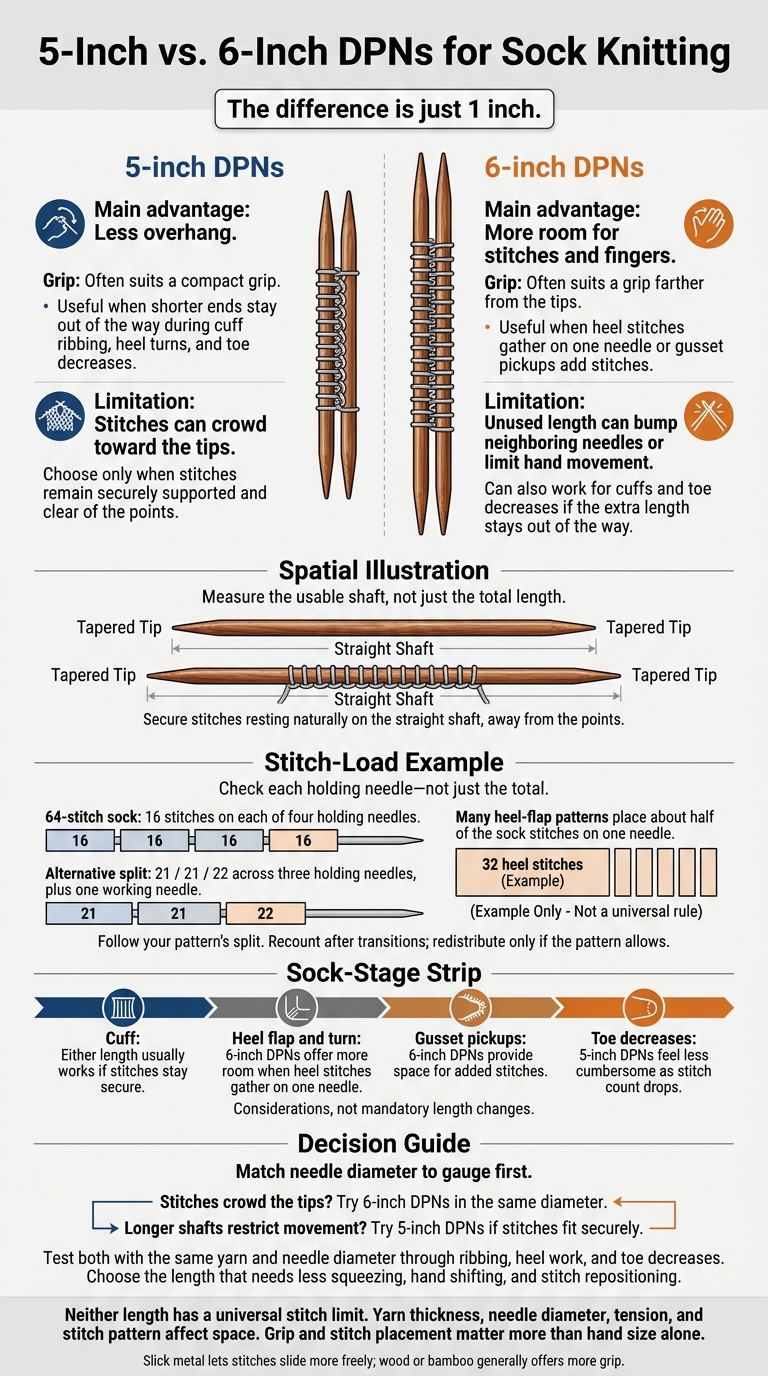
5-Inch vs. 6-Inch DPNs for Sock Knitting
5-Inch vs. 6-Inch DPNs: Space and Control
Sock cuffs, heels, and toes put different numbers of stitches on your needles. Once you’ve set your gauge, check how much straight shaft you need for each stage. Knitting needle length is a guide, not a rule: your grip and stitch placement matter more than hand size alone.
| Consideration | 5-inch DPNs | 6-inch DPNs |
|---|---|---|
| Main advantage | Less overhang | More room for stitches and fingers |
| Grip style | Compact grip | Broader grip |
| Useful sock stages | Narrow cuffs, heel turns, and toe decreases | Cuffs with more stitches and heel stitches gathered on one needle |
| Main limitation | Stitches can crowd toward the tips | Unused length can bump neighboring needles or limit hand movement |
Measure the usable shaft, not just the total length. The tips and taper leave less straight space for stitches. Material affects control, too: slick metal lets stitches slide more freely, while wood or bamboo generally offers more grip.
5-Inch DPNs: Less Overhang
Shorter ends can stay out of your way during cuff ribbing, heel-turn short rows, and toe decreases. Use them only when stitches stay fully supported and clear of the points. If the stitches feel cramped, 6-inch needles offer more room.
6-Inch DPNs: More Stitch and Grip Space
That extra inch helps when stitches crowd together, including when heel stitches collect on one needle. Six-inch needles can also work through toe decreases. Keep using them if the extra length doesn’t hit neighboring needles or strain your grip.
Cuffs, Heels, and Toes: Check Stitch Load
As your sock grows, the stitch load shifts from cuff to heel to toe. Check each holding needle - not just the total stitch count. Stitches should sit securely without bunching or slipping.
Needle length matters most as that load changes.
| Sock stage | Length considerations |
|---|---|
| Cuff | Either length usually works if stitches stay secure. |
| Heel flap and turn | 6-inch DPNs offer more room when heel stitches gather on one needle. |
| Gusset pickups | 6-inch DPNs provide space for the added stitches. |
| Toe decreases | 5-inch DPNs feel less cumbersome as the stitch count drops. |
Count Stitches per Holding Needle
Watch how stitches are divided between needles, especially when the heel or toe puts more stitches on one needle.
For a 64-stitch sock, a common split is 16 stitches per needle on four DPNs, or 21/21/22 across three holding needles and one working needle.
If your pattern calls for a different split, follow it to keep the instep and sole positioned correctly.
Many heel-flap patterns place about half of the sock stitches on one needle. Turning the heel changes that load, and picking up gusset stitches adds stitches along both heel edges.
Recount after each transition. Redistribute stitches only if your pattern allows it. Check for crowding at the tips and stitches sliding toward the unused end.
Check Gauge and Yarn Weight
Neither length has a universal stitch limit. Yarn thickness, needle diameter, tension, and stitch pattern all affect how much room your stitches need.
Check stitches as they rest naturally on the shaft, rather than pushing them tightly together. Keep them away from the tapered tips.
If stitches crowd a 5-inch needle, switch to a 6-inch needle in the same diameter.
Hand Size and Grip: Find a Comfortable Fit
After checking stitch load, see how the needles feel in your hands. Hand size plays a part, but grip matters more. You should be able to hold the needles without squeezing them or straining your wrists.
| Factor | 5-inch DPNs | 6-inch DPNs |
|---|---|---|
| Best fit | Often suits smaller hands or a grip close to the tips | Offers more shaft for larger hands or a grip farther from the tips |
| Holding space | Leaves less room for your fingers when stitches fill the shaft | Provides more room for both stitches and fingers |
Your knitting style also affects how much clearance you need. Skip the grip labels and focus on how the needles move. The working needle should move without forcing you to reset your hand, while held stitches stay secure. Repeated bumps, pinching, or hand repositioning point to a poor fit.
Test both lengths on the same sock to compare how they feel.
Test Both Lengths on the Same Project
Use the same needle diameter and sock yarn for both lengths. Try each length through ribbing, heel work, and toe decreases.
Watch for squeezing along the shaft, pressure against your palm, or bumps against neighboring needles. Check whether held stitches drift toward the points while you knit, not just when you pause to arrange them. If your grip feels strained, stop and adjust.
Choose the length that requires the least hand shifting and stitch repositioning.
Conclusion: Choose by Stitch Space and Grip
Check stitch load and grip comfort. Choose 6-inch DPNs if stitches crowd the tips or gusset pickups add bulk. Choose 5-inch DPNs for compact handling if longer shafts restrict movement. The right length keeps stitches secure and your hand relaxed.
FAQs
Can switching DPN lengths mid-sock affect my gauge?
Switching double-pointed needle (DPN) lengths can affect your gauge. Needle diameter sets your base stitch size, but needles that are too long can stretch stitches, especially when knitting small projects in the round. Pick a length that holds your stitches securely without crowding the tips.
Your tension and needle material affect gauge, too. If you change needles mid-project, knit a swatch to check that your gauge stays consistent.
How can I test whether my heel stitches will fit?
Measure around the widest part of the ball of your foot, then subtract 10% for negative ease. This helps the sock fit snugly. Using your chosen yarn and needle size, knit a gauge swatch in the round to check your stitches per inch.
Multiply your reduced foot measurement in inches by your stitches per inch to get your stitch count. Check that count against your pattern, and adjust your needle size if your gauge doesn’t match the pattern’s gauge.
Should I use five DPNs if four feel crowded?
Yes. Using five double-pointed needles lets you spread stitches across four holding needles instead of three. This gives you more room to work and reduces strain at the joins. Divide your stitches as evenly as possible.
If the needles still feel crowded, check that their length fits your project. 5-inch needles are common for socks, while longer needles may work better for other projects.