Your Cart is Empty


A yarn label can save you from buying the wrong yarn, running short, or shrinking a finished project in the wash. I check 6 things every time: fiber content, yarn weight, yardage, needle or hook size, gauge, and dye lot/care symbols.
Here’s the short version:
A few label facts matter more than most beginners think:
| Label detail | What I check | Why it matters |
|---|---|---|
| Fiber content | Wool, alpaca, cotton, acrylic, or blends | Changes softness, warmth, stretch, and wash method |
| Yarn weight | Category 0–7 | Affects thickness, drape, and project type |
| Yardage | Yards per skein × number of skeins | Shows if I have enough yarn |
| Needle/hook size | Suggested size on the ball band | Good starting point for tools |
| Gauge | Stitches and rows in 4 in x 4 in | Helps match the finished size |
| Dye lot | Matching lot numbers | Helps avoid shade changes |
| Care symbols | Wash, dry, bleach, iron icons | Helps prevent shrinking, felting, or heat damage |
If I’m new to yarn, this is the simplest way to read the label: start with fiber, then check yarn weight and yardage, then tool size and gauge, and finish with dye lot and care.
Fiber content tells you which fibers are in the yarn and how much of each one it contains. You’ll usually see this as percentages. So if a label says 70% alpaca, 30% nylon, that means alpaca makes up most of the yarn, with nylon mixed in.
Those percentages matter more than they may seem at first glance. They shape how the yarn feels in your hands, how warm it is, how well it holds up, and how you’ll need to wash it. More alpaca usually means more softness and warmth. Nylon, on the other hand, helps the yarn stand up to wear.
Blends help balance comfort, stretch, and strength. Alpaca tends to stretch more than wool and doesn’t bounce back as well, so adding wool can help a project keep its shape better.
Here’s a quick look at what common fibers often mean for use and care:
| Fiber | Best For | Key Trait | Care |
|---|---|---|---|
| Alpaca | Shawls, cowls, wraps | Silky soft; up to 3x warmer than wool | Hand wash, dry flat |
| Wool (Merino) | Sweaters, hats, mittens | Springs back into shape | Hand wash or delicate cycle |
| Cotton | Dishcloths, market bags, summer tops | Breathable and durable | Machine washable |
| Acrylic | Everyday projects, children's items | Machine washable; avoid high heat | Machine wash; avoid high heat |
| Blends | Fitted garments, high-wear items | Balances softness with durability | Follow the most delicate fiber |
There’s one simple rule for blends: care for the yarn based on its most delicate fiber. As Lion Brand puts it:
"A 20% wool, 80% acrylic blend should be treated as wool, not acrylic." - Lion Brand
That small detail on the label can change how long your finished project lasts and how much effort it takes to care for it.
If wool bothers your skin, alpaca may be worth a closer look. It contains no lanolin, the natural oil found in sheep’s wool, and it’s often a good pick for next-to-skin wear. And if you spot "Baby Alpaca" on a label, it usually refers to finer fiber, not a younger animal.
Next, check yarn weight, skein size, and yardage to make sure the yarn works with your pattern and tools.
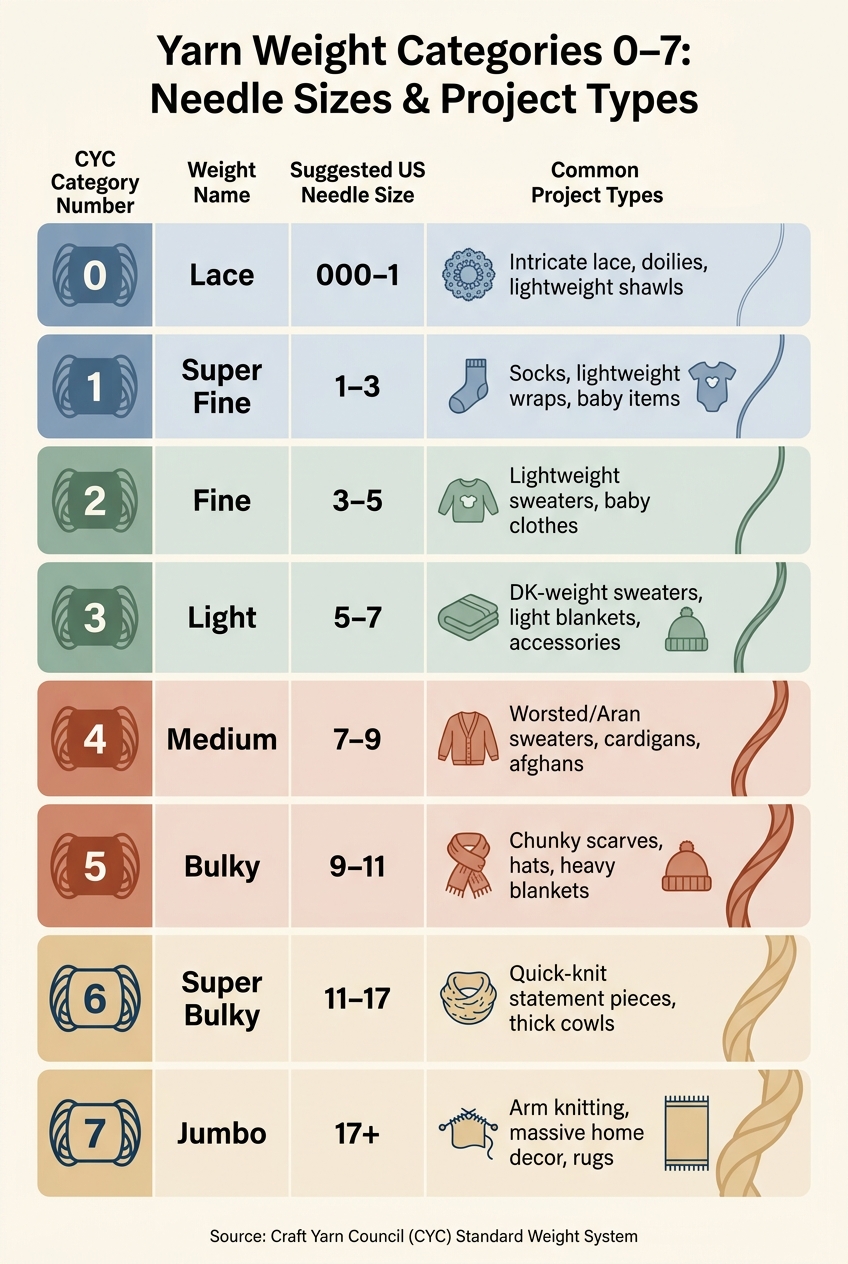
Yarn Weight Categories 0–7: Needle Sizes & Project Types
After fiber content, yarn weight is the label detail that most changes how your project looks and fits. Yarn labels usually show three separate measurements: weight category, skein weight, and yardage.
They sound similar, but they’re not the same thing.
The yarn weight category tells you how thick the strand is. Skein weight tells you how much the package weighs, usually in ounces or grams. Yardage tells you how much yarn you get and whether it’s enough for your pattern.
The Craft Yarn Council (CYC) uses a scale from 0 to 7 to sort yarn by thickness. 0 is the finest, and 7 is the thickest.
Here’s what each category usually means for projects and needle sizes:
| CYC Category | Weight Name | Suggested US Needle Size | Common Project Types |
|---|---|---|---|
| 0 | Lace | 000 to 1 | Intricate lace, doilies, lightweight shawls |
| 1 | Super Fine | 1 to 3 | Socks, lightweight wraps, baby items |
| 2 | Fine | 3 to 5 | Lightweight sweaters, baby clothes |
| 3 | Light | 5 to 7 | DK-weight sweaters, light blankets, accessories |
| 4 | Medium | 7 to 9 | Worsted/Aran sweaters, cardigans, afghans |
| 5 | Bulky | 9 to 11 | Chunky scarves, hats, heavy blankets |
| 6 | Super Bulky | 11 to 17 | Quick-knit statement pieces, thick cowls |
| 7 | Jumbo | 17 and larger | Arm knitting, massive home decor, rugs |
When comparing alpaca vs wool, yarn weight affects both drape and structure. A lighter yarn tends to hang softly. A thicker yarn can give you more body, though alpaca still has a soft, fluid feel. So when you pick a weight, think about how much shape your project needs.
To figure out whether you have enough yarn, multiply the yards per skein by the number of skeins. Then compare that total with your pattern.
For example, if a pattern calls for 1,200 yards and each skein has 215 yards, you’d need 6 skeins.
When you shop online, look at the yardage listed on the product page, not just the skein weight. Two skeins can weigh the same but still have different yardage, which can throw off your math fast.
Next, check the label for needle size, hook size, and gauge.
Once you've checked the yardage, look at the tool size and gauge, or learn to knit and crochet if you're just starting out. Those two details shape how the yarn will work up. Most yarn labels show a suggested needle or hook size on the ball band, the paper wrapper around the skein.
Gauge appears as a stitch count and row count inside a 4 in × 4 in square. That gives you a baseline for how the yarn works up at the maker's suggested tension. This matters most for fitted projects like sweaters and hats. Even a small shift in stitch size can leave the finished piece too tight or too loose. Alpaca has less spring than wool, so swatching matters even more for fitted garments.
Start with the suggested needle or hook size and the gauge printed on the label. Cast on enough stitches to make a swatch big enough to measure in the center. Then wash it and dry it flat the same way you plan to care for the finished project.
After it dries, lay it flat and measure both stitches and rows across the center 4 inches. Then compare those numbers with the label. If they match, you're set. If not, change your needle or hook size before you begin.
Don't try to force your tension tighter or looser. It's usually better to switch needle or hook size instead.
| Swatch Result (over 4 in) | What It Means | What to Do |
|---|---|---|
| Too many stitches | Your stitches are too small; the project will come out too small. | Move up to a larger needle or hook size. |
| Too few stitches | Your stitches are too large; the project will come out too big. | Move down to a smaller needle or hook size. |
| Matches the label gauge | Your gauge matches the pattern. | Proceed with the recommended tools. |
After each change, make a new swatch. It takes a little extra time, but it can save you from fit issues later.
After gauge, check dye lot and care symbols before you buy more skeins.
After gauge, look at the label details that affect how your project looks and how it holds up: color name, dye lot, and care symbols. These are easy to miss. But if you skip them, the problem usually shows up later - right when it's hardest to fix.
A dye lot is the batch a skein came from. Even small batch differences can shift the shade enough to show in a sweater or blanket.
For one project, buy all skeins from the same dye lot and check that the numbers match before you cast on.
| Feature | Same Dye Lot | Mixed Dye Lots |
|---|---|---|
| Color Consistency | Seamless match across all skeins | Subtle shade shifts may appear |
| Best For | Solid-color sweaters, blankets, large garments | Scrappy projects, multi-color designs, small accessories |
It also helps to keep one ball band with the project. If you need more yarn later, you'll have the label details on hand.
Care symbols use standard icons, so the same symbol means the same thing across brands. There are five core categories: washing (tub), bleaching (triangle), drying (square), ironing (iron shape), and professional care (circle). Dots inside an icon show heat level - one dot for low, three for high. Bars under a washing tub show how gentle the cycle should be.
| Category | Symbol | Plain-English Instruction |
|---|---|---|
| Washing | Tub with water | Machine wash |
| Washing | Tub with hand | Hand wash only; gentle agitation in a sink |
| Washing | Tub with 1–2 bars | Permanent press (1 bar) or delicate cycle (2 bars) |
| Bleaching | Empty triangle | Any bleach is safe |
| Bleaching | Triangle with lines | Non-chlorine bleach only |
| Bleaching | Crossed-out triangle | Do not bleach |
| Drying | Square with circle | Tumble dry |
| Drying | Square with horizontal line | Dry flat; reshape and lay on a flat surface |
| Ironing | Iron shape | Iron allowed; dots set heat level (1=low, 3=high) |
| Professional Care | Circle with letter | Professional care required; letters inside specify the solvent |
Animal fibers like alpaca and wool react badly to heat and agitation. That's how felting happens. So if the label shows a hand-wash or dry-flat symbol, take it seriously.
If you're giving the finished item as a gift, add a small care tag with the main symbols. The recipient won't have the ball band. Without care instructions, even a well-made piece can end up ruined in the wash.
When you shop online, you can't touch the yarn or inspect the label in person. That makes the label details even more important.
Color is usually the hardest part. Screen settings can shift what you see, so the shade on your monitor may not match what shows up at your door. Buyer reviews can help you judge whether the actual color matches the product photos.
Dye lots matter online too. Check the retailer's policy before you order. Many good yarn shops send matching dye lots by default, but if you're buying for a big project, contact the seller and confirm they have enough matching skeins in stock.
Price can be sneaky online. Compare yarn by the yard, not by the skein. One skein may look cheaper, but if it has far less yardage, it's not the better deal. Divide the price by the total yardage to compare apples to apples. And when you find the yarn you want in the right dye lot, buy enough for the whole project plus one extra skein.
If a label term throws you off, the Alpaca Direct YouTube channel can help. Use the same label checks before checkout.
Before you buy yarn - in person or online - run through this short checklist:
This check takes less than two minutes. And it can save you from buying the wrong yarn, running short halfway through, or felting a finished sweater in the wash.
Match the label first: fiber content and yarn weight/thickness. Those two have a big effect on gauge and drape.
Then look at yardage and needle size. Most of all, make sure you can hit the pattern’s gauge, even if that means changing needle size.
It also helps to check construction details like ply, twist, and blends. A yarn with more alpaca, for example, may act a bit differently.
If you’re swapping in dyed yarn, match dye lots when you can. And hang on to the original labels so you have the care info later.
Check the yarn label for both grams and yardage. Different fibers have different densities, so the same weight doesn’t always give you the same length.
To make sure you have enough yarn, use the yardage listed on the label and compare it with your pattern’s total yardage requirement. If you’re not sure whether a substitute will work, the Alpaca Direct YouTube channel has helpful tips on gauge and material requirements.
Not always. But if you want your finished measurements to match the pattern, you should.
Alpaca Direct recommends knitting a test swatch with your chosen needles and yarn because alpaca can behave a bit differently and change your results. For flexible, non-fitted projects - or if you already know how that yarn-and-needle combo works - you can sometimes skip it.
For most pattern-based projects, though, swatching is the safer move.

Comments will be approved before showing up.