Your Cart is Empty


If you want the short answer: alpaca is usually warmer for the same weight, while wool holds its shape better.
If I were choosing between them for cold-weather knitting, I’d keep it this simple:
A few numbers make the difference clear:
This comes down to how the fiber works. Alpaca traps heat with a hollow or semi-hollow core. Wool traps heat with crimp, which builds loft and spring. So if I’m making scarves, cowls, shawls, or loose sweaters, alpaca often makes more sense. If I’m making socks, fitted hats, or structured sweaters, wool is usually the better pick.
Quick Comparison
| Feature | Alpaca | Wool |
|---|---|---|
| Warmth at the same weight | Higher | Lower than alpaca |
| Weight for the same warmth | Lighter | Heavier |
| Stretch | Low | High |
| Shape retention | Lower | Better |
| Moisture absorption | About 10%–11% | Up to 30% |
| Best for | Scarves, shawls, loose sweaters, blankets | Socks, fitted hats, structured sweaters |
If you just want one rule to follow, here it is: alpaca wins on warmth and softness, wool wins on fit and bounce.
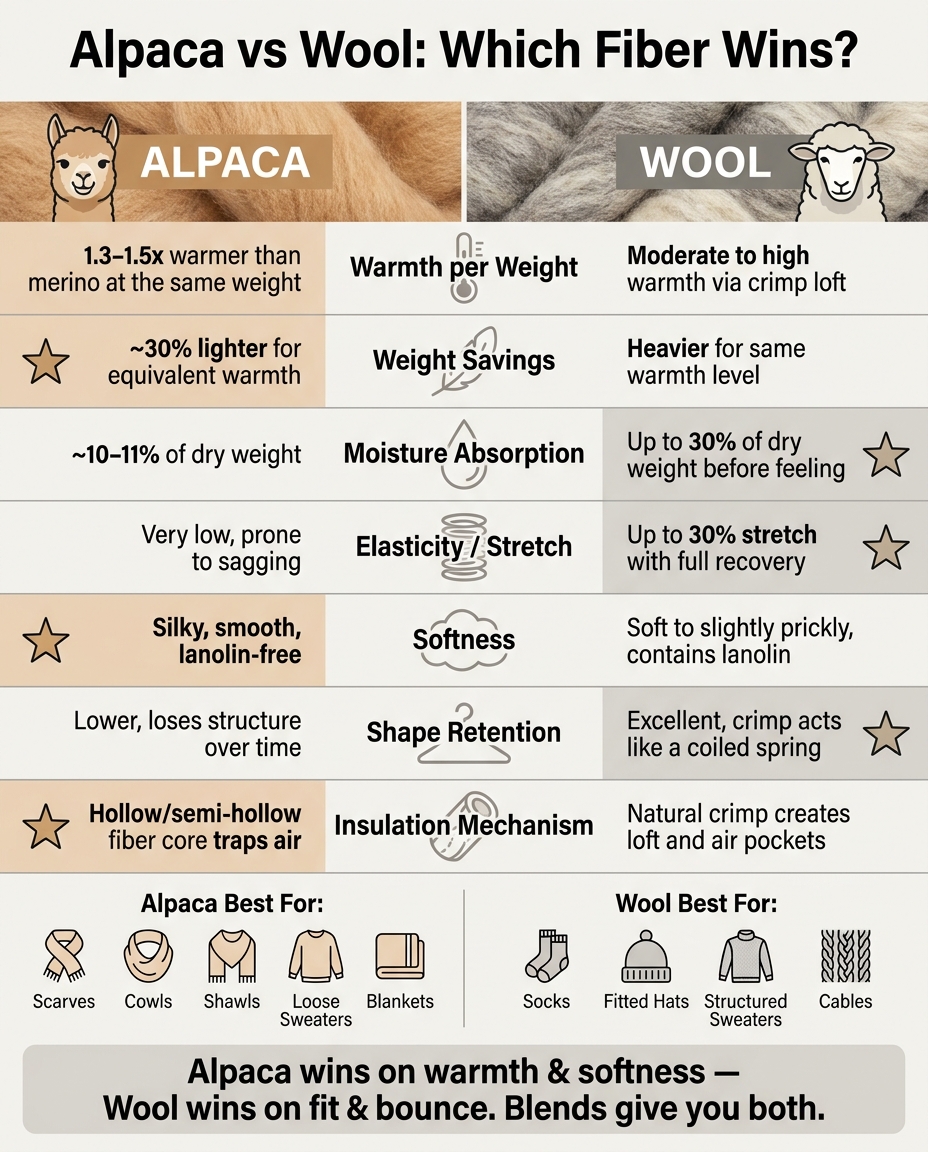
Alpaca vs Wool: Warmth, Weight & Performance Compared
Alpaca feels warmer for a simple reason: its fiber structure holds onto air. Many alpaca fibers have a hollow or semi-hollow core, so the insulation is built right into the strand. Sheep’s wool fibers are solid in the center and depend more on crimp to make air pockets in the fabric. That difference matters most when you want warmth without extra bulk.
In practice, alpaca is estimated to be 1.3 to 1.5 times warmer than merino wool of the same weight. An alpaca garment can also be about 30% lighter than a similar wool piece while giving you the same level of warmth. For knitters, that means a lighter skein can do more work in a cold-weather project.
Alpaca also takes in less moisture than wool and still feels warm when damp. That makes it a strong pick for low-movement wear, like outdoor layers or clothing you wear while sitting still in the cold. It also feels soft against the skin because its scales are smoother, and it contains no lanolin.
Put those traits together - warmth, softness, and low moisture absorption - and alpaca makes a lot of sense for next-to-skin layers and cold-weather garments where comfort matters.
Alpaca does its best work in projects where warmth, softness, and light weight matter more than structure. Good uses include:
Its natural drape also makes it a good fit for shawls and open-knit designs where you want fabric to flow instead of hold a firm shape.
Alpaca has less elasticity than wool, so ribbing and cuffs can loosen over time. If you’re making socks or any garment that needs to stay close to the body and spring back after wear, a blend with wool or a small amount of elastic fiber is often the better move. That’s the point where wool starts to pull ahead.
Sheep's wool keeps you warm in a different way than alpaca, but it works just as well. Instead of hollow fibers, wool leans on its natural crimp - that wavy, corkscrew shape built into each strand. Crimp creates loft, and loft traps air. Those little pockets of air are what hold heat close to your body.
That also explains why wool often feels springier than alpaca. Alpaca tends to feel lighter and less elastic, while wool has more bounce and body. Yarn construction plays a part too. Woolen-spun yarns build up that loft, so they often feel warmer than dense worsted-spun yarns made from the same fiber.
Loft changes more than warmth. It also affects how wool deals with sweat and movement when it's cold out. Merino wool can absorb up to 30% of its dry weight in water before it feels wet, far more than alpaca's roughly 10% to 11%.
Wool also has elastic memory. Its crimp works a bit like a coiled spring, so the fiber can stretch and then return to shape. Quality merino provides approximately 30% stretch with full recovery. That's why ribbing stays snug, cuffs don't go floppy, and socks keep fitting the way they should after repeated wear.
Wool makes more sense when you need structure, bounce, or long wear. Socks are the clearest case. Wool's elasticity helps stop sagging at the heel and toe, where alpaca on its own would slowly stretch out.
The same idea applies to fitted hats and structured sweaters with cables or clear stitch definition. Wool's natural spring helps those textures stay crisp over time. That mix of warmth and shape is why wool so often ends up being the more flexible cold-weather choice.
Use this quick chart to match each fiber to the project you're making.
| Feature | Alpaca | Wool |
|---|---|---|
| Warmth mechanism | Hollow or semi-hollow core | Natural crimp creates loft |
| Warmth per weight | High - roughly 1.3–1.5x warmer than merino | Moderate to high |
| Breathability | Good; less moisture-buffering than wool | High; absorbs moisture without feeling damp |
| Softness | Silky and smooth | Soft to slightly prickly |
| Elasticity | Very low; prone to sagging over time | Excellent; up to 30% stretch with full recovery |
| Best cold-weather uses | Throws, scarves, shawls, loose layers | Fitted sweaters, active socks, structured hats |
Alpaca gives you more warmth with less bulk. That’s a big plus in winter pullovers that need to stay warm without feeling like armor.
Wool, on the other hand, has more body and bounce. That spring helps ribbing stay snug and keeps cables crisp. The trade-off is feel: for some people, wool can come off a bit rougher on very sensitive skin.
The right fiber comes down to how the finished piece needs to fit, move, and hold up.
For sweaters, the difference is pretty clear. Pick alpaca if you want warmth and drape. Pick wool if you want structure and better shape retention over time.
Socks are where wool pulls ahead. Daily wear puts a lot of stress on a sock, and wool handles that well because it has stretch and strong moisture control. Alpaca socks feel very soft and warm, which makes them great for low-movement wear or just lounging at home, but they tend to stretch out faster underfoot.
For hats and scarves that sit right on sensitive skin, alpaca is often the easier pick. It’s lanolin-free, which matters for the roughly 1–2% of people who react to lanolin in wool. Its smooth fiber surface also feels gentler on the neck and forehead.
Blankets are another strong use case for alpaca. Its warmth-to-weight ratio stands out here, so you can make a blanket that stays warm without feeling too heavy.
If you want a middle ground, a wool-alpaca blend makes a lot of sense. You get alpaca’s softness and insulation, plus wool’s structure and bounce. That mix works well across almost any cold-weather project.
Once you compare insulation, weight, feel, and durability, the choice mostly comes down to how the finished piece will be worn.
Alpaca gives you more warmth per ounce and usually feels warmer at the same weight. Wool brings loft, stretch, and better shape retention. That’s why alpaca works well for blankets, shawls, scarves, and loose sweaters. Wool is the better pick for socks and fitted pieces that need more structure.
Before you buy yarn, match the fiber to what the project has to handle:
If you want warmth without much weight, go with alpaca. If you need stretch, structure, and durability, wool is the better fit.
Not always. Alpaca is often warmer than sheep’s wool because its fibers trap air well, which means strong insulation without as much weight or bulk.
That said, warmth doesn’t come down to fiber alone. Yarn structure, knit density, and loft all play a part. In some cases, lofty, woolen-spun sheep’s wool can feel just as warm as alpaca.
Alpaca yarn shines in projects where softness, warmth, and drape matter most. It’s a great pick for winter accessories like scarves, cowls, hats, wraps, and shawls because it gives you light insulation without a lot of bulk.
For cardigans and sweaters, alpaca has a luxe feel. But there’s a trade-off: it doesn’t have much elasticity, and it can stretch over time. That’s why a wool blend often works better for these garments, giving you more support, memory, and cleaner stitch definition.
It depends on what you want the finished piece to do: feel extra warm, hold its shape, or land somewhere in the middle.

Comments will be approved before showing up.