Your Cart is Empty


If I want one knitting needle set that covers most projects, I’d start with a set in US 4 to US 11, 5-inch tips, and cables that make 16-inch, 24-inch, 32-inch, and 40-inch circulars. That setup handles many sweaters, hats, shawls, and general DK/worsted knitting without buying a pile of fixed circulars.
Here’s the short version:
A few numbers help make this simple. Most sets include about 8 to 12 tip pairs, often in 4-inch or 5-inch lengths. Many also include cables for finished circular lengths from 16 inches to 40 inches, while extra cables can stretch that range to 60 inches.
| What I’m choosing | Best pick for me |
|---|---|
| One first set for most knitters | US 4–11, 5-inch tips, mixed cable lengths |
| Small-round knitting | 4-inch tips |
| Sweaters and shawls | 5-inch tips |
| Alpaca or silk blends | Wood or bamboo tips |
| Fast glide on wool | Metal tips |
| Magic Loop | Long, flexible cable |
| Fewer snags | Smooth join with no gap |
My bottom line: I’d buy based on join quality, tip length, material, cable feel, and size range - not just how many extras come in the case. The rest of the guide breaks down how each part affects comfort, yarn control, and project setup.
Once you’ve picked the join style and tip material you want, the next step is simple: check what’s actually in the set.
A standard interchangeable needle set usually comes with 8 to 12 pairs of needle tips, most often in 4-inch or 5-inch lengths. You’ll also usually get cables that make finished circular lengths of 16, 24, 32, and 40 inches. One small detail can trip people up here: some brands label cables by the finished needle length, not the cable length by itself.
Most sets also come with a few small extras that make a big difference in day-to-day use. These often include:
Those pieces aren’t just filler. A secure join helps prevent snags and keeps stitches sliding along without a hitch. Storage matters too. Most sets come in a dedicated case - fabric, wood, or plastic - with labeled pockets for tip sizes and a small zippered pouch for accessories.
The tip-to-cable connection is called the join, and it’s one of the biggest things you’ll notice while knitting. If the join feels smooth, knitting feels easy. If it doesn’t, you’ll know fast.
The two most common systems are screw-on and click-in.
With a screw-on system, the tip threads onto the cable end, and the tightening key helps lock it in place. When it’s fully tightened, this type of join can feel smooth. The tradeoff is that changing tips takes a bit more time, and you need to keep track of the key.
A click-in system uses a tool-free locking connection, so swapping tips is faster. That’s the big draw. But there’s a tradeoff here too: the locking mechanism can collect debris, and some knitters notice a slight step at the join.
One thing to watch: most brands use proprietary connection systems, which means parts are not universally interchangeable. And if you use a screw-on set, use the tightening key every time. Hand-tightening alone can loosen while you knit.
Once you’ve picked the join type, the next thing that matters is simple: how the set behaves when you’re ACTUALLY knitting.
With screw-on sets, attach the tip first, then use the tightening key to give it one last firm twist. Don’t skip that step. A join that feels fine at first can still loosen once you start working.
Before casting on, run your fingernail across the join. If your nail catches, something’s off. The connection is either loose or defective. When the join is tightened the right way, it should feel smooth and even.
End caps are also handy here. You can screw them onto a cable to hold live stitches in place with less risk of losing your work.
Tip length changes how the needle feels in your hand and what kinds of projects it suits best.
| Feature | 4 in. Tips (~10 cm) | 5 in. Tips (~13 cm) |
|---|---|---|
| Best For | Small-round projects, travel, smaller hands | Sweaters, shawls, larger hands, heavy yarns |
| Maneuverability | High; needed for tight curves | Lower; can feel awkward on small diameters |
| Comfort | Can cause hand cramping in long sessions for some knitters | Gives more leverage and a steadier grip |
| Storage | Fits in compact project bags and small cases | Needs larger organizers |
If your fingers feel jammed up near the joins, or your palm keeps resting on the cable, the tips are likely too short for the way you hold the needle.
Cable flexibility shows up fastest when you’re knitting small rounds on a long cable. A soft cable bends easily and stays out of the way. A stiff one fights those tight curves, which can get annoying fast.
A lot of plastic cables come out of the package with a strong coil and keep that memory. To relax the cord, dip the cable only - not the metal joins - in hot water for 5 to 10 seconds, then stretch it straight. Nylon-covered steel cables usually resist kinking better, so they’re a smart pick if you knit lots of small-circumference projects.
There’s also a neat little trick with the cable-key hole:
Thread waste yarn or dental floss through the cable-key hole before knitting to create a lifeline.
That small step can save you a lot of grief if you need to rip back.
Tip length, cable feel, and flexibility all connect back to needle size and material.
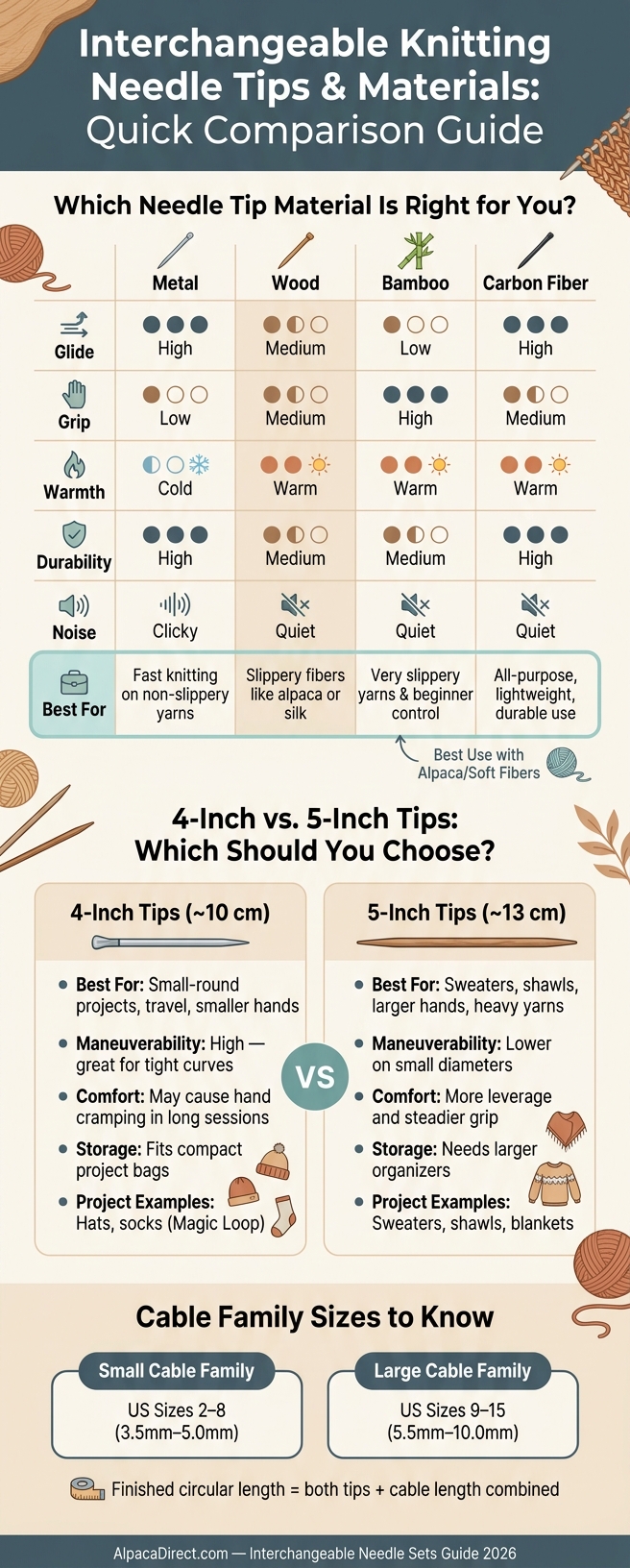
Interchangeable Knitting Needle Tips & Materials: Quick Comparison Guide
Now that we've covered the join and cable feel, the last two choices are size and material. These have a big effect on comfort and on how fast your stitches move.
A common starter set covers US 4 through 11 (3.5 mm–8.0 mm), which works for most DK and worsted projects.
There’s one detail that trips people up: cable family size. Sizes 2 through 8 use the small cable family, while sizes 9 through 15 use the large cable family, so it’s smart to check cable compatibility before you buy extra cables. Some sets come with both cable families plus a connector, which gives you more flexibility right out of the box. Also, the finished circular length equals the length of both tips plus the cable.
Tip material changes how the needle feels in your hands and how yarn moves across it. Think of it as a mix of grip, glide, and weight. Metal moves the fastest. Wood and bamboo give you more hold. Carbon fiber stays light and tough.
| Material | Glide | Grip | Warmth | Durability | Noise | Best Use with Alpaca/Soft Fibers |
|---|---|---|---|---|---|---|
| Metal | High | Low | Cold | High | Clicky | Fast knitting on non-slippery yarns |
| Wood | Medium | Medium | Warm | Medium | Quiet | Slippery fibers like alpaca or silk |
| Bamboo | Low | High | Warm | Medium | Quiet | Very slippery yarns and beginner control |
| Carbon Fiber | High | Medium | Warm | High | Quiet | All-purpose, lightweight, durable use |
Weight matters too, especially on long sessions. Metal is the heaviest option. Wood and bamboo feel lighter in the hand, and carbon fiber is very light without losing strength. If your yarn likes to slip and slide, wood or bamboo can help you stay in control. If you want stitches to move with less effort, metal usually feels faster.
Now that the parts, joins, sizes, and materials make sense, it’s time to pick the set that fits the way you actually knit. Go with the set that matches your most common projects, not the one stuffed with the most add-ons.
Here’s the simple way to think about it:
Yarn matters too. If you knit with slippery alpaca or silk blends, wood or bamboo tips usually give you a bit more control. If you want more speed on woolier yarns, metal tips tend to move faster. And before you buy, run your fingertip over the join. If it doesn’t feel smooth in the store, it won’t feel better halfway through a sleeve.
| Knitter Profile | Recommended Tip Material | Tip Length | Cable Flexibility | Common Size Range |
|---|---|---|---|---|
| Sock Knitter | Metal | 4 in. | High (Magic Loop) | US 0–3 |
| Sweater Knitter | Wood or Metal | 5 in. | Moderate | US 4–10.5 |
| Lace Knitter | Sharp Metal (Lace Tips) | 5 in. | High (memory-free) | US 2–8 |
| Alpaca Garment Knitter | Wood or Bamboo | 5 in. | Moderate | US 4–9 |
Once you’ve pinned down the right size range, tip length, and cable type, the last piece is knowing how to set everything up.
If you want a visual walk-through, Alpaca Direct’s tutorials and YouTube demos show joins and Magic Loop in action. Alpaca Direct also offers knitting needles, alpaca yarns, patterns, tutorials, and YouTube demonstrations for needle setup, joins, and Magic Loop.
A few points are worth keeping front and center before you buy.
Think about how your tools feel in your hands. Wood or bamboo tends to give you more grip and control, which helps a lot with slippery yarns. Metal needles, on the other hand, let stitches move faster.
If your hands get sore, 5-inch tips can help because they give you more leverage. 4-inch tips are often better for travel or for smaller hands. A simple clue: if your fingers bunch up near the join or your palm sits too close to the cable, the tips are too short. It also helps to check that the set includes the needle sizes and cable lengths you reach for most often.
It comes down to what feels good in your hands and what you like to knit. 4-inch tips are a good fit for smaller circumferences, like hats, sleeves, and cowls. 5-inch tips give you a bit more leverage, which can help with heavier yarns or long knitting sessions.
One practical detail matters here: 5-inch tips usually make the shortest circular needle length 24 inches. So if you knit smaller circular projects, you may need 4-inch tips instead. Go with the length that feels most comfortable for you.
It depends on the manufacturer’s connection system.
In most cases, you can mix tips and cables within the same brand system. But across different brands, that usually doesn’t work. Many companies use proprietary connections that are not compatible.
There’s another catch, too: some brands use different joins for different needle size ranges. So before you swap parts around, check that the tips and cable are made to fit each other.

Comments will be approved before showing up.