Your Cart is Empty


When choosing knitting needles, the decision often comes down to circular needles and straight needles. Here’s what you need to know:
| Feature | Circular Needles | Straight Needles |
|---|---|---|
| Knitting Style | Flat and in the round (seamless) | Flat only (requires seaming) |
| Weight Distribution | Weight rests on the cord and lap | Weight rests entirely on wrists |
| Best For | Large projects, seamless garments | Small flat projects, beginners |
| Portability | Compact and easy to carry | Bulkier, less travel-friendly |
Circular needles are versatile and ergonomic, while straight needles are simple and great for learning. Choose based on your project type and comfort preferences.
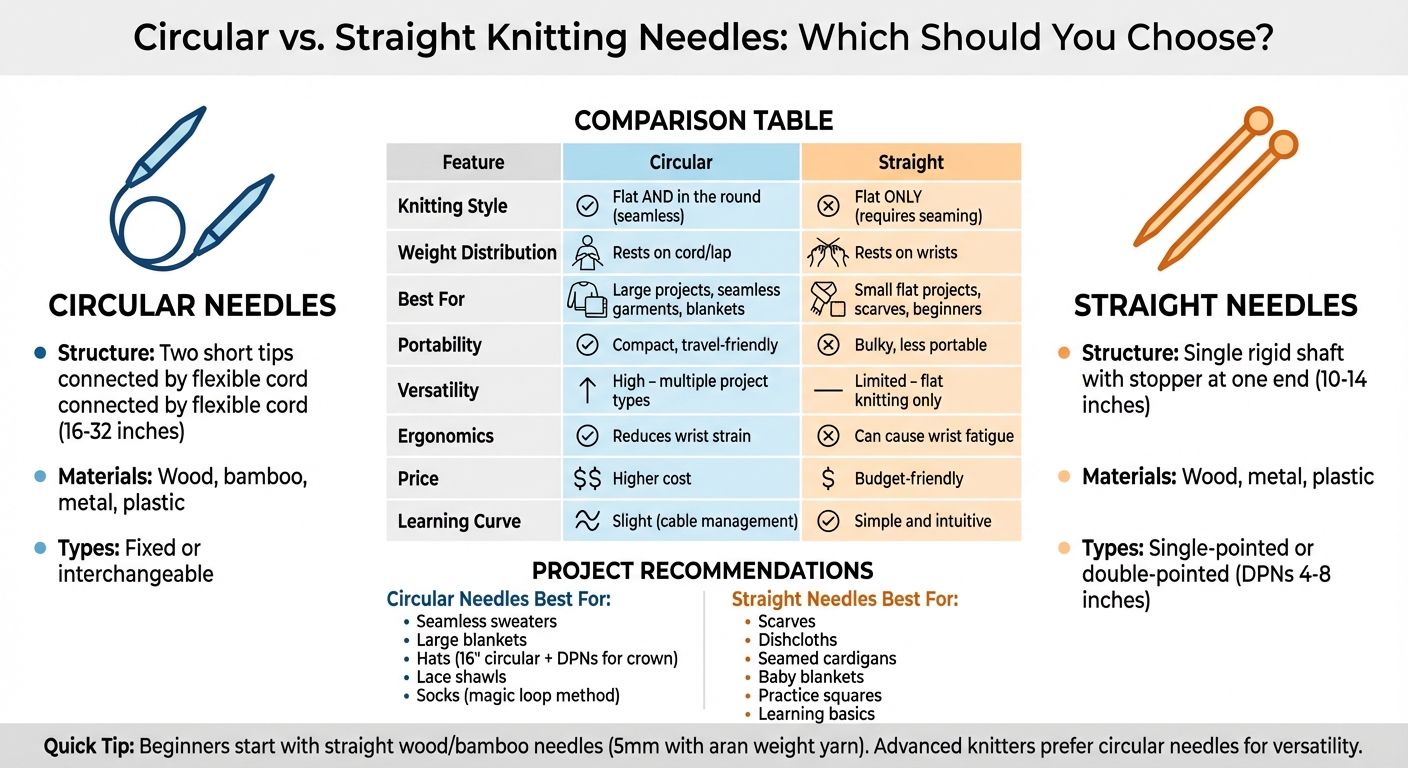
Circular vs Straight Knitting Needles Comparison Chart
Circular knitting needles consist of two needle tips connected by a flexible cord, which is often made from nylon or a nylon-coated multi-strand steel cable. The needle tips themselves come in a variety of materials, including wood, bamboo, metal (like stainless steel or aluminum), and plastic. Each material offers a different knitting experience, balancing how much grip or glide they provide.
There are two main types of circular needles: fixed and interchangeable. Fixed circular needles have tips permanently attached to the cord, while interchangeable sets let you mix and match different tip sizes and cord lengths, giving you more options for your projects. Cable lengths typically range from 16 to 32 inches, making them suitable for a wide variety of knitting tasks.
Straight knitting needles are the classic, rigid tools that many knitters are familiar with. Single-pointed straight needles are used in pairs and feature a stopper at one end to prevent stitches from slipping off. These needles are usually between 10 and 14 inches long and are made from materials like wood, metal, or plastic.
Double-pointed needles (DPNs) are a different type of straight needle. They are shorter - usually 4 to 8 inches - and come in sets of 3 or 5. DPNs are perfect for small-circumference projects, like socks or sleeves, where circular needles might not be practical due to their longer cords. These differences in structure make straight needles versatile for various knitting techniques.
The key differences between circular and straight needles become clear when comparing their design features.
| Feature | Circular Needles | Straight Needles |
|---|---|---|
| Basic Structure | Two needle tips joined by a flexible cord | Single rigid shaft (single-pointed or double-pointed) |
| Length Options | Cable lengths: 16 to 32 inches | Single-pointed: 10–14 inches; DPNs: 4–8 inches |
| Flexibility | High – cord allows folding and distributes weight evenly | Rigid – no flexibility |
These design elements play a crucial role in determining which needle type is best suited for different knitting projects.
Source: JoeriaKnits
Circular needles are incredibly versatile, suitable for both flat knitting and knitting in the round. When working on flat projects, you use them much like straight needles, turning your work at the end of each row. For seamless projects - like hats or sweaters - circular needles let you knit continuously in a tube without needing to turn your work.
One of their standout features is how they handle the weight of a growing project. Instead of the fabric resting entirely on the needles, it sits on the flexible cable, often in your lap. This design is easier on your wrists, making circular needles a great choice for larger or heavier projects like blankets. The cable can hold a large number of stitches, reducing strain and making knitting sessions more comfortable.
"For straight knitting, you can use circulars or straights. For knitting in the round, you can only use circulars. Also, with circulars, the weight of the fabric you create as you knit is distributed more evenly over the cable, so it is much easier on your hands and wrists." - Marria, Forum Member
When knitting in the round, it's important to pick a needle length slightly shorter than the circumference of your project. This prevents overstretching the stitches. For flat projects like scarves, many knitters find that cables in the range of 24 to 29 inches are more comfortable than shorter ones, such as 16 inches.
That said, straight needles offer a different knitting experience, with their own set of pros and cons.
Straight needles are designed strictly for flat knitting. If you're creating items like sweaters or hats, you'll need to knit separate panels and seam them together later. This means straight needles can't produce the seamless results circular needles can.
Managing the weight of your project is more challenging with straight needles. As your work grows, the entire weight of the fabric rests on the needle tips and, by extension, your wrists. This can lead to hand and shoulder fatigue, especially during long knitting sessions or when working with bulky yarn. Additionally, their fixed length limits the number of stitches you can work with, making them less practical for wider projects.
Despite these limitations, straight needles remain a favorite among beginners. They're simple to use, making them ideal for learning basic flat projects like scarves or dishcloths. Their straightforward design eliminates the need to manage an extra cord, though they can feel less convenient when tackling larger or more complex projects.
The table below highlights the key differences between circular and straight needles.
| Feature | Circular Needles | Straight Needles |
|---|---|---|
| Project Range | Flat and in the round (seamless) | Flat only (requires seaming for garments) |
| Ease of Use | Slight learning curve with cords; ergonomic | Simple and intuitive; can cause wrist fatigue |
| Weight Distribution | Weight rests on the cable/lap | Weight rests on the needles/wrists |
| Suitability for Large Projects | High; cables can hold many stitches (e.g., blankets, sweaters) | Low; limited by the fixed needle length |
| Portability | High; flexible cords tuck easily into small bags | Low; longer needles can be cumbersome |
Circular needles shine when it comes to seamless knitting, making them a go-to choice for garments like sweaters and large blankets. Their flexible cable can hold hundreds of stitches, shifting the weight to your lap instead of putting strain on your wrists. This makes them perfect for large-scale projects. For example, when knitting hats, you can use a 16-inch circular needle for the main body, then switch to a 32–40 inch needle or double-pointed needles (DPNs) as the crown narrows.
Lace shawls are another excellent match for circular needles. They can handle the high stitch counts required for wide, triangular patterns while keeping the design easy to see. Many knitters also enjoy using the magic loop method with long circular needles for socks, offering an alternative to managing multiple DPNs. Even flat projects like scarves are more portable and manageable when worked on circular needles.
"The advantage of knitting a blanket on a circular needle is that the cable that joins the two needle points holds the weight of the blanket. It won't strain your wrists or arms because the bulk of the blanket isn't in your hands, it's now in your lap." - Nancy Queen, NobleKnits
Straight needles are ideal for flat projects and are especially beginner-friendly. They’re perfect for straightforward designs like scarves and dishcloths, which help new knitters practice back-and-forth techniques. Straight needles also work well for seamed cardigans, where you knit the back, front, and sleeve panels separately before sewing them together.
For smaller projects, such as baby blankets with a manageable stitch count, straight needles (usually 9 to 14 inches long) provide enough room without feeling overcrowded. They’re also great for knitting squares for modular blankets or trying out new stitch patterns. However, as projects grow heavier, the weight resting on your wrists may lead many knitters to switch to circular needles, even for flat knitting.
| Project Type | Recommended Needle | Reason for Recommendation |
|---|---|---|
| Seamless Sweaters | Circular | Allows for seamless round knitting |
| Large Blankets | Circular | Supports many stitches and shifts weight to the cable |
| Hats | Circular + DPNs | Circular for the body; DPNs for shaping the crown |
| Lace Shawls | Circular | Handles large stitch counts and ensures clear pattern view |
| Socks & Booties | DPNs or Short Circulars | Best for small circumferences |
| Scarves & Dishcloths | Straight or Circular | Suitable for flat construction with fewer stitches |
| Seamed Cardigans | Straight or Circular | Panels are knit separately; circulars reduce strain |
For top-quality knitting needles, check out Alpaca Direct (https://alpacadirect.com). Want to see these techniques in action? Head over to our YouTube channel: https://www.youtube.com/@AlpacaDirect.
Circular needles are incredibly versatile - you can use them for both flat knitting and knitting in the round. Thanks to the flexible cable, the weight of your project rests in your lap rather than on your wrists. This setup is especially useful when working on larger projects like blankets or heavy shawls, as it reduces strain and makes the process more comfortable.
Another perk is their compact design, which makes them easy to carry around. They fit neatly into small project bags without the risk of poking through the fabric. Plus, with the magic loop technique, you can knit smaller items like socks without needing double-pointed needles.
On the downside, circular needles often come with a higher price tag, especially if you invest in a quality interchangeable set. Lower-quality cables can be frustrating - they might kink, twist, or have rough joins that snag your yarn. Additionally, there’s a bit of a learning curve when it comes to managing the cable, particularly if you’re used to straight needles.
Straight needles are straightforward and beginner-friendly, making them a great option for learning the basics. Their design eliminates the need to manage cords, offering a simpler knitting experience. The stopper or end cap at the end of the needle also helps keep stitches from sliding off, which is a big plus when you're still working on your tension.
They’re also budget-friendly and widely available, making them an accessible choice for new knitters. For example, you can find options like KnitPro Basix Single Pointed Needles starting at around $4.00. Straight needles are ideal for smaller, flat projects like scarves or dishcloths.
However, they do have their limitations. Straight needles require you to support the full weight of your project, which can lead to wrist strain, especially for larger or heavier items. They’re also less convenient to travel with due to their bulkiness and are strictly designed for flat knitting.
| Needle Type | Pros | Cons |
|---|---|---|
| Circular Needles | Versatile for flat and round projects; ergonomic weight distribution; portable; accommodates many stitches | Higher cost; risk of cable kinking; requires learning cable management |
| Straight Needles | Simple and affordable; beginner-friendly; stoppers prevent dropped stitches | Limited to flat knitting; can cause wrist strain on heavy projects; bulky and less portable |
For high-quality knitting needles and supplies, check out Alpaca Direct (https://alpacadirect.com). You can also explore helpful tutorials on their YouTube channel: https://www.youtube.com/@AlpacaDirect.
The type of knitting needle you choose can make a big difference in your project. It depends on what you're making, your level of experience, and your personal knitting style. For flat projects like scarves, dishcloths, or garment pieces that need to be seamed together later, straight needles are a great option. On the other hand, circular needles are incredibly versatile - they work for both flat and round knitting, making them a go-to for hats, sweaters, socks, and blankets.
If you're a beginner, starting with straight wood or bamboo needles is a smart choice. These materials provide extra grip, which is helpful when you're still learning to manage tension. Harriet from Flock Workshop highlights this point:
"For the absolute beginner, straight needles are a good starting point."
For instance, pairing a 5mm needle with aran weight yarn is an excellent way to practice. It gives you clear stitch visibility without the added bulk of thicker yarns.
As you gain confidence and skill, the advantages of circular needles become more apparent. Their design makes them ideal for a wide range of projects. For larger items, such as blankets or shawls, long circular needles (80 cm or more) are particularly useful. They also shine for small circumferences when using techniques like the magic loop. To avoid frustration, look for circular needles with a smooth join between the needle and the cable to prevent snagging.
The size of your project also plays a role in needle selection. For larger projects, circular needles help distribute the weight evenly, reducing strain on your wrists. For smaller flat projects, straight needles (typically 25–30 cm or 10–12 inches) are easier to manage and more comfortable to work with.
The right circular needle length varies based on your project and pattern. Often, patterns will list the recommended size and length. As a rule of thumb: 16-inch needles are great for smaller projects like hats, while 24 inches or longer is better for bigger pieces like sweaters. If you're uncertain, think about the size of your project and try different lengths to see what feels most comfortable.
Yes, you can use circular needles to knit flat by working back and forth, much like you would with straight needles. At the end of each row, simply turn your work and continue knitting. Circular needles are incredibly flexible, allowing you to handle both flat and round knitting projects with ease.
When it comes to knitting small circumferences, both magic loop and double-pointed needles (DPNs) shine in their own ways. The magic loop method uses a single long circular needle, which means you’ll deal with fewer needle transitions and enjoy added flexibility. On the other hand, DPNs rely on multiple short needles, giving you a sense of control and a classic knitting experience. It’s worth experimenting with both techniques to figure out which matches your personal style and the specific demands of your project.

Comments will be approved before showing up.