
Double Knitting Chart Guide for Reversible Designs

If you read one chart square as one stitch, your double knitting will go off track. In double knitting, 1 chart square = 2 stitches worked as a pair: one for the front and one for the back.
Here’s the short version:
- Read from the bottom up
- Flat: right-side rows go right to left; wrong-side rows go left to right
- In the round: every round goes right to left
- Cast on 2 stitches for each chart square
- MC square: knit front in MC, purl back in CC
- CC square: knit front in CC, purl back in MC
- Leave about 3–5 background pairs at each side of a motif
- Add markers every 30 pairs on large sections
- Swatch first, because double knitting often works up looser than plain stockinette . For more project inspiration and tools, check out our guide for knitters
That means a 20-square chart needs 40 cast-on stitches. And if you’re adding letters, the back side will read backward unless you chart it on purpose.
Understanding Double Knitting Charts
Quick comparison
| Item | What to do |
|---|---|
| Chart square | Work 2 stitches as one pair |
| Flat knitting | Read odd rows right to left; even rows left to right |
| Knitting in the round | Read every round right to left |
| Cast-on count | 2x the chart width |
| Motif spacing | Keep 3–5 pairs at each edge |
| Tracking large motifs | Place markers every 30 pairs |
I’d treat the legend as the final check, keep both yarns moving in order, and watch tension between the two layers so the fabric stays even on both sides.
How to Read a Double Knitting Chart Before You Cast On
With stitch pairs in mind, start with the legend and row direction. Double knitting charts don't work quite like standard charts, so it's smart to check both before you begin.
How Colors, Symbols, and Legends Map to Paired Stitches
A Main Color (MC) square means: knit with MC, then purl with the Contrast Color (CC). A CC square means the opposite: knit with CC, then purl with MC. On the back, those colors reverse. Keep both yarns at the back for the knit stitch and at the front for the purl stitch.
Designers sometimes use custom symbols for increases, decreases, or color swaps, so the pattern's legend is the only guide you can trust for that specific design. Treat the legend as the final word.
How to Follow Row Direction Flat and in the Round
Read charts from the bottom up, starting at the bottom-right corner.
| Construction | Right Side Rows | Wrong Side Rows |
|---|---|---|
| Flat Knitting | Right to Left (odd rows) | Left to Right (even rows) |
| Circular Knitting | Right to Left (every round) | N/A |
Use the row numbers and a magnetic marker to keep your place on the active row.
Chart Square Reference Table: What Each Square Means in Practice
Use this key to decode each square at the needle.
| Chart Square | Front Side Action | Back Side Action | What You'll See |
|---|---|---|---|
| Main Color (MC) | Knit with MC | Purl with CC | MC on front, CC on back |
| Contrast Color (CC) | Knit with CC | Purl with MC | CC on front, MC on back |
| Blank/no-stitch | No stitch worked here. | No stitch worked here. | Placeholder only - not a stitch |
Before you cast on, check whether the chart counts individual stitches or stitch pairs. For double knitting, cast on twice the chart width. A 20-square chart needs 40 cast-on stitches because each square becomes two stitches on the needle. That gives you the chart map you need before planning color swaps.
How to Work Color Swaps Without Breaking the Reversible Pattern
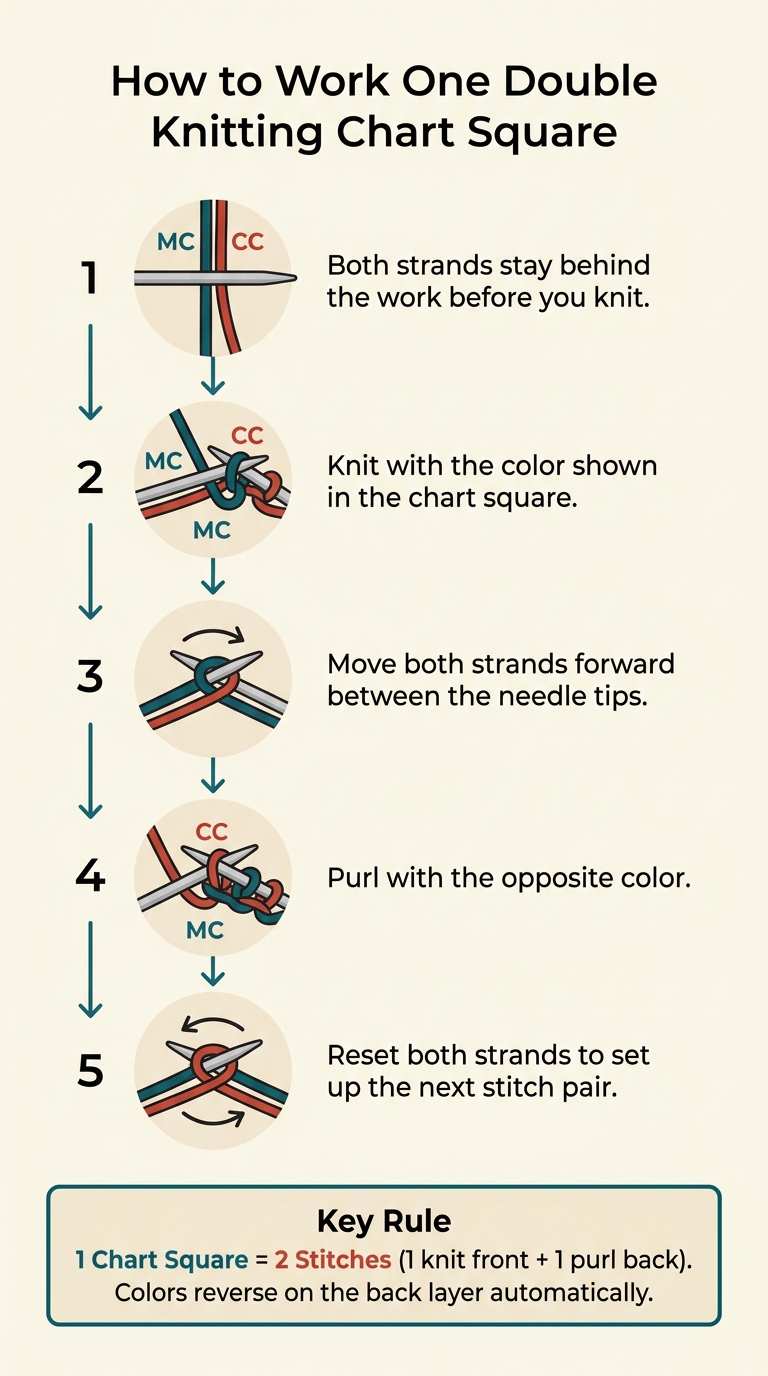
How to Work One Double Knitting Chart Square: Step-by-Step
With the legend in front of you, treat each chart square as two stitches worked together as a pair: one on the front layer and one on the back.
How to Knit One Chart Square Using Two Yarns
Work each square as a front stitch and a back stitch in this order:
- Hold both yarns at the back. Before you knit, both strands stay behind the work.
- Knit the front stitch with the color shown in the chart square.
- Bring both yarns to the front between the needle tips.
- Purl the back stitch with the opposite color.
- Move both yarns to the back to set up the next stitch pair.
As you go, keep an eye on the strand running between the two layers before it cinches up. Every few stitch pairs, spread the stitches across the right needle and check that strand. If it gets too tight, the fabric can pucker.
When the chart shows a color shift, switch which yarn knits the front stitch and which yarn purls the back stitch. That swap keeps the front and back layers lined up as the motif changes.
How Foreground and Background Colors Reverse on the Back
Because the purl stitch is worked with the opposite color, the back side mirrors the front with the colors reversed.
"Double knitting allows you to create a double-layered fabric with two different colors or patterns on each side, without any wrong side showing."
How to Plan Motif Placement and Keep Both Sides Aligned
Once you've read the chart square by square, zoom out and look at the motif as a whole. At that point, the job isn't just reading stitch pairs. It's deciding where the motif should sit across the full width of the fabric.
How to Center Motifs and Leave Enough Background Space
To center a motif, subtract its stitch pairs from the total number of pairs in the row, then divide the remainder by two. That gives you the space for each side.
It's smart to swatch first. Double-knitting gauge often comes out looser than stockinette, and that can throw off placement. If you're working letters or uneven icons, chart the back side separately. If you don't, the reverse will read backward. Also leave 3–5 background pairs on each side so the edges stay steady.
How to Check Alignment, Tension, and Edge Joins as You Knit
Set stitch markers at the edges of the motif before you begin. On larger pieces, add another marker every 30 pairs so it's easier to stay in sync with the chart. That small step can save a lot of trouble later.
A two-color tubular cast-on and Kitchener bind-off give you neat, stretchy edges. As you knit, check the back layer often for alignment mistakes. Keep both yarns at an even tension so the two layers stay joined without sagging.
Motif Types and Alignment Strategies: Comparison Table
Use this layout to match motif size, spacing, and marker placement.
| Motif Type | Typical Space Needed | Alignment Strategy |
|---|---|---|
| Geometric Bands | Often 30-pair repeats | Use markers every repeat to keep the band level across the fabric |
| Large Icons / Florals | ~59-pair repeats (about 10 inches) | Center by calculating side margins; track row by row |
| Letters / Text | Varies by font and size | Place centrally with enough background space on both sides; chart the back separately for readability |
| Small Icons | 5–10 pairs | Use a magnetic ruler to track row-by-row color swaps; mark the chart often |
| Abstract / Psychedelic | Variable | Maintain even tension to prevent show-through |
Clear placement also depends on yarn with good stitch definition.
Choosing Materials and Finding the Right Learning Resources
How Alpaca Yarn Affects Stitch Definition, Warmth, and Drape
Once you can read the chart, your yarn choice has a big effect on how the motif looks in the finished fabric. With double knitting, that matters a lot, because the design needs to read cleanly on both sides.
Alpaca yarn works well for reversible fabrics because it's warm, light, and soft. For charted work, pay close attention to stitch definition, halo, and drape. Those three things shape how crisp or soft your motif appears.
Alpaca halo can blur the edges of a charted design a bit, so high-contrast colors usually give you a cleaner, sharper result. It also helps to match yarns with similar weight and fiber behavior, so one layer doesn't dominate the other.
Circular needles are often easier to handle for double knitting, and slightly larger stitches can make chart squares simpler to follow. Before you start, swatch with the yarn you plan to use. Double knitting often comes out looser than stockinette or stranded colorwork, so it's smart to check gauge early instead of finding out halfway through.
Alpaca Direct Tools, Yarns, and Videos for Charted Projects
If you want some hands-on help, Alpaca Direct has tools and tutorials that fit nicely with the techniques above. Alpaca Direct carries alpaca yarns, circular needles, and patterns for reversible double knitting.
The Alpaca Direct blog and YouTube channel include short tutorials on cast-ons, lifelines, stitch markers, Kitchener bind-off, and other charted-project basics. They're handy when you need a quick refresher in the middle of a project and don't want to lose your place.
Key Takeaways
- Match your yarns by weight and behavior
- Swatch for gauge before you begin
- Use high-contrast colors for cleaner motifs
- Check your tension as you work
FAQs
How do I fix a double knitting chart if my stitches are off by one pair?
If your stitches shift by one pair in double knitting, the knit-purl sequence is probably out of line. Since double knitting works in paired stitches, those pairs need to stay together.
Check your stitch count right after each row. It also helps to use stitch markers between pattern repeats, so a skipped or added pair is much easier to spot. If the mistake is small and limited to one area, duplicate stitch can fix the color or alignment without undoing the whole row.
Why does my double knitting look uneven or pucker between layers?
Uneven or puckered double knitting usually comes down to tension. When your stitches are too tight, the fabric starts to bunch up. When they’re too loose, you may see gaps between stitches. A good rule of thumb is to aim for the same tension you’d want in a single-color fabric.
It also helps to keep your yarn movement steady as you switch between knit and purl stitches. If that transition changes from stitch to stitch, you can end up with accidental yarn-overs or uneven loops, which can throw off both layers.
How do I chart words so they read correctly on both sides?
Double knitting charts usually show only the front side. And each charted stitch stands for a pair of stitches: knit the front color, then purl the second color for the back.
The back comes out as a mirrored color negative of the front. So if you're charting text, plan for that color swap and mirror effect from the start so the words stay legible on both sides.
For a visual walk-through, visit our YouTube channel.