
Brioche Knitting in Round: Guide

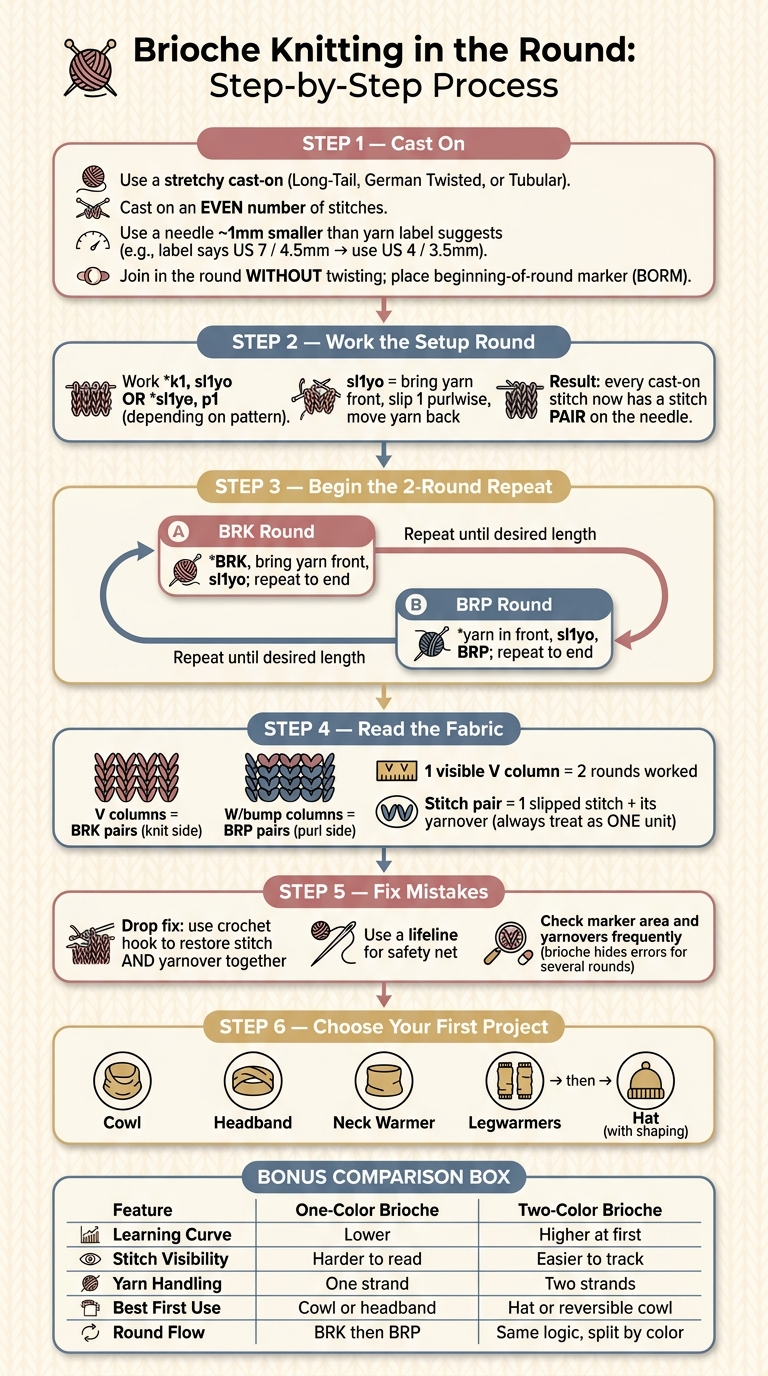
Brioche knitting in the round is a 2-round repeat: one BRK round and one BRP round. If I keep the yarn position right, cast on an even number of stitches, and treat each slipped stitch plus yarnover as one pair, the fabric stays stretchy, thick, and reversible.
Here’s the whole guide in plain English:
- I cast on with a stretchy cast-on and join in the round without twisting.
- I work one setup round to build the stitch pairs.
- I repeat 2 rounds:
-
BRK round: work the knit-side pair, then
sl1yo -
BRP round:
sl1yo, then work the purl-side pair
-
BRK round: work the knit-side pair, then
- I read the fabric by spotting V columns and pair structure.
- I count brioche rows by remembering 1 visible knit column = 2 rounds.
- I fix mistakes by putting the stitch and its yarnover back together.
- I start with simple projects like a cowl, headband, neck warmer, or legwarmers before trying shaping on a hat.
A few setup details matter a lot:
- Use an even stitch count
- A 16-inch circular needle often works for hats and cowls
- Going down about 1 mm from the yarn label needle size can help control the fabric
- Smooth, solid yarn is easier to read than fuzzy or busy yarn
- In 2-color brioche, one color works BRK rounds and the other works BRP rounds
Quick Comparison
| Topic | One-Color Brioche | Two-Color Brioche |
|---|---|---|
| Learning curve | Lower | Higher at first |
| Stitch visibility | Harder to read | Easier to track |
| Yarn handling | One strand | Two strands |
| Best first use | Cowl or headband | Hat or reversible cowl after some practice |
| Round flow | BRK round, BRP round | Same stitch logic, split by color |
One useful fact to keep in mind: brioche can hide errors for several rounds because the fabric is thick. So I check the marker area, yarnovers, and stitch pairs often instead of waiting until much later.
If I know the setup, the 2-round repeat, and how to read stitch pairs, the rest of brioche in the round gets much easier.
Brioche Knitting in the Round: Step-by-Step Setup & Repeat Guide
Part 1: Materials and Brioche Terms
Needles, Yarn, and Notions for Brioche in the Round
For small circular projects like hats and cowls, a different methods for knitting a hat in the round, such as using a 16-inch (40 cm) circular needle is a common pick, and double-pointed needles (DPNs) work well too when the circumference gets smaller. A simple rule helps here: go down about 1 mm from the needle size listed on your yarn label. So if the label suggests a US 7 (4.5 mm), try a US 4 (3.5 mm) instead. That smaller needle helps tame brioche’s stretchy, puffy fabric and makes the stitch pattern easier to see.
When it comes to yarn, smooth, solid-colored worsted-weight yarn is a smart place to start. It makes the stitch shape much easier to read, which matters a lot in brioche. Alpaca is also a nice fit because its loft and drape pair well with this fabric.
A few small tools make the process much less fussy:
- A beginning-of-round marker (BORM) to track where each round starts
- A removable stitch marker for the beginning of the round or key setup stitches
- A lifeline to protect your work if a stitch drops
For the cast-on, use one with some give so it matches brioche’s stretch. The Long-Tail, German Twisted, or Tubular cast-on all work well.
With your tools sorted out, the next step is learning the shorthand that shows up in brioche patterns.
Key Terms: BRK, BRP, sl1yo, Setup Round, and Stitch Pairs
Brioche relies on a small group of terms. Once these click, the pattern starts to look a lot less mysterious.
| Term | Abbreviation | What You Actually Do |
|---|---|---|
| Brioche Knit | BRK ("bark") | Knit the next stitch together with its yarn over from the previous round |
| Brioche Purl | BRP ("burp") | Purl the next stitch together with its yarn over from the previous round |
| Slip 1, Yarn Over | sl1yo | Slip 1 purlwise, yarn over, and return the yarn to work position |
| Setup Round | Setup | The first round after cast-on that creates the initial yarn over wraps |
| Stitch Pair | - | One slipped stitch plus its yarn over, treated as a single unit |
Treat each slipped stitch and yarn over as one stitch pair. On the needle, those pairs look doubled. Single stitches don’t.
Part 2: Setting Up One-Color Brioche in the Round
Cast On, Join Without Twisting, and Place the Round Marker
Cast on an even number of stitches, join without twisting, and place a beginning-of-round marker. Before you join, lay your circular needles flat and check that the cast-on edge isn't twisted or spiraling around the needle. That sounds simple, but it's easy to miss. Brioche is thick and reversible, so a twist can hide in plain sight until several rounds later. The join is what sets up the first round of stitch pairs.
Work the Setup Round That Builds the Brioche Structure
This is the round that builds the pairs brioche uses in the round. Work the setup round once to make the stitch pairs used in BRK and BRP rounds. Common setup rounds include *k1, sl1yo and *sl1yo, p1, depending on the pattern.
To work sl1yo, bring the yarn to the front, slip the next stitch purlwise, then move the yarn to the back. After the setup round, each cast-on stitch has a stitch pair on the needle.
Part 3: Working the Brioche Repeat in the Round
One-Color Brioche: Alternating BRK and BRP Rounds
One-color brioche runs on a simple two-round repeat.
Round 1 (BRK round): *BRK, move yarn to the front, sl1yo; repeat to end. Round 2 (BRP round): *With yarn in front, sl1yo, BRP; repeat to end.
Yarn position matters a lot here. After a BRK, bring the yarn to the front before sl1yo. Before a BRP, the yarn is already in front for sl1yo, and it stays there for the purl. That small detail keeps the repeat clean and stops a lot of common mistakes.
One spot trips people up all the time: the yarn over at the end of a needle tip or marker. It’s easy to drop it and not notice until later, so give that area a quick look each time you pass it.
As the fabric grows, the stitch pairs get easier to read. After a few repeats, you’ll start spotting the pattern without having to think so hard about every move.
Two-Color Brioche: Changing Colors by Round
In two-color brioche, Color A works the BRK round and Color B works the BRP round. In most patterns, work the setup round in Color B.
At the round marker, cross the two yarns once to keep the join neat and the tension even. When you pick up the next color, give it a slight tug to snug up the last yarn over from the previous round.
The color contrast helps a lot, too. It makes it easier to keep your place in the repeat and see which round you’re working.
One-Color vs. Two-Color Brioche: Side-by-Side Comparison
Both methods use the same stitch logic. The main differences are how easy the stitches are to see, how much yarn management is involved, and the look of the finished fabric.
| Feature | One-Color Brioche | Two-Color Brioche |
|---|---|---|
| Setup Difficulty | Easy; single strand throughout | Moderate; requires joining a second color |
| Stitch Visibility | Harder to read; must identify pairs by structure | Easier; colors separate BRK and BRP rounds visually |
| Color Effect | Solid, deeply textured, fully reversible | Bold vertical stripes; different dominant color on each side |
| Best First Project | Simple cowl or headband | Contrast-heavy hat or reversible cowl |
If you’re brand new to brioche, one-color is usually the easier place to start because it helps you learn the stitch structure without dealing with a second strand. Two-color often becomes easier to follow once that structure clicks, since the contrast shows you which round comes next.
Once you can tell which round you’re on, stitch reading becomes the next skill to use.
Part 4: Reading the Fabric and Staying on Track
How to Identify BRK, BRP, and Yarnover Pairs on the Needle
Once the repeat is moving, the next step is to read the fabric instead of staring at the pattern.
In brioche, you read what’s on the needle as either a single stitch or a stitch pair. To tell a BRK pair from a BRP pair, look at the column right below that pair. BRK pairs sit over columns of knit stitches, which show up as V shapes. BRP pairs sit over columns of purl stitches, which often look like Ws or small bumps. In two-color brioche, the contrast makes these pairs much easier to spot.
This kind of fabric reading also helps you see how many rounds you’ve worked and whether the pattern is still lining up the way it should.
How to Count Rounds and Confirm Your Place in the Pattern
Each visible brioche knit column stands for two rounds: one BRK round and one BRP round. So when you check gauge or measure length, count with that in mind. For every visible V in the column, you’ve worked two rounds.
A removable marker on the right side can help you track orientation. At the beginning-of-round marker, check that the stitch pattern lines up cleanly on both sides. If it doesn’t, the round is off, which can happen when transitioning to syncopated brioche or other complex variations.
In one-color brioche, a wrapped V column points to BRP, while a wrapped W column points to BRK. If you want to double-check what you’re seeing, use Alpaca Direct's YouTube demonstrations.
Part 5: Fixing Mistakes, Basic Shaping, and First Projects
How to Fix Missed Yarnovers, Misread Stitch Pairs, and Dropped Stitches
Once you can read brioche pairs, fixing mistakes gets a lot less stressful. You don’t have to guess or rip out half the round. You can spot what went wrong and fix it without losing your place.
If you drop a stitch, use a crochet hook to pull the dropped stitch and its yarn over back onto the needle together. That part matters. In brioche, you’re always restoring the full pair. A stitch without its yarn over, or a yarn over without its stitch, will throw off the column structure on the next round.
If you need a safety net, thread a lifeline through the live stitches. It makes backtracking much easier.
Basic Increases and Decreases in Brioche Pattern
Shaping in brioche follows the same pair-based logic. Protect each stitch and its yarn over as you work. Make increases and decreases only where the pattern tells you to, and keep each shape lined up with a stitch pair on the next round.
In one-color brioche, pay close attention to the V and W columns so you can stay oriented while shaping. That small habit can save you from a lot of head-scratching later.
Good First Brioche-in-the-Round Projects and Key Takeaways
Start with simple projects so you can lock in the repeat before dealing with shaping. A few good first picks are:
- cowl
- headband
- neck warmer
- legwarmers
After that, move on to a hat once you can keep stitch pairs lined up while shaping. Smaller-circumference projects are especially helpful because they let you practice tension and neat sl1yo transitions without taking on too much at once.
For step-by-step demos and project walk-throughs, use Alpaca Direct's YouTube tutorials.
How To: 1-Color Brioche in the Round (updated)
FAQs
Why does brioche in the round need an even stitch count?
Brioche in the round needs an even number of stitches because the pattern works in pairs: one stitch and its yarn over.
As you go around, you switch between working one stitch and slipping the next with a yarn over. That pair-based repeat has to line up all the way back to the start of the round.
With an even stitch count, the join stays in pattern, so the brioche knit and brioche purl sequence doesn’t drift out of place.
How can I tell if I’m on a BRK round or a BRP round?
Check which stitches have the yarn-over wrap.
If the top stitch in a column of knit stitches (V-shapes) is wrapped, you’re working - or just worked - a BRP round.
If the double stitch shows up in a column of slipped stitches (W-shapes), you’re working - or just worked - a BRK round.
In two-color brioche, the yarn color can also help you tell which round you’re on.
What should I do if I lose a yarnover in brioche?
If you lose a yarnover while working brioche in the round - usually when switching from one needle to the next - stop for a second and find the slipped stitch. Then carefully put the yarnover wrap back in place before you work the next stitch.
This tends to happen at needle changes, so it helps to slow down and watch those transitions closely. For more tips and technique demos, see Alpaca Direct’s YouTube channel.