Your Cart is Empty



You can knit this baby hat with just 80 to 120 yards of DK or light worsted alpaca yarn, a gauge of 28 stitches over 4 inches, and one of three cast-on counts: 54, 58, or 62 stitches.
I’d use this pattern if I wanted a soft baby hat for newborn, 3 to 6 months, or 6 to 12 months without extra fuss. The core steps are simple: check gauge after blocking, work a k2, p2 ribbed brim, knit the body in the round, then shape the crown with plain k2tog decreases.
Here’s the whole article in a short list:
A few points stand out. One 50 g skein is often enough, the ribbing is worked tighter so the brim keeps its shape, and sizing is based more on head circumference than age. That matters because baby sizes vary a lot.
If I were starting this project, I’d first match gauge, then pick the size by the baby’s head measurement, and only after that cast on.
Use the yarn and tools below to hit the pattern gauge and get the fit right.
This hat works best in DK or light worsted alpaca yarn, which gives it a warm feel without too much bulk. Go with 100% baby alpaca or a soft alpaca blend.
You’ll need about 80 to 120 yards total:
In most cases, one 50 g skein is enough.
With the yarn sorted, the next step is picking needles and a few basic tools.
Pick your needle size based on gauge, not the yarn label.
For DK yarn, start with US 5–6 (3.75 to 4 mm). For light worsted, start with US 7–8 (4.5 to 5 mm). If your gauge is off, switch needle sizes until it lines up.
You’ll also want these tools on hand:
Alpaca Direct offers alpaca yarns and knitting tools.
Your target gauge is 28 stitches and 32 rows over 4 inches in stockinette, measured after blocking. That number matters. It keeps the cast-on counts for newborn through 12 months on size.
Knit a stockinette swatch, wash it, block it, and then measure the center of the swatch, not the edges. If you have too many stitches in 4 inches, use a larger needle. If you have too few, go down a size.
Once your gauge matches, cast on the size below and begin the brim.
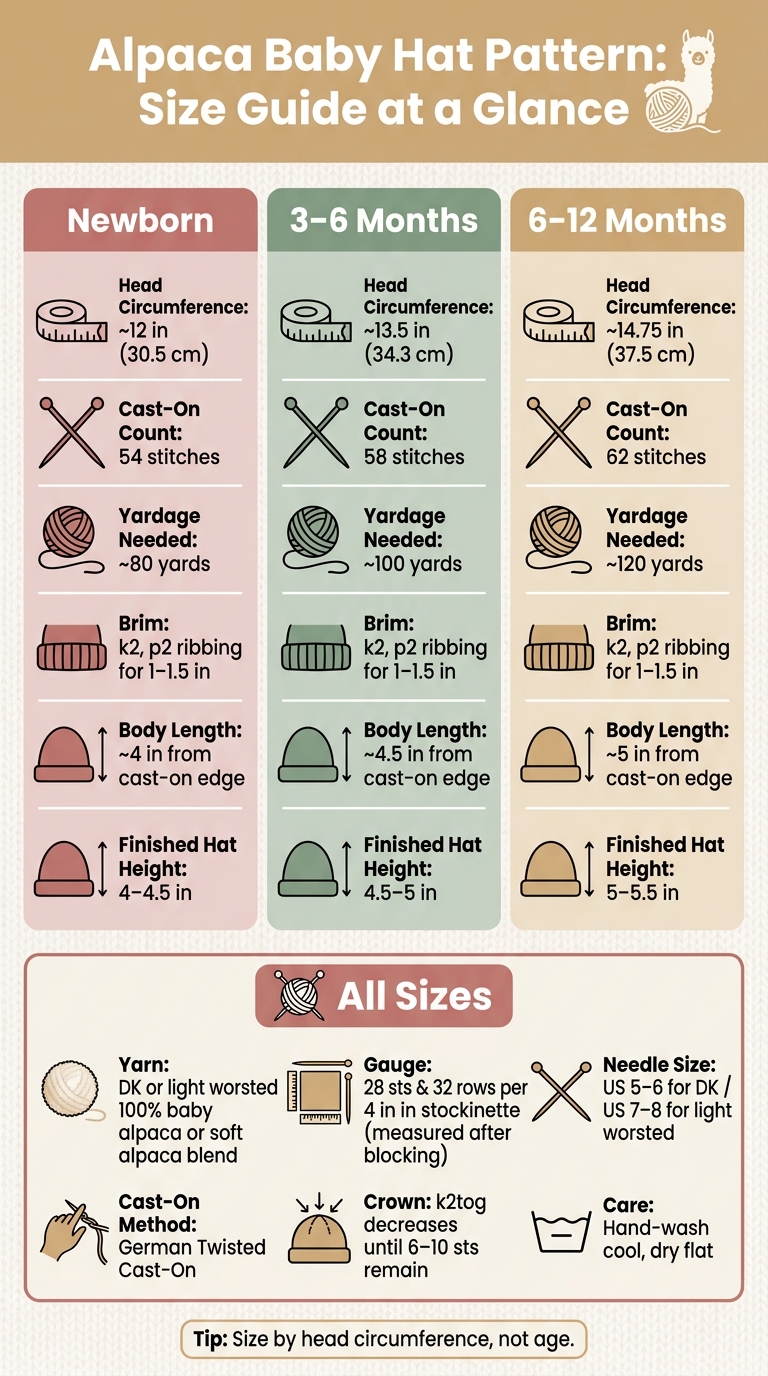
Knitted Baby Hat Pattern: Sizes, Yarn & Measurements at a Glance
Cast on and work the hat from the brim up in the round.
Use the German twisted cast-on for a stretchier edge.
| Size | Cast-On Count | Approx. Finished Height |
|---|---|---|
| Newborn | 54 sts | 4–4.5 inches |
| 3 to 6 Months | 58 sts | 4.5–5 inches |
| 6 to 12 Months | 62 sts | 5–5.5 inches |
If your stitch count shifts after swatching, fix it evenly on the first round. That keeps the crown balanced later, which saves you a headache when it’s time to shape the top.
After casting on, move straight into the ribbed brim.
Use a needle one size smaller for the ribbed brim. Work k2, p2 ribbing for 1 to 1.5 inches (2.5 to 3.8 cm).
When the brim is finished, switch to your larger needle and knit every round in stockinette. Keep going until the hat measures about 4 inches (10 cm) from the cast-on edge for Newborn, or up to 5 inches (12.7 cm) for the 6 to 12-month size. Measure from the cast-on edge, not from the top of the brim. That small detail matters.
Once the hat hits the target height, start the crown shaping.
Place markers to split the stitches into five or more sections. Then work k2tog at each marker on decrease rounds. Knit one plain round between decrease rounds, and keep repeating until 6–10 stitches remain.
To close the top, cut the yarn and leave an 8-inch tail. Thread the tail onto a tapestry needle, draw it through all remaining live stitches twice, and pull firmly to close the top. Then fasten off and weave the end to the inside of the hat.
Age labels are only a guide; head circumference gives a better fit.
Match the baby's head first, then fine-tune the cast-on and length.
Before you cast on, measure the baby's actual head with a soft tape measure. That gives you a better starting point than going by age alone. Here are the usual measurements to aim for:
| Size | Head Circumference | Finished Hat Height |
|---|---|---|
| Newborn | ~12" (30.5 cm) | 4–4.5 in |
| 3 to 6 Months | ~13.5" (34.3 cm) | 4.5–5 in |
| 6 to 12 Months | ~14.75" (37.5 cm) | 5–5.5 in |
If the baby falls between sizes, knit the larger size.
Use these fit notes before crown shaping.
Change the cast-on only in full repeat increments. That keeps the stitch pattern lined up and saves you a headache later.
Need a taller or shorter hat? Work more or fewer rounds in the body section before you begin the crown decreases. When you check the length, measure the hat flat without stretching it for the best reading.
Finish the hat with these last steps.
Thread the tails onto a tapestry needle, then weave them through the inner ribbing for a flat finish.
Alpaca stays soft and easy to wear with a simple wash routine. Hand-wash in cool water and lay the hat flat to dry. If you're giving it as a gift, include that care note so the hat stays in good shape.
If you want to see the steps in action, the Alpaca Direct YouTube tutorials can help with the German Twisted Cast-On, ribbing, and crown decreases. You can also find project resources at alpacadirect.com.
Compare the pattern’s circumference to the baby’s actual head measurement. Sizes can vary a lot, so it’s better to use the measurements from your project instead of a general baby size chart.
It also helps to check whether the pattern includes circumference adjustments. And make sure your knitting tension matches the pattern gauge, because that’s what sets the finished size.
Adjust your needle size until you hit the pattern’s target gauge. That’s the standard way to match your stitch count to the pattern.
With alpaca yarn, gauge matters because the fiber is drapey and has less memory than other wools. That can change the hat’s structure and fit. In some patterns, gauge may matter less, but follow it when the pattern calls for it.
Yes, often you can. Many baby hat patterns list circular needles as an option for knitting in the round.
That said, some patterns suggest switching to DPNs for crown shaping as the hat gets smaller. So it’s smart to check your specific pattern before you start.

Comments will be approved before showing up.