
How To Crochet Alpaca Wall Hanging For Nursery

You can make this nursery wall hanging with an alpaca blend, a simple color chart, and a dowel in one clear build: panel, motif, edging, blocking, then hanging.
If I wanted the short answer, it would be this:
- Use an alpaca blend, not pure alpaca, so the panel keeps its shape better.
- Plan for about 200 yards for a mini piece or 575–600 yards for a standard one.
- Most versions land around 9" × 9.5" or 18.5" × 22".
- A 20-inch dowel fits the standard size well.
- Build the piece with a steady stitch count, add the alpaca motif with tapestry crochet, then block it fully dry before hanging.
- For nursery use, keep it out of reach and never above a crib.
That’s the whole project in plain terms: soft yarn, a flat rectangular panel, a centered alpaca design, neat edges, and secure wall hanging. I’d also keep the palette soft - cream, warm gray, blush, sage, dusty blue, or pale yellow - and add a backing if the back has floats from colorwork.
A few numbers help set expectations. The standard panel uses about 35 stitches across, and the hanging cord is often about 25 inches (64 cm) long. If alpaca stretches after washing, I’d go down one hook size and test again.
Quick overview:
- Project type: Decorative wall hanging
- Skill focus: Tapestry crochet, color changes, clean finishing
- Main stitches: ch, sc, dc, sl st
- Texture option: bobbles, fringe, or tassels
- Care note: Hand wash cold / lay flat to dry
This guide is mostly about making the piece look neat, hang straight, and stay nursery-safe.
Yarn, Tools, and Colors: What to Gather Before You Start
Before you make your first stitch, get your supplies in one place. For a standard wall hanging that measures 18.5" wide × 22" tall, you’ll need about 575–600 yards of worsted weight yarn. A mini version at 9" wide × 9.5" tall uses about 200 yards. You’ll also need a 4.0 mm (G) to 6.0 mm (J) crochet hook, a tapestry needle, scissors, a measuring tape, and a 20-inch wooden dowel for hanging. That gives you everything needed for the tapestry panel.
How to Choose Alpaca Yarn and Supplies for This Project
Pick an alpaca blend instead of 100% alpaca if you want the piece to hold its shape better. If softness is high on your list, soft baby alpaca blends are a good fit. It’s smart to make a swatch first, then wash it gently and hang it for 24 hours to see how much it stretches. If the fabric feels too loose, go down one hook size.
How to Pick a Nursery-Friendly Color Palette
Color does a lot of the heavy lifting here. Start with a neutral background like cream, warm gray, or silver. Then layer in small accents such as blush, sage, dusty blue, or pale yellow.
Once your yarn, tools, and colors are set, you’re ready for the stitches and panel construction.
How to Crochet the Alpaca Wall Hanging Step by Step
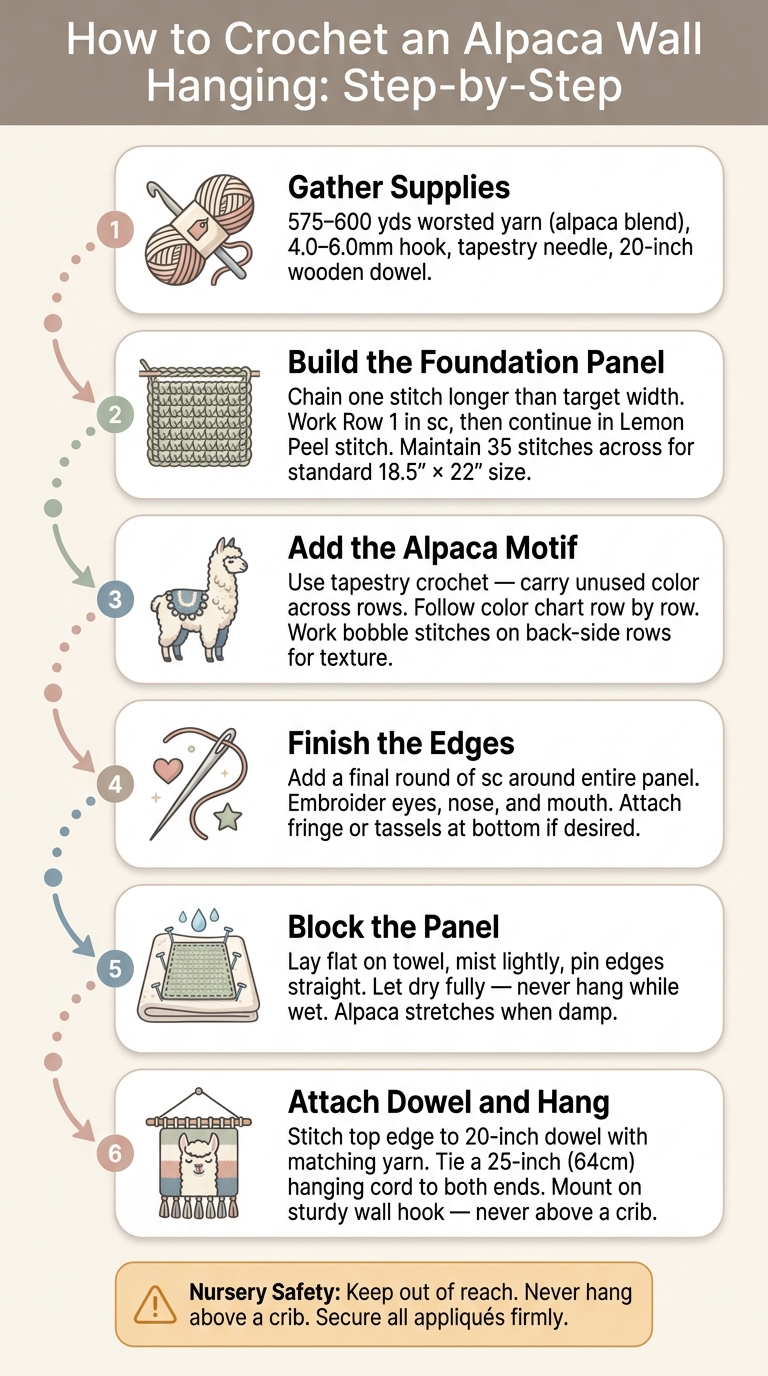
How to Crochet an Alpaca Wall Hanging: Step-by-Step Visual Guide
Work in this order: foundation chain, background panel, alpaca motif, then edge finishing.
Basic Stitches and Tapestry Crochet
You’ll use chain (ch), single crochet (sc), double crochet (dc), and slip stitch (sl st). Work the background in Lemon Peel stitch and the motif in tapestry crochet. The Lemon Peel stitch gives the fabric a nice texture and helps the panel keep its shape.
For the alpaca motif, carry the unused color across the top of the previous row and crochet over it with your active color. That keeps the fabric thickness even from row to row. Change colors on the last pull-through of the stitch.
Build the Panel, Add the Motif, and Finish the Edges
Start with a foundation chain that is one stitch longer than your target width, then work the first row in sc to make a steady base. From there, continue in Lemon Peel stitch and keep the stitch count even on every row - 35 stitches for the standard size - so the sides stay straight. Use a ch 1 turn when the next row starts with sc and a ch 2 turn when it starts with dc.
Once you get to the alpaca motif rows, follow the row-by-row color chart. Work bobble stitches on back-side rows so the texture stands out on the right side of the finished panel. After the last row, add a final round of sc around the whole panel. This covers carried yarn and gives you a neat edge for the dowel attachment. Embroider the eyes, nose, and mouth after crocheting so the alpaca shape stays flat and clean for the nursery decor.
When the panel is done, block it and get the hanging hardware ready.
Add Fringe, Tassels, or Soft Texture
If you want a softer look, add fringe after the edge round. For fringe loops, chain 10, skip 6 stitches, slip stitch, and repeat across the bottom edge. To attach fringe, cut yarn strands about 10 inches long, fold each bundle into a U-shape, pull the loop through the chain loop, then draw the ends through and tighten with a Lark's Head knot.
You can also use bobble stitches in the alpaca body rows for extra texture. Weave in all ends well before hanging the piece in a nursery.
How to Attach, Block, and Hang the Finished Piece
How to Attach the Panel to a Dowel or Hanging Rod
After the last edge round, attach the panel to the dowel. Use a tapestry needle and matching yarn to stitch the top edge of the panel to the dowel. Pass the yarn behind the dowel and through the top stitches all the way across.
For a panel that’s about 18.5 in. wide, a 20 in. dowel gives you a small overhang on each side for the hanging cord. A sewn or chained attachment works best because alpaca can relax over time.
Block the Piece and Attach a Hanging Cord
Blocking helps the panel keep its shape and keeps the edges straight once it’s on the wall. Lay the piece flat on a towel and mist it lightly. Don’t soak it. Then pin the edges flat while it dries.
Hang only after fully dry; wet alpaca can stretch.
Once the piece is dry, attach the cord and make sure the panel hangs level. Cut a 25 in. (64 cm) cord and tie both ends to the dowel to make a centered hanging loop.
Nursery Safety and Placement Tips
Before you hang it in the nursery, double-check the spot. Keep the piece well out of reach and never hang it above a crib. Attach the hanging cord to a sturdy wall hook or anchor so the wall hanging stays firmly in place.
Tapestry crochet leaves floats on the back. Add a backing to cover those floats and help prevent snags, which gives the piece a nursery-safe finish.
How to Customize the Wall Hanging as a Baby Shower Gift
Ways to Personalize the Design for a Nursery Theme
Once the wall hanging is done, tailor it to the nursery theme. Start with the room’s color palette: cream and fawn for boho, pastels for playful spaces, or ivory for a neutral look.
For a more personal touch, add a name, initials, or birth date with simple embroidery. Small 3D appliqués - like a crocheted flower, a bobble-stitch collar, or a simple bow - can add charm without taking over the design. Just make sure every accent is attached firmly for nursery safety. Keeping those details small helps the alpaca motif stay front and center.
Conclusion: Key Steps for a Nursery-Ready Alpaca Wall Hanging
A nursery-ready gift comes down to three things: a stable yarn blend, clean finishing, and secure hanging. Plan the motif and color palette first, crochet the panel with neat color changes, and finish it with a secure dowel attachment.
It’s also smart to include a care card: Hand Wash Cold / Lay Flat to Dry.
FAQs
How do I keep the wall hanging from stretching over time?
Use an alpaca blend with wool, acrylic, or cotton if you want better elasticity and shape retention. Pure alpaca has a habit of growing over time, which can make a piece lose its structure.
If you go with pure alpaca, keep your gauge consistent and use the right hook size. After washing, lay the piece flat to dry. Don’t hang it while it’s wet, or it can stretch out even more.
What’s the easiest way to read the alpaca color chart?
Read the pattern all the way through before you start so you know how the color changes are marked.
Most charts come with written instructions that tell you exactly when to switch colors, even in the middle of a row. If you're new to tapestry crochet, having both a chart and written directions can make the colorwork much easier to follow.
Do I need a backing on the back of the panel?
No, these alpaca wall hanging patterns don’t need a backing. They’re made as finished crochet panels that hang from a wood dowel or piece of driftwood.
The tapestry crochet design helps the panels keep their shape, as long as your stitch tension stays even. So there’s no need to add extra support to the back.