Your Cart is Empty



If a crease stays in alpaca after blocking, the issue is usually one of three things: the fiber did not get fully wet, the fabric dried under pressure, or the fold has been set by storage or heat.
When I look at stubborn creases in alpaca, I keep it simple: match the cause to the fix. A full soak often helps when the inside of the fabric stayed dry. Steam works better for deep fold lines. And if the yarn was damaged by direct heat, blocking may only soften the mark, not remove it.
Here’s the short version:
A few facts matter here. Alpaca has less crimp than wool, so it has less spring to push back against fold lines. It also tends to take in less water than wool, which is one reason a piece can seem wet on the outside while staying drier inside.
| Cause | What I’d expect to see | What usually helps |
|---|---|---|
| Incomplete saturation | Crease stays after one block | Full resoak and flat drying |
| Drying pressure | New line after blocking | Reblock with better support |
| Storage fold | Sharp fold line comes back | Directed steam and better storage |
| Heat damage | Flattened surface, dull spot | Limited softening only |
If you want the shortest answer possible: blocking can relax alpaca, but it cannot fix every type of crease.
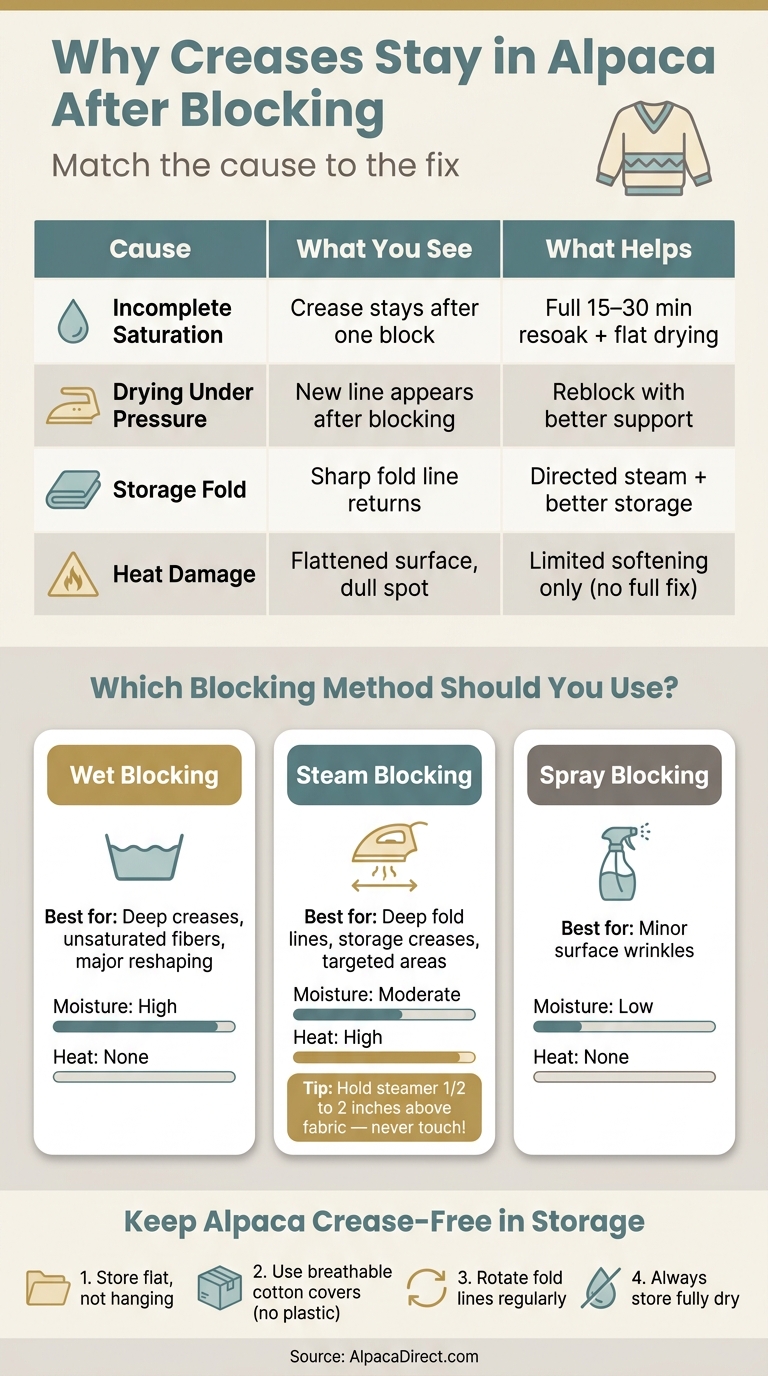
Alpaca Crease Causes & Fixes: Quick Reference Guide
When a crease sticks around after blocking, start with the most basic issue: the fabric may not have gotten fully soaked.
Dense alpaca can look wet on the outside while the inner fibers stay dry. And if those inner fibers stay dry, they can remain locked in the fold. In plain terms, the surface softens, but the core of the fabric keeps the crease in place.
If the soak doesn’t reach all the way through, the crease stays set.
If the fiber did soak through, the next thing to check is how it dried.
Any fold, seam, or edge that dries under pressure can set a new crease. That includes storage folds, too. A garment left folded tightly for a long time can develop a deep line that a light pass of steam may not remove.
Heat can also make things worse. High heat can felt, shrink, or weaken alpaca permanently.
If drying wasn’t the problem, the crease is often tied to repeated pressure or fiber damage.
Repeated wear, felting, or heat damage can lock a crease into the fabric. At that point, blocking may soften the line, but it usually can’t remove it completely.
The fix depends on why the crease is still there. If the fiber stayed dry at the core, a quick surface wetting won’t do much. In that case, the garment needs a full resoak. If the crease is more like a set fold, steam is usually the better move.
When the inside of the fiber wasn’t fully saturated the first time, the crease can stay stuck even if the surface feels softer. Soak the garment until it’s fully saturated, then reblock it.
Fill a basin with lukewarm water and a mild, pH-neutral wool wash. Submerge the garment and let it soak for 15 to 30 minutes. Once it’s saturated, never wring or twist the fabric. Instead, roll it in a towel and press out the extra water. Then move it to a dry towel or mesh rack, gently ease it back into shape with your hands, and let it air dry all the way, away from direct sunlight or heat.
Some creases come from tight folds, not from poor soaking. Those are often easier to fix with steam than with another wash.
Use steam for deep fold lines and storage creases. Hold a garment steamer or steam iron 1/2 to 2 inches above the fabric on steam only. Don’t let the iron touch the alpaca. Direct contact can crush the pile. If the crease came from heat damage, steam may soften how it looks, but it won’t remove it all the way.
After steaming, smooth the area by hand while it’s still warm and damp. Then let it dry flat before you move it or wear it.
Getting rid of creases is only half the job. You also want to avoid making new ones while the garment dries.
Always dry alpaca flat on a fresh towel or mesh rack. While it’s still damp, smooth out bumps and wrinkles by hand. If you want straighter edges and more even tension, use blocking wires or blocking tools such as Knit Blockers.
For small wrinkles between washes, a light mist or a short burst of steam usually does the trick. Smooth the area by hand, then let it dry flat.
After blocking, storage can bring creases right back. If a crease shows up again after blocking, storage is often the first place to look.
Hanging alpaca can stretch the fabric and leave shoulder dimples. It’s better to fold sweaters, shawls, and accessories loosely and store them flat. Use wide folds instead of sharp creases, and switch up the fold line from time to time. If you fold along the same spot over and over, the fabric can start to hold that line. A little acid-free tissue at the fold points helps soften the pressure.
The fold itself isn’t the only issue. Pressure and trapped moisture can make those lines stick.
Pressure and moisture are rough on stored alpaca. If heavy items sit on top of a garment, they can press deep lines into the fabric. So place alpaca near the top of a drawer or give it its own shelf.
For storage, stick with breathable cotton, canvas, or pillowcase covers. Skip plastic bags and sealed bins. They can trap moisture and may lead to yellowing and mildew. And don’t store alpaca unless it’s fully dry. Moisture trapped under pressure can set into the fabric and cause permanent shape change.
Cedar blocks or lavender sachets can help keep moths away without harsh chemicals.
See the Alpaca Direct YouTube channel for blocking, steaming, and garment-care demos. The videos make steam distance and handling much easier to follow.
Once you know why the crease showed up, the next step is simple: pick the blocking method that fits the problem.
Here’s the quick match-up:
| Blocking Method | Best For | Moisture and Heat |
|---|---|---|
| Wet Blocking | Deep creases, stitch smoothing, major reshaping | High moisture; no heat |
| Steam Blocking | Deep fold lines, storage creases, targeted areas | Moderate moisture; high heat |
| Spray Blocking | Minor surface wrinkles | Low moisture; no heat |
When steaming, hold the steamer or iron 1/2 to 2 inches above the fabric. Keep it above the fabric at all times. Never let the steamer or iron touch alpaca.
Stubborn creases in alpaca usually come from a small set of causes: fibers that didn’t get fully saturated, a fold that set during drying, or storage pressure that brought the crease right back. Each one calls for a different fix, so it helps to work through them in order. That saves time and helps prevent damage to the fabric.
After you remove the crease, storage habits make the difference. Store alpaca flat, dry, and loosely folded so the fabric stays smooth.
Submerge the garment fully in lukewarm water and let it soak for 20 to 30 minutes. While it’s soaking, leave it alone. Don’t twist, squeeze, or move it around.
It’s ready when the fibers feel softer and slightly relaxed. That gives you a better shot at reshaping it cleanly for a smooth, polished finish.
Creases in alpaca are rarely permanent. In most cases, a simple wash and reblocking session will do the trick, giving the fibers time to relax and settle back into their original shape.
If you're dealing with light wrinkles, mist the area a bit and smooth it gently with your hands. For deeper creases, use steam from a safe distance for 10 to 15 minutes. Skip direct ironing, since it can harm alpaca fibers.
Store alpaca only when it’s clean and fully dry. Put garments flat in a drawer or on a shelf. Never hang them, because that can stretch the fibers and throw off the shape.
To help avoid creases and wear, fold pieces loosely or roll them. Skip heavy stacks. Use breathable storage, like cotton bags or cedar chests, and check on them from time to time.

Comments will be approved before showing up.