Your Cart is Empty


If I want speed, I pick pre-stringing. If I want control, I pick hook beading. That’s the whole choice in one line.
Here’s the short version:
One detail matters more than it may seem: bead-hole size. For pre-stringing, the bead must fit the yarn. For hook beading, it must fit the hook and a doubled yarn loop. If that fit is off, the method gets frustrating fast.
My rule of thumb:
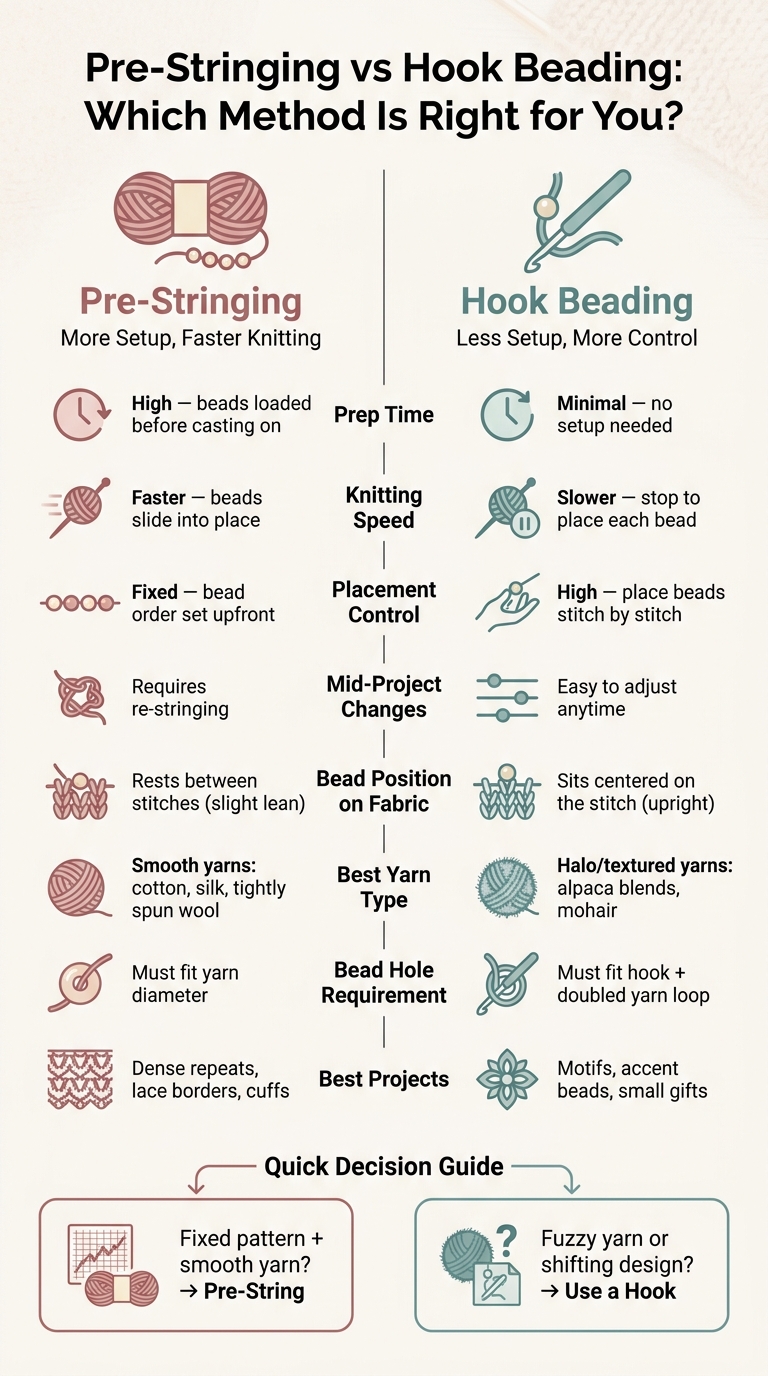
Pre-Stringing vs Hook Beading: Which Method Is Right for You?
| Method | Best for | Main tradeoff | Yarn match | Bead look |
|---|---|---|---|---|
| Pre-stringing | Dense repeats, borders, cuffs | Faster knitting, less freedom later | Smooth yarns | Beads rest between stitches |
| Hook beading | Accents, motifs, small gifts | More control, slower knitting | Fuzzy or halo yarns | Beads sit on the stitch |
If you’re choosing between the two, I’d keep it simple: fixed pattern and smooth yarn? Pre-string. Fuzzy yarn or shifting design? Use a hook.
Pre-stringing puts the prep at the start, then lets you knit without constant stops. Compared with hook beading, it gives you more speed but less freedom once you're in the middle of the work.
This method works best when the bead placement is fixed and repeats in a set pattern. You string the beads in reverse order so they land in the right sequence as you follow the chart. That sounds a little backwards at first, but it makes sense once you start knitting.
The time savings show up most in high-density beaded sections - dense lace borders, all-over beaded panels, or cuff patterns with frequent repeats. In those spots, sliding a bead into place and knitting on is faster than stopping to grab a hook for every single bead. If you're only adding a few accent beads, though, the setup often takes more time than it saves.
That speed only helps if the yarn and bead pass through each other without a fight.
Before you commit, test the bead holes with your yarn. Laceweight and light fingering yarns usually pair well with 6/0 or 8/0 seed beads. Heavier yarns need larger beads or beads labeled with large holes.
Texture matters just as much as yarn weight. Smooth, tightly spun yarns - like many merino or cotton blends - tend to pass through bead holes with less drag. Halo-heavy fibers, such as brushed alpaca or mohair blends, can snag inside the hole and slow everything down. If you're using those yarns, pick beads with larger, smoother holes or switch to hook beading to cut down on friction.
Pre-strung beads usually sit on one stitch leg instead of the center of the stitch, which gives them a slight lean. That's part of the look, not a mistake. It's also one reason pre-stringing fits repeat-heavy lace and borders so well.
Pre-stringing shines when bead placement is fixed, repeated, and dense. It's a good match for:
In each of these cases, the work you do at the start pays you back over many rows of smoother, more rhythmic knitting.
Pre-stringing asks you to lock in your bead plan before you even cast on. Hook beading works differently. You place each bead as you knit, so you can make decisions in the moment.
Yes, it slows the rhythm a bit. Each bead takes a few extra seconds. But that slower pace gives you something pre-stringing can't: stitch-by-stitch control. When placement matters more than raw speed, hook beading is usually the better pick.
With a crochet hook, you can add each bead to the exact stitch you want. And if your plan changes halfway through, that's no big deal.
Say you knit a swatch and realize the first bead layout looks too crowded. With hook beading, you can switch to a new chart and place beads only where they look best. No re-stringing. No starting over.
This is especially handy with hand-dyed yarns. Pooling and variegation often don't show up until the knitting is underway, so being able to adjust bead placement as the color pattern appears can make a big difference.
Hook-placed beads tend to sit more centered and upright on the stitch. That gives lace a cleaner, more lifted look. Use a hook that passes through the bead hole cleanly and doesn't split the yarn.
| Yarn Weight | Bead Size | Hook Size |
|---|---|---|
| Lace weight | 8/0 (~3 mm) | 0.60–0.75 mm |
| Fingering | 6/0 (~4 mm) | 0.75–1.0 mm |
| Sport / DK | 4/0 or larger | Match to bead opening |
These are common starting points for swatching.
Hook beading also works well with alpaca blends, mohair, and other halo yarns. With pre-stringing, beads slide over inches or even yards of yarn, rubbing against those fine surface fibers the whole time. Hook beading keeps each bead at a single stitch, so there's much less friction and the halo stays intact.
Hook beading makes the most sense when beads are used as accents, not full coverage. A bead in the center of each lace flower. One beaded row at the top of a cuff. A few scattered highlights across a cowl panel. In setups like these, the extra time per bead stays small, and the added control is worth it.
It's also a good match for smaller gift projects like fingerless mitts, scarves, and cowls. You can tweak the look as you go. Add a few more beads to spotlight a motif for one person, or keep it softer for someone else, without changing your yarn setup.
After looking at each method on its own, it helps to put them head-to-head. The biggest differences come down to speed, control, yarn fit, and the kind of project you’re making.
Pre-stringing asks for more work at the start, then moves faster once you begin knitting. Hook beading flips that around. There’s almost no setup, but each beaded stitch takes extra time because you stop and place the bead as you go.
There’s also a control tradeoff. With pre-stringing, the bead order is set before you start. That can be great for planned layouts, but it also means less freedom if you change your mind halfway through. Hook beading gives you that freedom because you place beads stitch by stitch.
The finished look is a little different too. Hook-placed beads sit on the stitch, while pre-strung beads rest between stitches.
| Factor | Pre-Stringing | Hook Beading |
|---|---|---|
| Prep time | High - beads loaded before casting on | Minimal |
| Knitting speed | Faster - beads slide into place as you go | Slower - stop to place each bead |
| Placement control | Fixed - bead order set before you begin | High - place beads stitch by stitch |
| Bead placement on the fabric | Rests between stitches | Sits on the stitch |
| Mid-project changes | Requires re-stringing | Easy to change placement mid-project |
In a lot of cases, the yarn makes the choice for you before the pattern does. Smooth yarns like cotton, silk, and tightly spun wool work well for pre-stringing because the beads can slide onto the strand more easily. Halo yarns like alpaca blends and mohair are usually better for hook beading, since threading beads onto fuzzy yarn can turn into a headache fast.
Bead-hole size matters too. Pre-stringing needs a hole large enough for the yarn diameter. Hook beading needs a hole large enough for both the hook and a doubled yarn loop. That small detail can save a lot of trial and error.
For project types, pre-stringing tends to shine when you want repeated bead layouts, like dense beadwork or beaded borders on lace shawls. Hook beading is often the better pick for motifs, small accents, and projects where you may want to adjust placement as you knit. That makes it handy for cuffs and small gift items, especially when you want a little freedom instead of locking every bead into place ahead of time.
| Factor | Pre-Stringing | Hook Beading |
|---|---|---|
| Yarn type | Smooth yarns like cotton, silk, and tightly spun wool | Halo or textured yarns like alpaca blends and mohair |
| Bead hole needs | Fits the yarn diameter | Fits the hook and a doubled yarn loop |
| Lace shawls | Best for dense or border bead patterns | Best for motifs and accent beads |
| Cuffs | Good for repeating bead patterns | Good for accent details placed as you knit |
| Gift items | Efficient for repeating layouts | Flexible and easy to customize, especially for small gifts that need flexible placement |
Once you compare speed, control, and yarn fit, the choice usually comes down to three things: how many beads you plan to use, how your yarn works with the beads, and how much freedom you want while knitting.
Pre-stringing makes the most sense for fixed bead layouts on smooth yarns, including smooth alpaca blends. It can save time while you knit and tends to work best for dense repeats where the bead pattern is already set.
If your yarn has more texture, or if bead placement might shift as you go, hook beading is the safer pick. It works better for halo yarns like brushed alpaca or mohair, where repeated sliding can press down the fibers. For scattered accents, motif lace, and alpaca gifts, that extra control is often worth the slower pace.
For technique help, Alpaca Direct offers blog posts and YouTube videos on beading methods and yarn choice.
Neither method wins every time. The better fit depends on your yarn, your bead count, and how much control you want in the moment.
For beginners, hook beading is usually the easiest way to add beads to knitting. You use a crochet hook to slip a bead onto the yarn loop of a slipped stitch, so the whole thing feels simple and easy to follow.
It also gives you better control over bead placement than pre-stringing. Kelley demonstrates this technique on the Alpaca Direct YouTube channel.
Choose a crochet hook that can slip through the bead hole without a fight, but is still big enough to grab the yarn loop and pull it through.
If you want more beadwork tips and knitting how-tos, check out Alpaca Direct’s educational resources and YouTube channel.
Yes. Pre-stringing is a good fit when beads show up in a steady pattern across a project, because you need to load every bead onto the yarn before you start knitting.
Hook beading works differently. You add beads one at a time as you knit, which gives you more control right where you need it. Use both together, and you get the best of both worlds: the speed of pre-stringing for larger sections and the precision of hook beading for small details.

Comments will be approved before showing up.