
Best Needle Types for Alpaca Wool

If you knit with alpaca, needle material matters more than with sheep’s wool. Alpaca is smooth, low-stretch, and heavier, so stitches slip more easily and fabric can grow after blocking.
Here’s the short answer:
- Bamboo gives the most grip and helps if your stitches slide.
- Wood sits in the middle and feels smoother than bamboo.
- Metal gives the most glide but can let alpaca slip off the needle.
- Straight needles work best for small flat pieces.
- Circular needles help with sweaters, shawls, and other heavier projects.
- DPNs are for small tubes like socks, mittens, sleeves, and hat crowns.
I’d keep one point in mind before anything else: alpaca does not bounce back much. So if your tension is uneven, or your needle is too slick, the fabric will show it. And if your needle size is too large, the finished piece may stretch after washing and hanging.
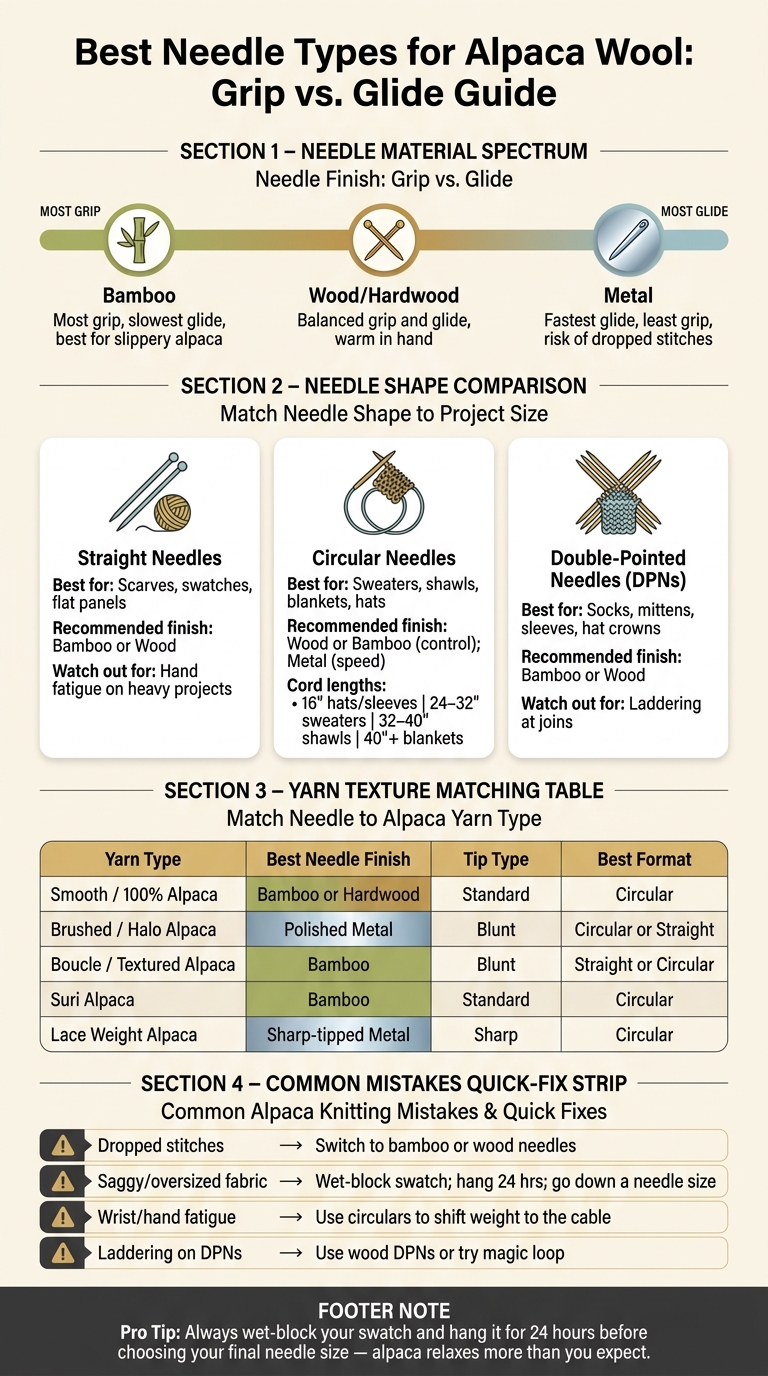
Best Needle Types for Alpaca Wool: Grip vs. Glide Guide
Circular Knitting Needles - Review and Comparison
Quick Comparison
| Needle Type | Best Finish | Main Use | Watch Out For |
|---|---|---|---|
| Straight | Bamboo or wood | Scarves, swatches, flat panels | Heavy fabric can strain hands |
| Circular | Wood or bamboo for control; metal for glide | Sweaters, shawls, blankets, hats | Slick metal can drop stitches |
| DPNs | Bamboo or wood | Socks, mittens, sleeves, hat tops | Laddering and dropped stitches |
A few fast takeaways from the article:
- 16-inch circulars are common for hats and sleeves.
- 24- to 32-inch circulars are often used for sweater bodies.
- 32- to 40-inch circulars are common for shawls.
- 40 inches or more helps with wide shawls and blankets.
- For alpaca, it’s smart to wet-block your swatch and hang it for 24 hours before choosing your final needle size.
If I had to sum it up in one line, it would be this: pick bamboo for control, wood for balance, and metal for glide - then match the needle shape to the project size.
1. Bamboo Straight Needles
Bamboo straight needles are a strong match for alpaca because they add grip where alpaca tends to slip. Compared to alpaca vs merino wool, alpaca fiber has a smoother surface than sheep's wool, so stitches can move around more than you want. Bamboo's natural friction helps slow that down.
That extra grip does two things: it helps keep stitches on the needle, and it makes even tension easier to hold. That matters with alpaca because it has very little bounce. If your stitches loosen up, the yarn usually won't spring back and fix it for you. That's why bamboo is especially handy for flat pieces that need a bit more control.
Use bamboo straight needles for flat alpaca projects like:
- scarves
- swatches
- panels
As Kathleen Cubley, Alpaca Direct, notes:
"They're just grippier than metal needles, they warm up in your hands and are easier on arthritic joints, and they're quiet."
That blend of grip and comfort makes bamboo a good fit for long alpaca knitting sessions.
Bamboo is also a fast-growing renewable grass, so it's a lower-impact needle pick. Go for well-finished bamboo needles, and swatch first since the added friction can change your gauge. If you'd like something a bit smoother, hardwood straight needles are the next choice.
2. Hardwood Straight Needles
If bamboo grips a bit too much, hardwood is a nice step in the middle. It gives alpaca more glide without feeling slippery. In terms of friction, it sits between bamboo and metal, which makes it a strong middle-ground pick for alpaca.
Alpaca is smoother than sheep's wool, so stitches tend to move more easily on slick surfaces. Hardwood adds enough grip to help stop stitches from sliding off by accident. That also makes it useful for alpaca blends with silk or bamboo.
Polished hardwood works well for brushed alpaca because the smoother surface helps fibers move along without snagging. That kind of balance is handy for flat projects where steady stitch control matters, making them excellent alpaca gifts for knitters.
Keep hardwood needles away from humidity and direct sunlight so they don't warp or develop extra drag. Fine hardwood needles also need a lighter touch. If you want less friction than hardwood offers, metal straight needles are the next step.
3. Metal Straight Needles
Compared with hardwood, metal has the least resistance. It’s the slickest choice, so alpaca stitches glide with almost no drag.
That smooth surface can speed up knitting. But there’s a catch: loose tension is easier to overlook, and stitches can slide off before you mean to let them go. If your tension is steady, metal can feel great. If it tends to drift, alpaca gives you less room for error because it doesn’t bounce back much. That’s why swatching matters before you cast on a full project.
The sharper tips on most metal needles are a big plus for lace patterns and cables, where precise stitch work counts. They work well for flat alpaca pieces that need speed and clean stitch definition. Ribbing also helps when shape retention matters. That mix makes metal a good fit for projects where control matters more than grip.
Metal is also the most durable option and resists warping. The downside is comfort. It can feel cold in your hands, which some knitters notice during long sessions.
Swatch, block, and measure before starting.
4. Bamboo Circular Needles
Once alpaca projects go beyond flat pieces, bamboo circular needles start to shine. Alpaca is smoother than sheep wool, so stitches tend to slide more easily. Bamboo has a matte surface that adds just enough grip to help you manage those slippery stitches without giving up support. That extra control can also help keep your stitch size more even.
"Alpaca can be a bit slippery, so wooden or bamboo needles make it easier to keep your stitches under control." - Yanantin Alpaca
This matters even more as the fabric gets heavier. Circular needles spread the weight of alpaca fabric across the cord instead of leaving it all on your hands and wrists. That can cut wrist strain and help you hold steadier tension.
Size also matters here. A 16-inch circular is a good fit for hats and sleeves. For shawls worked flat, a 32- to 40-inch circular usually makes more sense.
5. Wood Circular Needles
If bamboo feels a bit too grabby, wood circular needles are a nice middle ground for alpaca. They let stitches move more freely without turning the needle into a slip-and-slide. Since alpaca is smooth and low-friction, wood gives you enough hold to keep stitches in place without dragging down your rhythm.
They’re also a solid pick for bigger projects like sweaters, wraps, and blankets. The cord holds the weight of the fabric, which takes some pressure off your wrists. For sweater bodies, a 24- to 32-inch circular usually works well. For wide shawls or blankets, go with 40 inches or longer so the fabric can spread out more comfortably.
When you’re shopping, pay close attention to the cord. A cord that keeps its curl can get annoying fast. Nylon-coated steel or high-quality plastic cords tend to work well because they stay straighter and feel easier to handle. A polished wood circular with a smooth join gives you better glide while still keeping your stitches under control. If you want a good balance of grip, speed, and comfort, this is often the sweet spot.
Here’s the practical difference between wood and bamboo circulars:
| Feature | Wood Circular Needles | Bamboo Circular Needles |
|---|---|---|
| Surface Finish | Polished; smooth glide with grip | Matte; highest friction |
| Knitting Speed | Moderate to fast | Slower |
| Best For | All-purpose alpaca knitting | Very slippery fibers, absolute beginners |
| Cost | Higher initial investment | More affordable |
6. Metal Circular Needles
If you want the fastest glide in a circular needle, metal is the next step up.
Compared with wood, metal gives you more speed and less control. It’s the slickest option, which means alpaca moves along fast. That can feel great when you’re in a rhythm. But if your tension is on the loose side, stitches can slide a little too easily. That’s the main trade-off: faster stitching, less grip.
For large alpaca projects, nylon-covered steel cables are a smart pick because they have no memory and resist kinking under the weight of heavier alpaca fabric. Tip shape matters just as much as the finish. Sharp tips work well for lace shawl patterns and frequent shaping, while blunter tips can help cut down on splitting. One more thing: metal tends to feel cold in the hand, and some knitters notice that during longer sessions.
| Feature | Metal Circular Needles | Impact on Alpaca Knitting |
|---|---|---|
| Surface Finish | Smooth and slick | Fastest glide; stitches can slip off if tension drifts |
| Tip Shape | Sharp or blunt | Sharp for lace and shaping; blunt if yarn splits |
| Cord Material | Nylon-coated steel | Resists kinking under heavy alpaca fabric |
| Temperature | Cold in the hand | May feel uncomfortable during long sessions |
| Durability | Very durable | Holds up well on heavy alpaca projects |
7. Bamboo Double-Pointed Needles
When circular needles start to feel clunky on small tubes, DPNs make alpaca much easier to handle. Bamboo works well here because it has more grip, which helps keep small-circumference stitches from sliding off. That extra grip also helps at the joins between needles, where stitches are most likely to fall on a slick fiber like alpaca.
These needles are a good fit for socks, mittens, sleeves, and hat crowns. In those cases, circular cables can get in the way, and stitch control matters more than speed. Match the needle size to the yarn weight, then go a bit smaller for cuffs and ribbing so they hold their shape better.
DPNs usually come in sets of four or five. A five-needle set lets you spread stitches across four working needles, which can reduce strain at the joins. It also tends to make the setup feel a little less fussy. Look for lightly polished tips so stitches move cleanly without turning slippery.
| Feature | Bamboo DPNs | Metal DPNs |
|---|---|---|
| Grip Level | High - keeps slippery alpaca secure | Low - stitches slide freely |
| Best For | Socks, mittens, sleeves, hat crowns | Fast knitters with tight tension |
| Hand Feel | Warm, lightweight | Cold, can be tiring in long sessions |
| Durability | Can snap under high pressure | Highly durable |
| Stitch Control | Excellent at joins between needles | Higher risk of dropping stitches at ends |
If you want a bit more glide, wood DPNs are the next step up in smoothness.
8. Wood Double-Pointed Needles
Wood DPNs land right between bamboo’s grip and metal’s speed. They’re a bit smoother than bamboo, which gives alpaca’s slippery fibers enough hold while still letting stitches move cleanly during needle changes. That sweet spot matters most in small rounds, where a dropped stitch is more annoying to fix. For socks, mittens, and alpaca baby clothes, wood is often a smart pick.
Put simply: wood DPNs give alpaca enough grip to stay under control without the extra drag of bamboo.
If you’re working with 100% baby alpaca or Suri alpaca, wood DPNs can give you more control on silky yarns, including baby alpaca and Suri blends. They also tend to have slightly blunter tips than metal, which can help cut down on splitting with smooth alpaca yarns.
Wood DPNs offer that middle ground between bamboo’s grip and metal’s speed. Polished wood DPNs can give you a smoother finish and faster glide than standard bamboo while still feeling warm in the hand. One tradeoff: wood can snap if dropped, so it’s worth storing them with care.
| Feature | Wood DPNs | Bamboo DPNs |
|---|---|---|
| Surface Finish | Polished, smoother glide | More natural grab, slightly more friction |
| Best Yarn Match | Smooth, silky alpaca and alpaca blends | Smooth yarns, loose knitters |
| Control | Good grip with easy glide | Best for very slippery yarns |
| Durability | Can break if dropped | Flexible and generally sturdy |
| Hand Feel | Warm, smooth, low-noise | Warm, silent |
Metal DPNs are the next step if you want the fastest glide.
9. Metal Double-Pointed Needles
If you want the fastest tool for small-round knitting, metal DPNs are usually it. With alpaca yarn, they offer the smoothest glide. The polished surface lets stitches slide with very little resistance, which makes it easier to move fast through hat crowns, thumb gussets, and other small shaping jobs.
That said, alpaca can get a little slippery on metal. For loose knitters, that often means a higher chance of dropped stitches.
Where metal DPNs stand out most is precise work in tight rounds. Their sharper tips help you make clean decreases, whether you're shaping a hat crown or working a thumb gusset on a mitten. Because they’re rigid, they also help small rounds keep their shape as you knit.
Comfort matters too, especially if you’ll be knitting for a while. Metal needles stay cold to the touch and make a clicking sound as you work. Some knitters don’t mind that at all. Others find it less comfortable for long small-round sessions. So the tradeoff is pretty clear: more speed, less control.
| Feature | Metal DPNs | Impact on Alpaca Projects |
|---|---|---|
| Surface Friction | Very low (slick) | Faster knitting, but higher risk of dropped stitches |
| Tip Profile | Often sharper | Better for lace, decreases, and shaping |
| Durability | Highly durable | Less likely to snap than thin wooden DPNs |
| Temperature | Cold to the touch | Less comfortable for long sessions or arthritic hands |
| Noise | Clicking as you knit | Noticeable compared to wood or bamboo |
Pros and Cons by Needle Type and Finish
Alpaca is smoother and stretchier in a different way than sheep's wool, so needle grip matters a lot more. In plain English, your choice usually comes down to grip vs. glide.
Bamboo gives you the most grip. Metal gives you the most glide. Hardwood lands somewhere in the middle. So if you want to narrow things down fast, start by choosing the best needles for alpaca yarn projects based on finish before you worry about size or shape.
That also explains why metal needles often feel faster, yet too slick for some alpaca yarns. With heavier alpaca projects, circular needles help because the fabric can rest in your lap instead of hanging from your wrists. DPNs work best for small tubes, but they take more hands-on control.
| Needle Option | Strengths | Limitations | Best Alpaca Textures |
|---|---|---|---|
| Bamboo Straight | High grip; warm | Can snap; slower knitting | Slippery 100% alpaca; Suri alpaca |
| Hardwood Straight | Grippier than metal; smooth finish | More expensive; fragile if dropped | Standard Huacaya alpaca; wool blends |
| Metal Straight | Fast; sharp tips; highly durable | Cold; slippery; clicking | Chunky alpaca blends; tight-tension projects |
| Bamboo Circular | Secure grip; beginner-friendly; weight in lap | Tips may wear down | Slippery alpaca; Suri alpaca; silk blends |
| Wood Circular | Quiet; warm to touch; ergonomic | Cables may have memory; tips wear down | 100% baby alpaca; lace |
| Metal Circular | Smooth joins; highly durable; fast | Cold; can be too slick for alpaca | Alpaca/wool blends; tight-tension projects |
| Bamboo DPNs | Secure grip for small tubes | Fiddly to manage multiple needles | Fine fingering-weight alpaca |
| Wood DPNs | Quiet; good friction | Can snap at thin sizes | Snug-fit alpaca; baby weight |
| Metal DPNs | Rigid; sharp tips; highly durable | Slippery; cold; clicking | Alpaca blends; experienced knitters |
Wood and bamboo usually feel warmer in the hand, while metal feels colder. If you're stuck between options, this finish-first comparison is a good shortcut. Then you can pair that finish with the yarn weight and the shape of the project.
How to Match Your Needle to Your Alpaca Yarn and Project
Finish gets you part of the way there. After that, the two things that matter most are yarn texture and project shape.
Start with yarn texture. For smooth alpaca, bamboo or hardwood usually works best because it gives you a bit more control. For brushed or haloed yarn, polished metal is often the better pick since it helps the yarn move without snagging. If you're working with boucle or another textured yarn, bamboo is a smart choice because it can help keep the stitches from getting away from you.
Suri alpaca needs a little extra attention here. It's much smoother, shinier, and drapier than Huacaya, so bamboo tends to work especially well because it adds control where the yarn itself gives you less grip. If you're using alpaca blends with wool or silk and you're not sure what to choose, bamboo is still a safe default.
Then look at project shape. Straights work well for small flat pieces. Circulars are better for heavier fabric since they help carry the weight. DPNs are the go-to for small tubes like hats, socks, and gloves. Get this match wrong, and you'll usually notice pretty fast through splitting, slipping, or uneven tension.
| Yarn Texture | Needle Finish | Tip Type | Best Format |
|---|---|---|---|
| Smooth / 100% Alpaca | Bamboo or Hardwood | Standard | Circular |
| Brushed / Halo Alpaca | Polished Metal | Blunt | Circular or Straight |
| Boucle / Textured Alpaca | Bamboo | Blunt | Straight or Circular |
| Alpaca/Wool Blends | Metal or Wood | Sharper (for lace/detail) | Any |
| Suri Alpaca | Bamboo | Standard | Circular |
| Lace Weight Alpaca | Sharp-tipped Metal | Sharp | Circular |
Use memory-free cords, such as nylon-coated steel, because kinks add drag.
Common Mistakes When Knitting Alpaca With the Wrong Needles
Most alpaca problems come down to three bad pairings: too much slip, too large a needle, or not enough support.
One of the most common issues shows up with loose knitters using slick metal needles. Alpaca is smooth to begin with, so those stitches can slide around a little too easily. That’s when dropped stitches start to creep in. A quick swatch can save a lot of grief here. If the stitches feel like they’re skating off the needle, switch to bamboo or wood for extra grip.
Needle size trips up a lot of people too. Go too large, and the fabric can turn saggy after blocking. Alpaca has a habit of relaxing once it gets wet, and it can grow more than you’d think when the finished piece starts carrying its own weight. That’s why it helps to wet-block your swatch and hang it for 24 hours before settling on a size. It’s a small step, but it can keep you from making a sweater that suddenly stretches like it has a mind of its own.
Support becomes a bigger deal as the project grows. Big alpaca pieces worked on straight needles can be hard on your wrists and throw off your tension. Switching to circular needles - even if you’re still knitting flat - puts the weight on the cable and into your lap instead of making your hands do all the work. For long knitting sessions, that change can feel like night and day.
Knitting in the round for smaller projects needs a bit more control too. Laddering happens when gaps stay open between DPNs. If that keeps happening, wood DPNs can help because they hold stitches a little better. Magic loop is another good fix if you want more control at the joins.
| Mistake | Why It Happens | Quick Fix |
|---|---|---|
| Dropped stitches | Slick metal + smooth fiber | Switch to bamboo or wood needles |
| Saggy or oversized fabric | Oversized needle | Wet-block swatch; hang 24 hours; go down a size |
| Wrist or hand fatigue | Large straight needles on big projects | Use circulars to shift weight to the cable |
| Laddering on DPNs | Gaps stay open between needles | Use wood DPNs or try magic loop on circulars |
| Split yarn | Too-sharp tip | Move to a needle with a blunter tip |
Conclusion
Alpaca needle choice mostly comes down to three things: grip, glide, and project shape. Bamboo or hardwood usually work best with smooth yarns, while metal is often a better fit for alpaca-wool blends. Circular needles help with larger pieces, DPNs are the go-to for small rounds, and straight needles make sense for flat swatches and small accessories.
After that, match the needle shape to the project and learn how to knit a perfectly fitting sweater and dial in your gauge with a swatch in your actual U.S. needle size. Then wet-block that swatch so you can see how the stitches relax and how the final drape will set. That step matters with alpaca because it has low elasticity and can end up looser than you expect.
For alpaca yarn, needles, project ideas, and YouTube tutorials, Alpaca Direct is a useful resource, including their YouTube channel for technique guidance.
FAQs
Should beginners use bamboo needles for alpaca?
Yes. Bamboo needles are a good pick for beginners using alpaca wool.
Alpaca fibers can be slippery, and bamboo gives you a bit more grip. That helps keep your stitches in place and makes them less likely to slide off the needle.
They’re also lightweight and warm in the hand, which can make longer knitting sessions feel easier and help cut down on hand strain.
How do I choose needle size for alpaca yarn?
Start with the needle size listed on the yarn label. Alpaca has a smooth feel and doesn’t spring back much, so it’s smart to knit a gauge swatch before you begin.
If your swatch comes out too tight, move up a needle size. If it’s too loose, go down a size. For ribbed trims, cuffs, or hems, a smaller needle can help give those edges a snugger fit.
Can I knit alpaca flat on circular needles?
Yes. You can knit flat on circular needles by working back and forth across the rows, then turning your work at the end of each row.
Circular needles are especially helpful for alpaca projects because the flexible cable helps spread the garment's weight across your lap, which can help cut wrist strain.