Your Cart is Empty


Textured knit-purl patterns create depth and dimension by combining two basic knitting stitches: knit (smooth "V" shapes) and purl (raised bumps). These patterns not only enhance the visual appeal of your projects but also add functionality, like extra warmth or elasticity in items such as scarves, hats, and sweaters. Alpaca yarn is ideal for textured knitting due to its crisp stitch definition, softness, and warmth-to-weight ratio.
Key Points:
Whether you're crafting cozy accessories or stylish home decor, textured knit-purl patterns paired with alpaca yarn elevate your knitting projects.
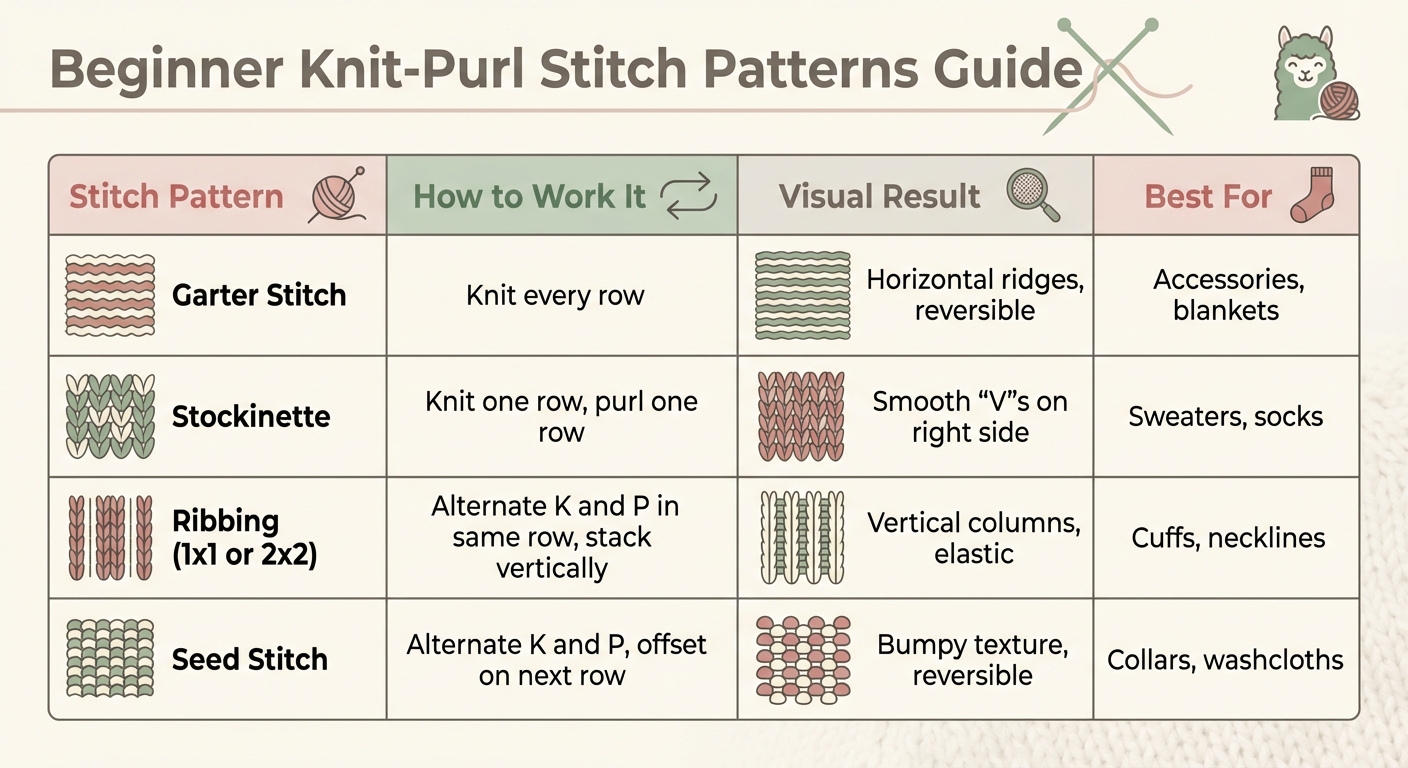
Beginner Knit-Purl Stitch Patterns Comparison Guide
Understanding knit and purl stitches is key to bringing out the texture in your alpaca projects. Knit stitches create smooth "V" shapes, while purl stitches form horizontal bumps. The difference lies in yarn placement: for knit stitches, the yarn stays at the back of the work, while for purl stitches, it moves to the front.
As Kate Atherley, a knitting author and editor, explains:
"There are only two stitches in knitting, and every knitted fabric is just a combination of those two."
By stacking these stitches in different ways, you can create a wide range of textures. Knit stitches stacked together form smooth vertical columns, while alternating knit and purl stitches produce ridges or bumps. Ribbing patterns, for instance, bring depth by making knit stitches stand out as "V" columns and purl stitches recede into valleys, creating a three-dimensional look.
When switching between knits and purls in the same row - like in ribbing or seed stitch - always move the yarn between the needle tips. This small but crucial step prevents loose stitches and keeps your work neat. Maintaining consistent tension during these transitions is essential for an even finish.
Once you've mastered these basics, you'll be ready to troubleshoot common issues that arise when switching stitches.
One of the most frequent mistakes is accidentally creating yarn overs when switching between knit and purl stitches. This happens when the yarn is moved over the needle instead of between the needle tips, adding an unintended extra stitch. Emily Wessel, co-founder of Tin Can Knits, advises:
"The most important thing to note is when you switch from a knit to a purl in a single row, you MUST move your yarn from the back of the work... to the front of the work... bringing it in between the needles (not over the needles, or you will create an extra stitch)."
Another common issue is misunderstanding the phrase "knit the knits and purl the purls." This means working the stitch as it appears on the needle: knit if it looks like a "V" and purl if it looks like a bump.
Tension gaps in ribbing can also make your work look uneven. To address this, use a needle one or two sizes smaller for ribbed sections. Kate Atherley explains:
"Although ribbing pulls in when you're knitting it, over time it relaxes and stretches out, so using a smaller needle helps it hold its shape and stay tidy."
If you're dealing with curling edges in stockinette stitch, consider adding a garter or seed stitch border to stabilize the fabric. Also, for textured patterns to stand out, stick to solid-colored, smooth yarns like alpaca. Yarns with variegated colors or a fuzzy texture can obscure the definition of your stitches.
With these techniques in hand, beginners can refine their skills using simple textured patterns. Garter stitch is an excellent starting point: knit every row to create horizontal ridges that are reversible, flat, and easy to manage. This makes it perfect for scarves or blankets where both sides are visible.
Stockinette stitch alternates one knit row with one purl row. The smooth "V" shapes on the front side and bumps on the back make it the foundation for many projects like sweaters and socks, though it does tend to curl at the edges. Ribbing - whether 1x1 (knit one, purl one) or 2x2 (knit two, purl two) - creates elastic vertical columns, making it ideal for cuffs and necklines.
For a textured, flat fabric, try seed stitch. This pattern alternates knit and purl stitches within the same row, then offsets them on the next row by purling the knits and knitting the purls. The result is a bumpy, grain-like texture that's fully reversible. It works well for washcloths, collars, or any project where stability and texture are desired.
| Stitch Pattern | How to Work It | Visual Result | Best For |
|---|---|---|---|
| Garter Stitch | Knit every row | Horizontal ridges, reversible | Accessories, blankets |
| Stockinette | Knit one row, purl one row | Smooth "V"s on right side | Sweaters, socks |
| Ribbing (1x1 or 2x2) | Alternate K and P in same row, stack vertically | Vertical columns, elastic | Cuffs, necklines |
| Seed Stitch | Alternate K and P, offset on next row | Bumpy texture, reversible | Collars, washcloths |
These beginner-friendly patterns provide a solid foundation for exploring more intricate textured designs as you grow your knitting skills.
Ready to take your knitting projects to the next level? These textured knit-purl patterns add depth and dimension to your work, ranging from simple designs to more intricate styles. Below, you'll find details, tips, and instructions for some standout patterns that can bring a fresh look to your creations.
The Purl Ridge Stitch, also known as Horizontal Welts, is perfect for beginners looking to add a touch of texture. As designer Cassie May explains:
"Purl ridge stitch is horizontal purl ridges on a field of stockinette stitch... it looks like textured horizontal stripes."
This pattern follows a straightforward 4-row repeat:
The result? Raised horizontal ridges with a vintage, welted appearance - great for hats and pillows. To prevent edge curling, consider adding a border. Using alpaca yarn can enhance the definition of these ridges, giving your project a polished look.
For a more intricate design, try the Textured Ribbons Stitch, which creates the illusion of interwoven ribbons. This intermediate-to-advanced pattern features an 18-row repeat that produces a decorative, overlapping effect. Keeping track of rows with markers or a counter is essential to maintain the pattern's flow. Alpaca yarn works wonderfully here, as its stitch definition makes the ribbon-like texture stand out beautifully.
For advanced knitters, Raised Diamonds and Berry Stitch offer stunning three-dimensional textures:
| Stitch Pattern | Difficulty Level | Row Repeat | Visual Effect | Best For |
|---|---|---|---|---|
| Purl Ridge Stitch | Beginner | 4 Rows | Horizontal textured welts | Hats, Pillows |
| Textured Ribbons | Intermediate/Advanced | 18 Rows | Woven ribbon illusion | Scarves, Shawls |
| Raised Diamonds | Advanced | 8 Rows | Embossed geometric motifs | Decorative Accents |
| Berry Stitch | Advanced | 4 Rows | Three-dimensional bobbles | Blankets, Pillows |
For the best results, block your finished pieces to help the textures pop and to even out any uneven tension. Whether you're crafting cozy pillows or elegant shawls, these patterns will make your projects stand out.
Alpaca yarn has a natural stretch that can enhance textured designs, but it needs the right techniques for structure. For a polished look, use a tubular cast-on, which creates rounded edges that flow smoothly into ribbing. For areas that need extra stability, like underarms, opt for a cable cast-on instead of the e-loop cast-on to avoid looseness. These choices help maintain the definition of textured patterns.
When working garter stitch in the round, alternate your rounds: Round 1: Knit; Round 2: Purl. Keep in mind that some textured patterns may skew slightly when knit in the round, but this can be corrected during blocking.
Blocking is key to setting textured alpaca projects, but this fiber requires gentle handling. Start by blocking your gauge swatch to understand how much the yarn will stretch - alpaca can grow noticeably after blocking. As Kathleen Cubley from Alpaca Direct notes:
"Blocking makes the yarn bloom - the fibers 'plump up' and the stitches fill in - and it smooths out the stitches, making them look more even."
For textured patterns, spray blocking is ideal as it helps preserve the dimensional texture. Pin your dry project in place with rust-proof T-pins and spray until damp. Designer Amy van de Laar advises caution with wet-blocking:
"Wet-blocking, where you soak the project before laying/pinning it out to dry, can really flatten out texture, especially if you've used a yarn that doesn't 'bounce back' much once it's dry (like an alpaca or silk blend)."
If you choose to wet block, support the wet alpaca evenly with both hands to avoid distortion. To remove excess moisture, roll the project in a clean towel and step on it gently before laying it flat to dry. Proper blocking not only evens out tension but also enhances the visual appeal of your stitch texture.
To keep your alpaca projects in great condition, follow a gentle care routine. Alpaca's natural antimicrobial and odor-resistant qualities mean it doesn’t need frequent washing. Often, simply airing the garment outside is enough to refresh it. When washing becomes necessary, hand wash in cool water (no warmer than 85°F) using mild wool detergent or baby shampoo. Let it soak for 5–10 minutes without agitating - never wring, scrub, or twist.
Flat drying is crucial. Reshape the piece to its original dimensions on a towel and keep it out of direct sunlight. Knitting expert Jody Moody recommends steam finishing:
"I would recommend fulling any of your projects done in alpaca with a moist steam to bring out the beauty of the yarn and your stitch work."
Store your finished knits folded flat in breathable cotton bags, adding cedar blocks or lavender sachets for natural moth protection. If a snag occurs in your textured pattern, use a crochet hook to pull the loop to the wrong side - never cut the yarn. This simple fix will keep your project looking flawless.
Textured knit-purl designs open up a world of creative possibilities, combining technique with versatility to craft beautiful, functional pieces.
Textured knit-purl patterns bring a fresh dimension to everyday accessories. Whitney Van Nes perfectly captures the charm of a seed stitch:
"A firm seed stitch has a wonderfully satisfying texture, like warm pebbles on a garden path or like crisp kernels on a sweet cob of corn".
For a cozy hat, try alpaca yarn - just 1–2 skeins of Speckled Hen (80% Baby Alpaca, 20% Merino, 120 yards per 50g skein) will do the job. Ribbed patterns, especially twisted ribbing (knitting through the back loop), are both visually striking and functional. Adding clear elastic thread to hat brims enhances durability and fit. Tayler Harris highlights the magic behind ribbing:
"Part math and part magic, ribbing is incredible. By simply alternating columns of knits with columns of purls, you create a fabric with enormous resilience".
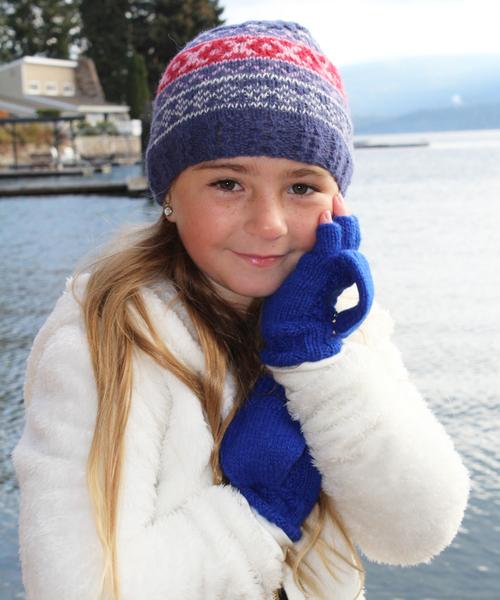
For quick projects like matching hat and mitten sets, opt for super bulky alpaca-blend yarns such as Pouf (50% Alpaca, 50% Highland Wool, 108 yards per 100g). These can be completed in just one or two evenings. When sizing hats, aim for "negative ease" - slightly smaller than the head circumference - so the stretchy fabric fits snugly.
These same textured techniques can also bring a modern, stylish twist to home decor projects.
Textured patterns are a fantastic way to add depth and visual interest to home decor. Designer Jake Canton describes how a simple K7, P1 pleated texture can create a striking, folded paper fan effect. This pattern not only enhances the look but also adds structural richness. For a 40-inch-wide throw, use sport-weight alpaca yarn and cast on a multiple of 8 + 7 stitches (about 319 stitches total) with 32- to 47-inch circular needles.
Double knitting is another great option for home projects, producing reversible, double-thick throws that are perfect for baby blankets or cozy couch throws. To make a 28-inch-wide blanket, cast on a multiple of 10 + 7 stitches, then double that number (294 stitches total). Choose 100% alpaca yarn for a luxurious drape, or alpaca-wool blends for added elasticity and stitch definition.
For table runners or other flat items, garter stitch or seed stitch borders can help prevent edge curling, a common issue with stockinette textures. Wet blocking is essential to set the folds and even out the tension, ensuring a polished finish.
Textured knit gifts made with alpaca yarn are both practical and thoughtful. Alpaca fiber is hypoallergenic, with minimal lanolin, making it an excellent choice for those with sensitive skin. Its insulating properties provide warmth without adding bulk, making it ideal for cowls, mittens, and scarves.
For baby showers, seed stitch blankets are a standout choice, showcasing alpaca's softness and texture definition. Winter holiday gifts like basketweave scarves and moss stitch cowls highlight alpaca's unique qualities. As Norman from Nimble Needles describes:
"It almost feels like it has some kind of innate buoyancy like the garment was hovering over your body".
To ensure longevity, include care instructions with each gift. For items like fitted hats or socks that require shape retention, alpaca-wool blends are a better choice than 100% alpaca, which may lack elasticity and sag over time. Premium hand-dyed alpaca yarn, priced around $20–$30 per 100g skein, adds a touch of luxury to these handmade creations.
Learning to master knit and purl stitches opens up endless possibilities for creating textured designs that are both visually striking and functional. As Andrea Lotz from Interweave explains:
"It's amazing what you can accomplish with the simplest stitches: knit and purl. A wealth of texture, patterning, and structural elements are possible using just the basics of knitting."
When paired with alpaca yarn, these stitches truly shine. Alpaca's stitch definition and natural drape elevate patterns to a professional level. Laura Ferguson, Designer at Purl Soho, highlights this beautifully: "This elegantly plied yarn is as articulate in a textured rib as it is in smooth stockinette stitch." Meanwhile, Joelle Hoverson, Founder and Co-owner of Purl Soho, describes alpaca's drape as "a drape like a warm waterfall."
Whether you're knitting a seed stitch baby blanket or a basketweave scarf, textured patterns add both interest and excitement to your projects, making each row more satisfying. Start with simple designs like garter ridges or moss stitch to build confidence, then move on to more intricate geometric patterns. Don’t forget to swatch first - alpaca’s density can affect your gauge and final results.
For detailed tutorials and project ideas, check out the resources at Alpaca Direct or their YouTube channel. Combining basic knit-purl techniques with the luxurious qualities of alpaca yarn opens the door to creating everything from quick, stylish accessories to timeless heirloom pieces that celebrate both your craftsmanship and the fiber's beauty.
To tell the difference between knit and purl stitches, focus on their shapes. Knit stitches resemble "V" shapes, with the yarn coming from the back of the work. Purl stitches, on the other hand, have a bumpy "U" shape, with the yarn coming from the front. Interestingly, the back of a knit stitch appears as a purl, and the back of a purl stitch looks like a knit. Paying attention to these details can make it easier to "read" your knitting. For more visual guidance, check out Alpaca Direct's YouTube tutorials.
Worsted weight alpaca yarn works wonderfully for textured stitch patterns. It provides an excellent mix of warmth and stitch clarity, making the intricate details of your designs pop beautifully.
To maintain the texture of alpaca while blocking, avoid completely soaking the fiber. Fully wetting alpaca can weaken it and cause it to lose its shape. Instead, try lightly spritzing or spraying the project with water. Then, pin it into the desired shape while it's damp or even dry. This approach helps preserve the texture by preventing over-saturation and minimizes the risk of distortion or flattening.

Comments will be approved before showing up.