Your Cart is Empty


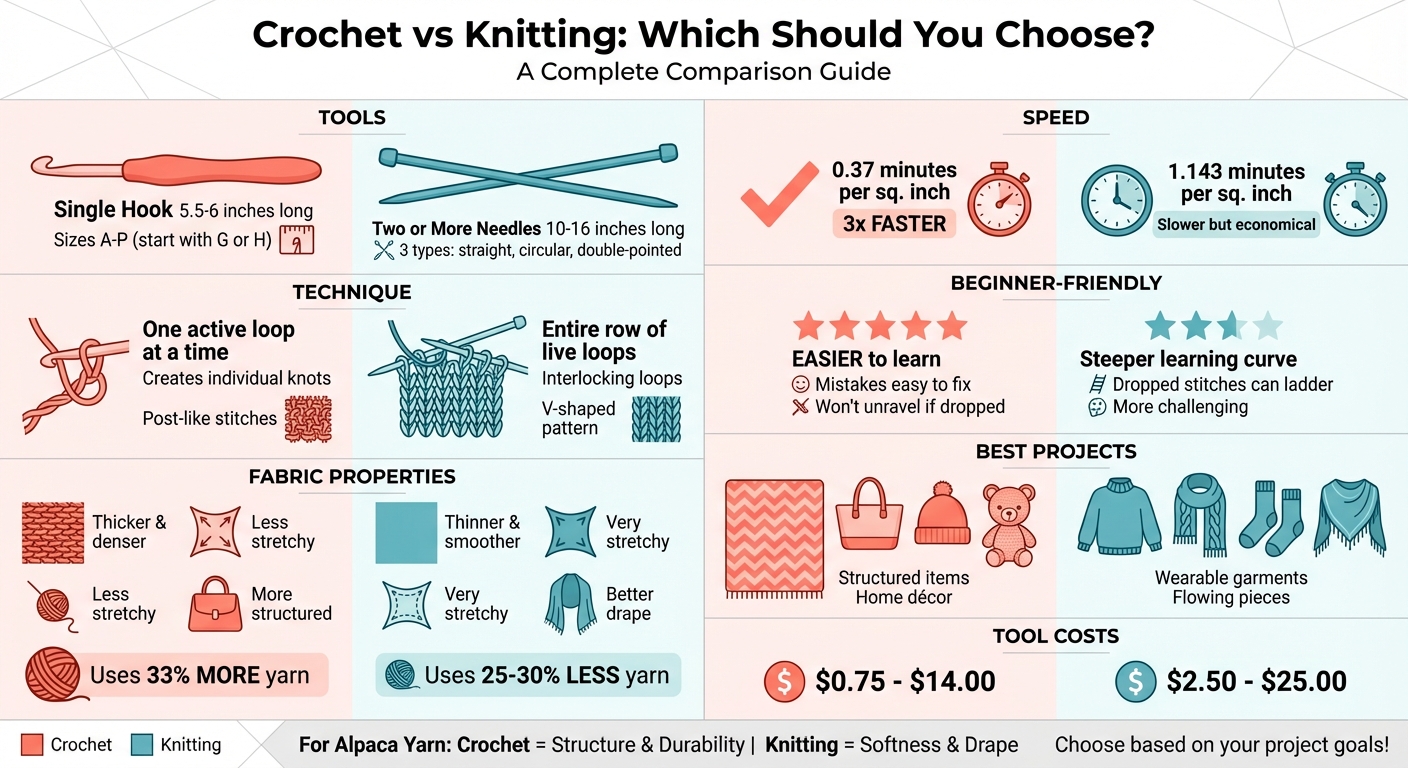
Crochet and knitting are two popular crafts for creating handmade items, but they differ in tools, techniques, and outcomes. Here’s a quick breakdown to help you decide:
Both crafts pair beautifully with alpaca yarn, known for its softness and warmth. Crochet provides durability and shape retention, while knitting highlights alpaca’s drape and texture. Your choice depends on your project goals and personal preferences.
| Feature | Crochet | Knitting |
|---|---|---|
| Tools | Single hook | Two or more needles |
| Fabric | Thicker, less stretchy | Thinner, more elastic |
| Speed | Faster | Slower |
| Yarn Usage | ~33% more yarn | Less yarn |
| Best For | Structured items (blankets, bags) | Wearables (sweaters, scarves) |
| Ease for Beginners | Simpler to learn | Steeper learning curve |
Whether you choose crochet or knitting, both offer rewarding ways to work with yarn and create beautiful, functional items.
Crochet vs Knitting: Complete Comparison Guide for Beginners
The most noticeable difference between crochet and knitting lies in the tools. Crochet relies on a single hook, which has a curved end to grab and pull yarn through loops. Knitting, on the other hand, uses two or more pointed needles that hold and transfer stitches back and forth. This core distinction influences everything from how you hold your materials to how you approach fixing mistakes.
Crochet hooks are compact, typically measuring between 5.5 and 6 inches long, with diameters ranging from 0.4 mm to 19 mm. In the US, hooks are sized using letters (A through P), with sizes G or H being a great starting point for beginners. Knitting needles, by contrast, are longer - straight needles can range between 10 and 16 inches - and come in three main styles: straight needles for flat projects like scarves, circular needles (connected by a flexible cord) for seamless items like sweaters or large blankets, and double-pointed needles (DPNs) for smaller circular projects like socks.
When working with alpaca yarn, which tends to be slippery, the material of your crochet hook can make a big difference. Metal hooks (like aluminum or steel) have a smooth surface that allows yarn to glide quickly, making them a favorite for experienced crocheters handling animal fibers. Wooden or bamboo hooks, on the other hand, create more friction, which is helpful for beginners trying to maintain control and avoid dropped stitches. Alpaca Direct offers individual hooks starting at just $0.75, including ergonomic options from brands like Knitter's Pride that are designed to reduce hand strain - especially useful for those with arthritis.
Alpaca Direct also provides a variety of knitting needles tailored to different skill levels and project needs. Bamboo and birch wood needles (such as Addi Bamboo or Brittany Birch) offer a natural grip, which helps keep slippery alpaca fibers in place. These are especially good for beginners using a size 8 (5 mm) needle. For more advanced knitters, metal needles made from stainless steel, like those from ChiaoGoo, offer a smooth surface for faster stitching with animal fibers.
Circular needles start at about $10.45, while interchangeable sets - offering multiple needle sizes with swappable tips and cables - range from $104.45 to $199.95. For smaller projects, such as alpaca socks, double-pointed needle sets are available starting at $10.45.
The way stitches are formed is a key factor that sets crochet and knitting apart, shaping not only the look and feel of the fabric but also how mistakes are handled. Crochet relies on a single hook to pull yarn through loops, creating individual knots one at a time. Knitting, on the other hand, uses two needles to create interlocking loops that are passed back and forth. These distinct methods influence everything from the fabric's appearance to how easy it is to fix errors.
In crochet, you usually work with just one active loop on the hook at a time. Each stitch is completed before moving on to the next, which makes the fabric secure and less prone to unraveling. Knitting, however, keeps an entire row of live loops active on the needles. Since each loop depends on the one below it, dropping a stitch can lead to unraveling into a "ladder" if left uncorrected.
Crochet's single-stitch method produces fabric with small knot-like or "post" stitches standing upright. Because each stitch is completed individually, the fabric is more stable and resists unraveling. This makes crochet a great choice for projects that need structure, like sturdy bags, blankets, or amigurumi (stuffed toys). However, this stability comes at a cost - crochet fabric tends to be thicker and less stretchy. It also uses about 33% more yarn than knitting for projects of the same size.
"Crochet also creates a 'double thick' fabric compared to knitting. The fabric tends to be super cozy and can also be a stiffer material compared to knit fabric." – Knitting.com
Knitting's interlocking loops create a "V" or braid-like pattern that results in a smoother, thinner fabric. This fabric drapes beautifully and offers natural stretch, making it ideal for garments like sweaters, scarves, and socks that benefit from a snug yet comfortable fit. However, the interdependence of stitches means that dropped stitches can unravel quickly if not fixed.
For those eager to learn the basics of either craft, especially with alpaca yarn, Alpaca Direct's YouTube channel (https://www.youtube.com/@AlpacaDirect) provides step-by-step tutorials to guide you through both knitting and crochet techniques.
The texture and durability of your project can vary significantly depending on whether you choose to crochet or knit. Crochet naturally creates a thicker, denser fabric because its stitches resemble small knots, offering a solid structure. In contrast, knitting produces a smoother, thinner fabric thanks to its interlocking loops. These differences influence key qualities like warmth, drape, and how well your project works with alpaca fiber, which has its own set of unique traits.
When it comes to stretch, knitting stands out. The interlocking loops in knitting allow for significant flexibility, enabling the fabric to stretch and bounce back into shape. On the other hand, crochet tends to be more rigid due to its knot-like structure. However, alpaca fiber presents a challenge for both methods because it has low stitch memory, meaning even flexible knitted fabrics may gradually lose their original shape over time.
"Knitting stitches are interlocking loops, and their construction means that each stitch is able to stretch quite a bit. Crochet stitches are more like knots, making them very solid." – Matt Spiers, Gathered
Alpaca fiber, known for being warmer yet lighter than sheep's wool, owes these qualities to its hollow fiber core. It's also hypoallergenic since it lacks lanolin. However, its tendency to lose shape underscores the importance of choosing the right technique for your specific project.
| Craft | Pros for Alpaca Projects | Cons for Alpaca Projects |
|---|---|---|
| Crochet | Creates a sturdy, warm fabric that holds its shape | Uses more yarn and can result in heavier fabric with less drape |
| Knitting | Produces soft, flexible fabric with excellent drape and texture | Prone to stretching or "growing" over time due to alpaca's low memory |
The dense, structured nature of crochet makes it a great option for alpaca projects that need to maintain their shape and provide warmth. This is why crochet is often favored for items like blankets, rugs, and bags. However, one downside is that crochet typically requires 25% to 30% more yarn than knitting for projects of the same size. Additionally, the fabric tends to have a stiffer drape, which may limit its use for garments requiring fluidity.
Knitting brings out the softness and natural drape of alpaca fiber, making it an excellent choice for garments like sweaters, scarves, and socks that benefit from a fabric that conforms to the body. To address alpaca's tendency to lose shape, many crafters blend it with wool or nylon for added stability. Despite its softness and flexibility, alpaca's hollow fibers ensure that even thick knitted items, like blankets, remain lightweight compared to those made with sheep's wool. These attributes make knitting an appealing choice for projects where comfort and texture are key considerations.
Crochet tends to be more beginner-friendly because it uses just one hook and manages a single active stitch at a time. This setup allows you to pause your project without worrying about stitches slipping off or unraveling. Knitting, however, involves coordinating two needles while keeping an entire row of live stitches active, which can feel a bit daunting for newcomers.
When it comes to fixing mistakes, crochet has a clear advantage. Each stitch in crochet locks the previous one in place, so even if you drop your hook, your work stays intact. To correct an error, you can easily pull back the yarn - often called "frogging" - to the point of the mistake and start again. Knitting, on the other hand, can be more challenging. A dropped stitch in knitting can unravel down multiple rows, creating a ladder effect that can be intimidating for beginners to fix. These differences make crochet a more forgiving craft for those just starting out, and we offer step-by-step tutorials on our YouTube channel to guide you through either craft.
"The simplicity of a single active stitch (or just a few at any one time) makes crochet an easier craft to approach as a newbie." – Knitting.com
Alpaca Direct provides beginner-friendly resources to help you get started in both crafts. Their YouTube channel includes tutorials like "How to Crochet For Absolute Beginners" and "How To Knit For Absolute Beginners", where instructor Kelley walks you through the fundamentals. If you're learning to fix dropped stitches, check out the "Fix-A-Stitch" video on their channel for helpful tips.
Crochet's single-hook method is forgiving and easy to manage. Since you're only working with one active loop, you can pause your project anytime without worrying about losing stitches. To keep your place, use stitch markers at the beginning and end of each row. For your first project, start with a size G or H hook and worsted weight yarn in a light color, which makes it easier to see and follow each stitch.
Knitting might have a steeper learning curve, but once you get the hang of it, the process can feel rhythmic and almost meditative. Keep a crochet hook nearby - it’s a handy tool for rescuing dropped stitches. Alpaca Direct suggests starting with size 8 (5 mm) wooden needles. Wooden needles offer more grip than aluminum ones, helping prevent stitches from slipping off as you work. For your cast-on row, use a slightly larger needle to maintain a loose tension before switching to the recommended size.
When deciding between crochet and knitting, especially with premium alpaca yarn, the type of project you want to create plays a big role. Knitting is perfect for garments that need a soft, flowing look - think sweaters, cardigans, or lace shawls. Alpaca's natural softness shines through in knitted pieces, as the thinner, more flexible fabric hugs the body and works wonderfully for items like scarves and cowls that sit close to the skin.
Crochet, by contrast, creates a thicker and sturdier fabric, making it ideal for items that need structure and durability. It's the go-to choice for hats, tote bags, textured blankets, or amigurumi toys. Crochet is also quicker for covering large surfaces; a 2022 Craftematics study found that double crochet stitches take just 0.37 minutes per square inch, compared to 1.56 minutes for knitted garter stitch.
"Alpaca wool is anecdotally softer and cozier than even mohair or merino... what to make with alpaca yarn includes anything warm and wearable - don't waste this deluxe yarn on home decor or amigurumi!" – Kristi Kittelson, Editor, AllFreeKnitting.com
For socks, it's best to use an alpaca blend with nylon or another synthetic fiber. Pure alpaca doesn't have the elasticity (or "memory") needed to keep socks from sliding down. Below are some project ideas tailored to the strengths of both knitting and crochet.
Crochet is unbeatable when structure and texture are priorities. Hats are a standout project, as the thicker fabric provides warmth without needing a lining. Plus, crochet's speed means you can finish a beanie in just a few hours. Bags and baskets also benefit from crochet's dense, non-stretchy fabric, which holds its shape even when loaded with heavy items.
Crochet's textured stitches make it ideal for creating visually interesting blankets, sturdy bags, and accessories like cowls or headbands. For amigurumi (stuffed toys), crochet's ability to form three-dimensional shapes is a major advantage. However, many experts recommend reserving premium alpaca yarn for wearable projects rather than decorative items.
Knitting is the top choice for projects that require elegance and drape. Sweaters and cardigans made with alpaca yarn are lightweight and comfortable, avoiding the bulkiness that can come with thicker fabrics. Knitted pieces also offer natural elasticity, making them perfect for ribbed cuffs, fitted sleeves, and stretchy necklines.
"Alpaca's natural drape also comes into play, allowing for garments that flatter the figure." – Alpaca by Design
Scarves and shawls are classic knitting projects, especially with alpaca yarn, which feels soft and smooth against the skin - without the itchiness often associated with traditional wool. For advanced knitters, alpaca yarn provides the perfect canvas for intricate lacework or Fair Isle designs, as its thinner fabric showcases stitch detail beautifully. Socks are another popular option, but an alpaca-nylon blend is recommended to ensure durability and prevent slipping. Alpaca Direct offers a variety of alpaca yarns and patterns to help bring these knitting ideas to life.
When deciding between crochet and knitting for your alpaca projects, it’s important to weigh both time and cost. Here’s the bottom line: crochet works up faster, but knitting stretches your yarn budget further. A 2022 Craftematics experiment compared the two crafts using 5mm tools and 400-stitch swatches (20x20). The findings? Double crochet took 0.37 minutes per square inch, while knitted stockinette required 1.143 minutes - making crochet about three times faster. However, crochet’s speed comes with a trade-off: it uses roughly 33% more yarn than knitting for the same project size.
"Knitting uses about 25–30 percent less yarn than crochet, making it a more economical choice." – Carrie Buchholz, Skillshare
Let’s talk yarn. Premium alpaca fibers like Berroco Ultra Alpaca ($14.45 per skein) or Cascade Eco Alpaca ($18.95 per skein) are popular choices. But for larger projects like blankets, crochet’s higher yarn consumption means you’ll need several extra skeins, significantly increasing costs. A May 2023 experiment by Amy Gunderson for Interweave highlighted this difference. Using Universal Yarn Deluxe Chunky and 6mm tools, she measured yarn efficiency with 20-stitch-by-20-row swatches. Stockinette stitch produced 3.03 square inches per gram, while single crochet managed only 1.89 square inches per gram - meaning stockinette used just 60% of the yarn required for the same area in single crochet.
When it comes to tools, both crafts are relatively affordable. Crochet hooks range from $0.75 to $14.00, while knitting needles cost between $2.50 and $25.00. For beginners, Alpaca Direct suggests starting with size 8 (5mm) straight wooden needles for knitting - wood offers better grip, reducing the chance of dropped stitches. For crochet, a size G or H hook is recommended. Knitting may require additional accessories like stitch markers ($2.50–$10.00) and stitch holders ($1.85–$7.00), but these are one-time investments.
Here’s a quick comparison:
| Feature | Crochet | Knitting |
|---|---|---|
| Speed (per sq. inch) | 0.37 minutes | 1.143 minutes |
| Yarn Consumption | Uses ~33% more | Uses 25–30% less |
| Tool Cost | $0.75–$14.00 | $2.50–$25.00 |
| Best For Budget | Quick projects, tight deadlines | Large projects, expensive yarns |
For beginners using yarns like Cascade 220 ($11.95) or Berroco Vintage ($9.95), knitting is the better choice for large-scale projects since it saves on yarn costs. Crochet, on the other hand, shines for smaller, time-sensitive items like hats or bags.
When deciding between crochet and knitting for your alpaca projects, it all comes down to the structure and drape you’re aiming for. Crochet is perfect for sturdy, structured items like blankets or home decor that need to maintain their shape. The dense, "double thick" fabric it creates makes it ideal for heavy throws that won’t sag over time. On the flip side, knitting highlights alpaca’s natural softness and drape, making it the go-to choice for flowing scarves, shawls, and sweaters that flatter the figure.
"Since knitted fabrics are stretchy, projects like blankets require careful seaming to avoid losing their shape. Additionally, due to the softness of the fibers, knitted alpaca stitches can be prone to drooping over time." – Alpaca by Design
To break it down, crochet is best for blankets, offering durability and structure. Knitting shines for wearables, taking full advantage of alpaca’s soft, flowing qualities. For tool recommendations, see the Tools section for the best needle and hook sizes.
For yarn, Berroco Ultra Alpaca ($14.45) is a great choice for its softness, while Berroco Vintage ($9.95) offers a machine-washable blend that’s beginner-friendly. If you’re a beginner, wooden or bamboo needles like Chiaogoo Bamboo provide better control compared to metal ones.
Looking for project ideas? Try knitting patterns like "Ausable" by Amy Christoffers or "Brick Sweater" by Clare Lee. For crochet, start with a simple cowl rather than a long scarf to avoid potential frustration. Keep in mind that alpaca lacks stitch memory, meaning it’s more prone to sagging than wool. For garments that need more structure, alpaca blends with wool, silk, or nylon are excellent options.
Crochet and knitting each bring their own strengths to the table, catering to different creative visions. Knitting, with its two-needle technique, produces a thinner, stretchier fabric that drapes beautifully - perfect for garments like sweaters, socks, and lightweight scarves. Plus, it typically uses about 25–30% less yarn than crochet. On the other hand, crochet, which uses a single hook, creates a thicker, more durable fabric that’s ideal for blankets, toys, and home décor.
For beginners, crochet can feel less intimidating since you’re only managing one tool instead of two. Knitting, however, offers a natural elasticity and drape that make it a favorite for wearable projects. Ultimately, the best choice depends on your project goals and personal preferences.
When working with alpaca yarn, these differences become even more apparent. Knitting enhances alpaca’s soft, fluid qualities, while crochet provides a more structured fabric that helps counteract alpaca’s natural tendency to stretch over time. Both techniques highlight unique aspects of this luxurious fiber.
Ready to dive in? Check out Alpaca Direct's YouTube channel for step-by-step tutorials on both knitting and crochet. You’ll also find a curated selection of premium alpaca yarns and tools to bring your projects to life.
Yes, it’s absolutely possible to learn both crochet and knitting at the same time - it all comes down to your learning style and how much time you can dedicate. While both crafts involve working with yarn, they use different tools and techniques. Starting with one can help you develop basic skills, but diving into both simultaneously can be equally rewarding. Many beginners find online tutorials, such as those on Alpaca Direct’s YouTube channel, a helpful way to ease into both crafts at their own pace.
For those just starting out, a smooth, medium-weight yarn like worsted weight alpaca is a great choice. Its natural stretch makes it easier to learn and helps keep your stitches consistent. Plus, alpaca yarn is known for being soft, warm, and easy to work with - perfect for beginners. Look for an option that's both affordable and durable, so you can unravel and redo your work without worrying about damaging the yarn. For extra guidance, Alpaca Direct provides beginner-friendly yarns and offers helpful tutorials on their YouTube channel to get you started.
To keep your alpaca projects from stretching out of shape, it's important to block them properly. Start by wetting the finished piece, then reshape it and pin it flat to dry. This process helps set the dimensions and ensures stability.
Another tip is to choose yarns that have good elasticity and avoid working with loose tension. Maintaining consistent tension while crafting and taking the time to block your project will go a long way in preserving its shape and preventing sagging as time goes on.

Comments will be approved before showing up.