Your Cart is Empty



Alpaca yarn is a top choice for winter crafting due to its warmth, softness, and durability. Its hollow-core fibers trap heat effectively, making it warmer yet lighter than traditional wool. Plus, it’s hypoallergenic, making it ideal for sensitive skin. Whether you’re knitting scarves, hats, or blankets, alpaca yarn offers comfort and style for cold weather.
Here’s a quick rundown of 10 winter projects you can create with alpaca yarn:
Alpaca yarn’s unique properties make these projects both functional and stylish for winter. Choose a project that fits your skill level and enjoy the benefits of this luxurious fiber.
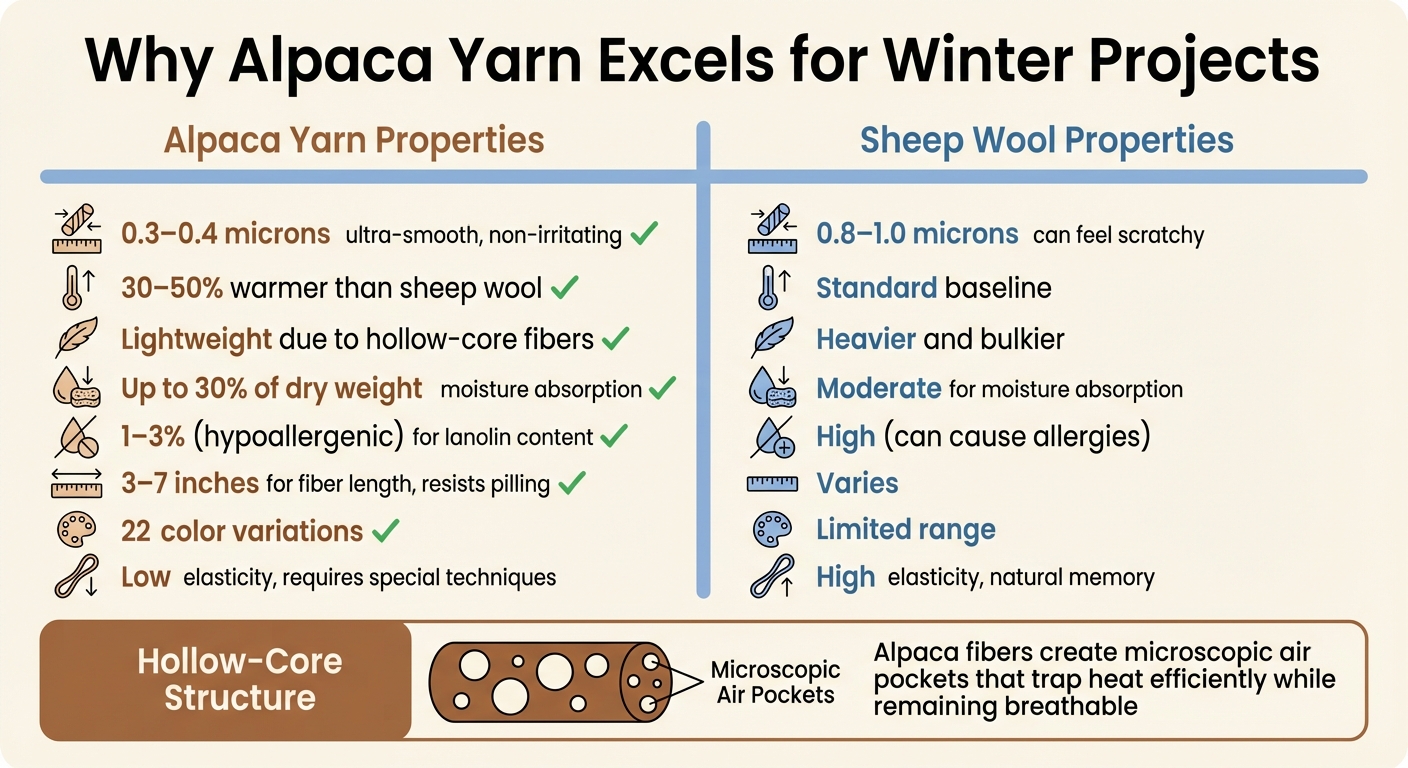
Alpaca Yarn vs Sheep Wool: Properties and Benefits Comparison
An alpaca scarf is a fantastic choice for a first winter knitting project. Thanks to its hollow-core fibers, alpaca yarn traps warmth through microscopic air pockets, offering excellent insulation without the bulk. This makes it a go-to accessory for keeping your neck warm in colder months.
What sets alpaca fibers apart is their gentleness. With scales measuring just 0.3–0.4 microns - compared to sheep wool's 0.8–1.0 microns - they're far less likely to irritate sensitive skin. To achieve the perfect balance of warmth and drape, use sport-weight yarn with US 3 (3.25 mm) to US 5 (3.75 mm) needles.
"Season Alpaca's grade of fiber is the most prized for softness. 'Baby' refers not to the age of the animal it comes from, but to the fineness of its fiber, and 'super' means that the fiber has been further sorted for quality." - Lili Tobias, Customer Service Coordinator, Purl Soho
Alpaca yarn’s durability is another reason it shines. With a staple length of 3–7 inches, it resists pilling and breakage, while its ability to absorb up to 30% of its weight in moisture ensures added comfort. This combination of softness and strength makes it a long-lasting choice for winter wear.
For a polished look, consider a 2x2 ribbing pattern to introduce stretch and texture, or opt for brioche stitches if you want extra warmth. After knitting, wet block your scarf by soaking it in cool water with mild soap for 15–30 minutes. Lay it flat to dry to even out the stitches and emphasize alpaca’s beautiful drape.
A chunky alpaca beanie is the perfect combination of warmth and speed. With thick yarn and simple techniques, you can whip up a cozy hat in just a few hours - ideal for last-minute gifts or when the cold weather hits unexpectedly. To get started, you'll need size US 13 (9 mm) circular needles (16 inches long) and about 100–200g of chunky alpaca yarn, which comes out to roughly 50–100 yards total. Thanks to alpaca's natural properties, this project is not only quick but also incredibly warm.
The secret to alpaca’s warmth lies in its hollow-core fiber. This unique structure traps heat without adding weight, making it a top choice for winter wear. As Amit Jivani from Alpaca Direct puts it, "Alpaca itself is a hollow core fiber. So, when warmth really matters, alpaca is my fiber of choice". This quality ensures that your beanie isn’t just warm - it’s exceptionally comfortable to wear, even on the coldest days.
Another standout feature of alpaca yarn is its smooth, soft texture. Its ultra-fine fiber scales provide a silky feel, while the low lanolin content (just 1–3%) makes it hypoallergenic, making it a great option for anyone with sensitive skin.
However, alpaca yarn does have one quirk: it lacks elasticity. To keep your beanie from stretching out over time, consider knitting the brim with negative ease or incorporating a bit of elastic thread for added durability. A simple 1x1 ribbing pattern works well for the brim, ensuring a snug fit, while the rest of the hat can be knit in stockinette stitch. Basic decreases, like K2TOG, will shape the crown nicely. When you’re done, lightly mist the finished beanie with water and shape it by hand. Avoid soaking it, as this helps maintain its structure.
This chunky alpaca beanie project is a great way to stay warm while enjoying the benefits of this luxurious fiber.
If you loved the alpaca beanie, mittens with a cable stitch are the next step to elevate your winter wardrobe. These mittens pair the intricate texture of cable stitching with alpaca's naturally insulating fibers, creating a cozy, stylish option for chilly hands.
What makes alpaca perfect for this project? Its hollow-core fibers provide excellent insulation, while the soft texture is gentle enough for even the most sensitive skin.
To get the best results, opt for chunky alpaca yarn or double up on lighter-weight yarns like Baby Alpaca to achieve the right thickness. Choose needles that can handle the detail of cable patterns. Start with a 2x2 ribbed cuff about 2.5–3 inches long, then work your cable pattern - such as C4B (cable four back) or C4F (cable four front) - on the back of the hand. Keep the palm in plain stockinette stitch for extra comfort.
Since alpaca yarn has limited stretch, it’s a good idea to knit tightly using smaller needles (US 4 or 5). Alternatively, consider an alpaca/wool blend for better structure. For a polished finish, use a "no-hole" method for the thumb gusset and lightly steam the mittens to set the cable design and smooth out any fuzziness.
An infinity cowl is the perfect winter accessory, showcasing alpaca yarn’s ability to provide warmth without weighing you down. Thanks to the hollow-core fibers in alpaca yarn, this type of cowl traps heat efficiently, keeping you cozy on frosty mornings while remaining comfortable indoors without feeling bulky or restrictive.
What truly sets alpaca yarn apart is its smooth texture. Unlike sheep wool, alpaca yarn is much gentler on the skin, significantly minimizing any scratchy or prickly sensation. Designer Laura Ferguson from Purl Soho highlights this beautifully:
"a twisted rib pattern stands tall to protect the back of the neck, while a stockinette front gently drapes below the chin".
This thoughtful design ensures a blend of structure and softness, making infinity cowls both practical and comfortable for all-day wear.
To craft the ideal infinity cowl, opt for worsted-weight alpaca yarn with a multi-strand, eight-ply structure. This provides the cowl with enough body to maintain its shape over time. Using textured patterns like twisted ribbing or slipped stitches will add thickness, boosting insulation. Since alpaca yarn has minimal elasticity, knit with a relaxed tension and bind off loosely to ensure the cowl stays stretchy and easy to slip on and off.
For care, hand wash your cowl in warm water with a mild detergent, then lay it flat to dry. After the first wash, wet block it to set the stitches and enhance the overall finish. This combination of thoughtful design and proper care results in a stylish, functional winter essential you’ll reach for again and again.
Adding a classic alpaca sweater to your winter wardrobe feels like the next step after cozy scarves and hats. This sweater provides incredible warmth without the heaviness, thanks to microscopic air pockets that trap heat while allowing breathability. According to Alpaca Collections, alpaca sweaters are 30–50% warmer than sheep's wool. It’s an excellent choice for layering during colder months, offering both function and style.
One standout feature of alpaca sweaters is their natural hypoallergenic quality. Since they lack lanolin, they’re gentle on sensitive skin, making them a comfortable option for nearly everyone. Joelle Hoverson, founder of Purl Soho, perfectly describes the luxurious feel:
"Alpaca, with its long fibers, is slightly downier than merino. It is also heavier and denser than merino, which means a super cozy Pullover with a drape like a warm waterfall."
This graceful drape not only enhances comfort but also elevates the overall look, striking a balance between practicality and sophistication.
Durability is another hallmark of alpaca sweaters. The long, silky fibers resist pilling, retain their shape, and even handle damp conditions well. One reviewer, Virginia, shared her experience: "This sweater is soft and comfortable and I love the colors... It never pills, and fits just right." These qualities ensure your sweater remains a reliable favorite season after season.
When choosing an alpaca yarn, look for options that combine warmth and resilience. Stitch patterns like ribbing, cables, or seed stitches highlight alpaca’s excellent stitch definition while adding texture and visual interest. For care, hand wash your sweater in cold water with mild detergent, lay it flat to dry, and store it folded with cedar or lavender sachets to protect against moths.
An alpaca throw blanket is a fantastic way to expand on the cozy charm of alpaca sweaters, offering a larger project that’s both functional and luxurious. Thanks to the unique properties of alpaca fiber, these blankets are perfect for chilly evenings, providing warmth without making you feel overheated. This is due to the fiber's microscopic air pockets, which trap heat efficiently.
One of the standout features of alpaca throws is their incredible softness. Unlike traditional wool, alpaca fibers have cuticle scales that protrude only 0.3 to 0.4 microns. This creates a smooth texture that feels gentle against even the most sensitive skin. Over time, high-quality alpaca blankets become even softer with regular use.
When crafting an alpaca throw, durability is key. Since 100% alpaca fiber lacks the natural elasticity of sheep wool, it’s important to use multi-strand or plied yarns - like an eight-ply structure - to ensure a stable and balanced fabric. This approach enhances stitch definition and offsets the fiber's limited stretch. You can also blend alpaca with wool or knit with two strands held together to improve resilience and prevent sagging. For modular designs, using the mattress stitch to join individual blocks creates a seamless and sturdy finish that can handle the blanket’s weight without compromising its appearance.
Certain stitch patterns work particularly well with alpaca fiber. Brioche stitches highlight the fiber’s natural loft, while Fair Isle colorwork adds visual interest and structural integrity through the floats, which provide extra support. This combination of techniques enhances both the blanket’s durability and its aesthetic appeal.
To keep your alpaca throw in excellent condition, hand wash it in cold or warm water with a mild detergent. Gently roll it in a towel to remove excess water, then lay it flat to dry - avoid using a dryer at all costs. When storing, fold the blanket and place it in a cool, dry area, using cedar or lavender to deter moisture and insects. With proper care, your alpaca throw can become a cherished item that lasts for generations.
Textured alpaca leg warmers are the perfect blend of style and practicality, especially for chilly winter days. Made from alpaca yarn, known for its exceptional warmth and soft feel, these leg warmers are a go-to accessory for layering under boots or over leggings. The secret to crafting a standout pair lies in the stitch patterns. Cable stitches not only add visual flair but also increase thickness by trapping heat in their twisted design. Meanwhile, brioche stitch creates a plush, insulating fabric that maximizes alpaca's natural thermal properties. As Norman from Nimble Needles explains:
"Voluminous stitches, like brioche stitch, can be a fabulous and very warm option, in my opinion."
Alpaca fibers are naturally hollow, forming air pockets that trap heat effectively. They can also absorb up to 30% of their dry weight in moisture, keeping your legs warm without feeling damp or clammy. Plus, the smooth texture of alpaca yarn ensures comfort, making it a great choice for those with sensitive skin.
Since pure alpaca lacks the elasticity of wool, it's essential to incorporate ribbed cuffs and use smaller needles to create a denser fabric that holds its shape over time. For a slouchy, trendy look, aim for a finished length of around 20 inches. Start with US #8 needles for the cuff and switch to US #10 needles for the main body of the leg warmer.
To ensure a snug fit, try threading a thin elastic band along the top row. When it comes to care, hand wash your leg warmers in warm water with a mild detergent and lay them flat to dry for best results.
An alpaca ear warmer headband is a quick and practical winter project, perfect for those chilly days when a full hat feels too much but your ears still need extra warmth. The secret to its effectiveness lies in alpaca fiber's hollow core, which creates tiny air pockets that efficiently trap heat. As The Alpaca Yarn Co. explains:
"Alpaca is a hollow core fiber so it keeps you warmer than wool when you need to be warm, but breathes when you need to be cool."
What sets alpaca apart for headbands is its smooth, soft fibers, making it gentle on sensitive skin. Unlike sheep wool, whose outer scales protrude 0.8 to 1.0 microns, alpaca scales are much finer at just 0.3 to 0.4 microns. This means no itching or irritation around your forehead or ears.
To ensure your headband stays in place, make it 1–2 inches smaller than your head circumference. This slight difference allows for the stretch needed to create a snug fit. For faster crafting, use bulky alpaca yarn with a Size N crochet hook or opt for worsted-weight yarn with US 7–8 needles. Since pure alpaca yarn can stretch over time due to its lack of "memory" (unlike wool), incorporating textured stitches like cables or ribbing helps maintain its shape.
When finishing your project, avoid soaking the headband, as it may lose its structure. Instead, lightly mist it with water and gently shape it by hand. For a polished, seamless finish, use a provisional cast-on and close the ends with a Kitchener stitch. This avoids creating a bulky seam that might press uncomfortably against your head. The result? A lightweight, breathable accessory that can absorb up to 30% of its weight in moisture without ever feeling damp. It's a stylish and functional addition to your winter wardrobe, and a perfect gateway to exploring more alpaca-based creations.
Alpaca slipper socks are a go-to choice for cold-weather comfort, thanks to their hollow fibers that form countless insulating air pockets. This natural design keeps your feet warm without adding bulk, making them perfect for cozying up on chilly days. It's no wonder alpaca has become a staple for winter wear.
But warmth isn't the only thing alpaca excels at - its moisture-wicking ability is another standout feature. The fibers actively move moisture away from your skin, keeping your feet dry even during extended use. As Pacas, Inc. explains:
"Alpaca fibers wick and push away moisture keeping your body dry and warm."
Verified buyer Melissa C. shared her experience:
"I've had my Pacas for 3 years now, and they don't wear out! ... The best part is that there are no holes worn through."
To enhance durability, especially in high-wear areas like heels and toes, consider reinforcing these spots with a thin nylon or wool thread. Double-knitting the sole using a slip-stitch pattern (Row 1: K1, SL1WYIB, K1) also adds extra strength. Since alpaca fibers lack the elasticity ("memory") of sheep wool and can stretch over time, these reinforcements are crucial for long-lasting wear.
What makes alpaca even more appealing is its softness. Its cuticle scales are smaller - just 0.3 to 0.4 microns compared to the 0.8 to 1.0 microns of sheep wool - resulting in a smoother, itch-free texture. Plus, with only 1–3% lanolin content, alpaca is naturally hypoallergenic.
For a quick and rewarding project, try knitting the popular "Mrs. Hupps' Slippers" pattern with chunky alpaca yarn. Use Judy's Magic Cast-On for a seamless finish, and aim for a gauge of 9 stitches and 12 rows per 2 inches in stockinette for accurate sizing. Once complete, hand wash your socks in warm water with a mild detergent, then lay them flat to dry to maintain their shape and prevent stretching. The result? A pair of slipper socks that keep your feet warm, dry, and luxuriously comfortable all winter long.
An alpaca shawl brings both sophistication and warmth to any winter outfit. Thanks to the hollow core structure of alpaca yarn (in fibers above 20 microns), it creates tiny air pockets that trap heat without adding bulk. Knitting expert Norman from Nimble Needles highlights this feature, noting how it keeps the fabric lightweight yet cozy.
What truly makes alpaca shawls stand out is their natural drape. As Mary Auxier from Purl Soho describes, drape means the fabric "can't stand up on its own. Instead, it puddles and flows around you". This flowing quality gives alpaca shawls an elegant silhouette that sheep wool simply can't match. After washing, alpaca yarn often develops a soft halo - a gentle, fuzzy texture that further enhances its luxurious feel.
For larger shawls, consider blends of alpaca with wool, silk, or tencel to improve shape retention. Pure alpaca lacks the elasticity, or "memory", needed to bounce back after stretching. Blends help maintain the shawl's form over time. For instance, the Klaziena Shawl pattern by Kirsten Bishop uses an alpaca/tencel blend with a 3.5 mm hook to achieve a stable 63-inch wingspan. This ensures the shawl holds its structure and is easier to care for.
When selecting an alpaca shawl, look for high-quality grades like Baby Alpaca (19–20 microns) or Royal Alpaca (18 microns or below). These finer fibers provide a smooth, soft texture that’s gentle on the skin and hypoallergenic.
To care for your shawl, hand wash it in warm water with a mild detergent and lay it flat to dry. Avoid hanging it while wet or storing it on hangers, as the weight can cause the fabric to stretch. To prevent surprises, wash and block a swatch with light weights before you begin to gauge how much the fabric might stretch.
From cozy scarves to elegant shawls, alpaca yarn brings a special touch to your winter wardrobe. Its hollow core traps heat effectively, while the ultra-fine fiber scales (measuring just 0.3–0.4 microns) provide an incredibly smooth texture that feels luxurious against the skin.
Alpaca yarn is also highly practical - it can absorb up to 30% of its dry weight in moisture without feeling damp, making it a great choice for snowy strolls or rainy-day commutes. Plus, with only 1–3% lanolin, it's hypoallergenic and gentle enough for even the most sensitive skin. Whether you're knitting a warm beanie, soft mittens, or an elegant shawl, alpaca yarn's natural qualities make it a standout option.
Beyond its functional benefits, alpaca yarn offers a touch of luxury at a price point that works for all skill levels.
Pick a project that suits your abilities and winter needs, and don't forget to care for your creations properly - hand wash them in lukewarm water and lay them flat to dry. With 22 natural colors to choose from and impressive durability, your alpaca pieces will keep you cozy for years to come.
Alpaca yarn stands out as a fantastic option for winter projects thanks to its naturally hollow fibers. This structure helps trap heat efficiently, providing excellent warmth and insulation. It's the perfect material for creating cozy scarves, hats, mittens, and blankets to keep you snug during chilly weather.
Beyond its warmth, alpaca yarn is prized for being incredibly soft and lightweight. It delivers comfort without adding bulk, making it a pleasure to wear. Plus, it’s hypoallergenic - unlike sheep wool, alpaca yarn doesn’t contain lanolin, making it a friendly choice for those with sensitive skin. These features combine to make alpaca yarn an ideal pick for crafting winter essentials that feel as good as they look.
To keep your alpaca yarn creations looking their best, treat them with care and wash them gently. Always hand wash in cool water with a mild detergent, steering clear of harsh chemicals like bleach or fabric softeners that can harm the fibers. After washing, lay your item flat on a clean towel, reshape it to its original size, and allow it to air dry naturally. Be sure to avoid direct sunlight or using a tumble dryer, as both can damage the material.
Since alpaca yarn naturally resists dirt and odors, frequent washing isn’t typically needed. Often, simply airing out your garment is enough to freshen it up. To avoid pilling or stretching, handle knitted pieces gently and minimize agitation. For especially delicate items, professional dry cleaning is a safe alternative. By following these steps, your alpaca yarn projects will remain soft, cozy, and stunning for years to come.
Alpaca yarn is cherished for its incredible softness and the warmth it provides. However, it has less elasticity compared to some other fibers, so it requires a bit of extra attention to help your projects maintain their shape over time. A simple tip? Knit with slightly looser tension. This reduces the risk of overstretching the yarn, which can affect its flexibility.
If you're working on intricate designs like lace or textured stitches, take your time and avoid pulling the stitches too tightly. Tight stitches can distort the pattern and make the design less defined. After finishing your project, blocking can work wonders. Alpaca yarn responds beautifully to gentle stretching and shaping during the blocking process, allowing your piece to hold its structure while showing off its natural drape.

Comments will be approved before showing up.