Your Cart is Empty


Understanding knitting needle sizes is crucial for creating well-fitted, beautiful projects. Here's what you need to know:
For beginners, start with US size 8 (5.0 mm) wooden needles and worsted yarn to practice basic stitches. Always check your yarn label for recommended sizes and tension guidelines.
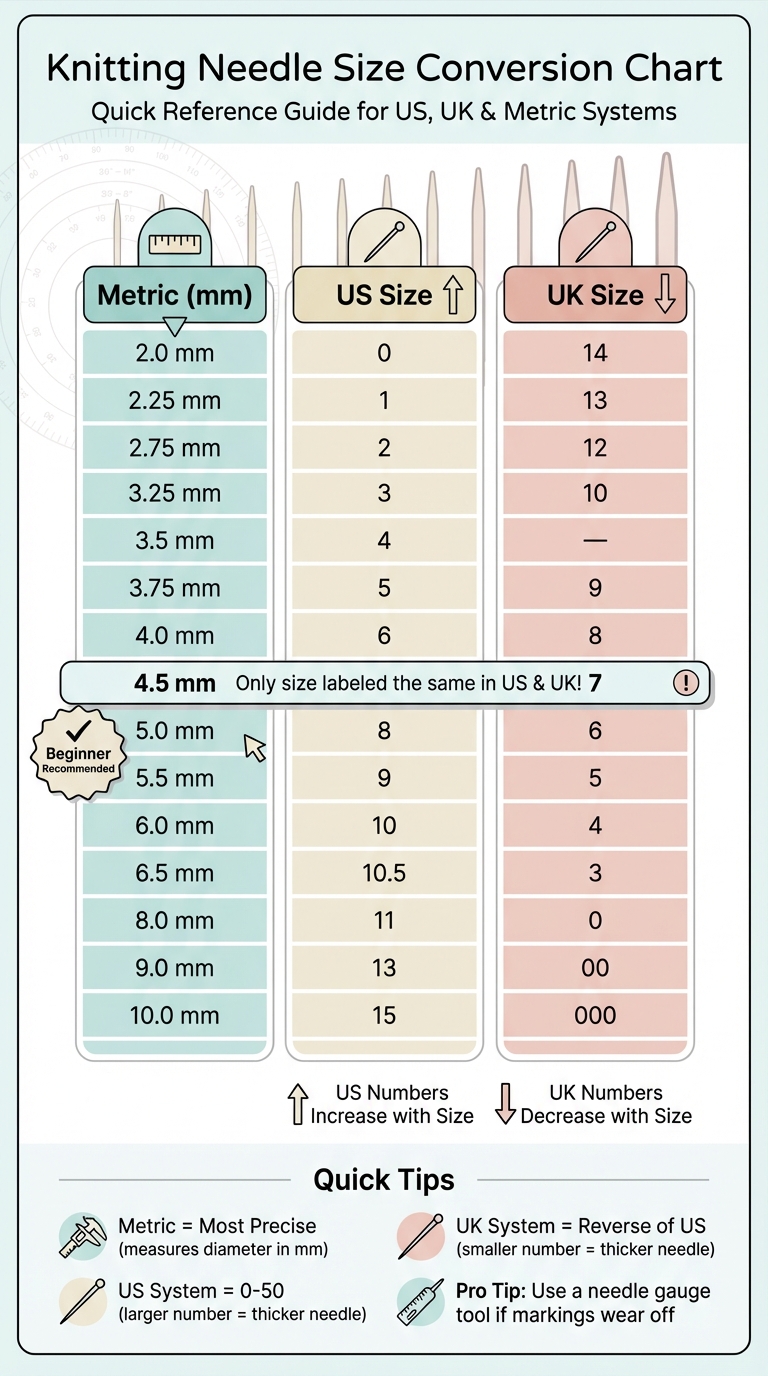
Knitting Needle Size Conversion Chart: US, UK, and Metric Sizes
Knitting needles come in three sizing systems used worldwide, and they don’t always align. Knowing how each system works can save you from ordering the wrong needles or misinterpreting a pattern.
The metric system is the simplest - it measures the needle shaft's diameter in millimeters. For example, a 5.0 mm needle is exactly 5.0 mm thick, whether it’s made of bamboo, metal, or plastic. This precision makes it a favorite in Europe, Canada, and among many modern knitters.
The US system, on the other hand, assigns numbered sizes (ranging from 0 to 50), where larger numbers mean thicker needles. Meanwhile, the UK system - also called the Imperial or British system - works in reverse: smaller numbers indicate thicker needles. For instance, a UK size 6 needle is thicker than a UK size 8. Knitting expert Sarah E. White explains:
The British and American versions are opposites, with the American system starting with low numbers for needles with smaller diameters and working up to larger numbers for larger diameters, while the British system starts with high numbers for low diameters and low numbers for high diameters.
Interestingly, only a 4.5 mm needle is labeled as "Size 7" in both the US and UK systems. For other sizes, you’ll need to convert. Over the last few decades, the UK system has been largely replaced by metric measurements, so you’re more likely to encounter UK sizes in vintage patterns.
If your needle markings have worn off, a needle gauge tool can help. This tool has holes in precise millimeter increments, allowing you to measure your needle’s diameter by finding the snug fit.
Here’s a quick conversion chart for easy reference:
When working with patterns from different countries or shopping online, use this chart to convert needle sizes:
| Metric (mm) | US Size | UK Size |
|---|---|---|
| 2.0 mm | 0 | 14 |
| 2.25 mm | 1 | 13 |
| 2.75 mm | 2 | 12 |
| 3.25 mm | 3 | 10 |
| 3.5 mm | 4 | - |
| 3.75 mm | 5 | 9 |
| 4.0 mm | 6 | 8 |
| 4.5 mm | 7 | 7 |
| 5.0 mm | 8 | 6 |
| 5.5 mm | 9 | 5 |
| 6.0 mm | 10 | 4 |
| 6.5 mm | 10.5 | 3 |
| 8.0 mm | 11 | 0 |
| 9.0 mm | 13 | 00 |
| 10.0 mm | 15 | 000 |
Double-check your yarn label and confirm whether your pattern uses US or UK sizing to avoid any confusion.
Getting the right balance between needle size and yarn weight is essential for achieving the fabric texture you want. The thickness of your yarn determines the needle size you should use - thin yarn works best with smaller needles for tighter, more controlled stitches, while thick yarn pairs well with larger needles to create stable, well-balanced fabrics. If your needle is too small, you’ll end up with dense, stiff stitches, while an oversized needle can lead to loose, unstable fabric with visible gaps.
To make things easier, yarn is typically grouped into standard weight categories - ranging from delicate lace to chunky jumbo. Yarn labels usually include a recommended needle size range to help you get started. For example, worsted weight yarn is a popular choice in the U.S. and an excellent option for beginners.
Here’s a quick guide to match yarn weights with needle sizes and common projects:
| Yarn Weight | Metric Size | US Size | Typical Projects |
|---|---|---|---|
| Lace | 1.5–2.75 mm | 000–2 | Lace shawls, doilies |
| Fingering / Sock | 2.25–3.25 mm | 1–3 | Socks, baby clothes, lightweight tops |
| Sport | 3.25–4.0 mm | 3–6 | Cardigans, baby clothing |
| DK (Double Knit) | 3.75–4.5 mm | 5–7 | Sweaters, scarves, hats |
| Worsted / Aran | 4.5–5.5 mm | 7–9 | Blankets, winter sweaters |
| Bulky / Chunky | 6.0–8.0 mm | 10–11 | Quick hats, cowls, rugs |
| Super Bulky | 9.0–12.0 mm | 13–17 | Chunky scarves, heavy blankets |
| Jumbo | 12.75 mm+ | 17+ | Arm-knit looks, home decor |
For example, lace weight yarn can produce 8 or more stitches per inch, while jumbo yarn might only give you 1 to 1.5 stitches per inch. Always check the yarn label for the manufacturer’s recommended needle size and tension guidelines.
Once you’ve chosen a needle size based on your yarn weight, the next step is to fine-tune for your personal knitting tension. Everyone knits differently, so it’s important to knit a test swatch before diving into your project. The standard swatch size is 10 cm x 10 cm (4 in x 4 in). By measuring your swatch, you can see if your stitch count aligns with your pattern’s requirements.
These small adjustments can make a big difference. For instance, if a pattern calls for 21 stitches per 4 inches for a 40-inch sweater but your swatch shows just 19 stitches, your finished sweater could end up closer to 44 inches.
The material of your needles also affects tension. Bamboo and wood needles provide extra grip, which helps tighten stitches, while metal needles allow for smoother, looser knitting. If you knit tightly, metal needles might help relax your fabric. On the other hand, bamboo needles are great for knitters with a looser style who want more control.
For projects like shawls that need extra drape, try using a needle one size larger than the yarn label suggests. This creates a looser, airier fabric with better flow.
Want a visual walkthrough? Check out our tutorial videos on matching needle size to yarn weight and adjusting gauge on our YouTube channel: https://www.youtube.com/@AlpacaDirect.
Needle length plays a crucial role in how manageable your project is and how well your stitches are spaced. Using needles that are too short can overcrowd your stitches, while overly long needles can stretch them out - especially in small circular projects. Just like needle size impacts your gauge, needle length is essential for keeping your stitches under control.
The type of needle you choose also influences how you handle your project. Each style has its advantages depending on what you're working on.
Straight needles are the traditional choice. These needles have a pointed end and a stopper on the other, making them perfect for flat knitting (working back and forth in rows). They typically come in 10-inch and 14-inch lengths and are great for smaller projects like scarves or dishcloths. However, for larger projects, they can feel cumbersome since the entire weight of your work rests on your wrists.
Circular needles are a versatile option, consisting of two needle tips connected by a flexible cord. Measured from tip to tip, they range from 9 inches to 60 inches in length. These needles are suitable for both flat and circular knitting. According to Emily from The Creative Folk:
Circular needles are the most versatile, suitable for both flat garments and knitting in the round.
The flexible cord takes the weight off your wrists and lets it rest in your lap, making these needles a great choice for heavier projects like blankets or sweaters.
Double-pointed needles (DPNs) are short needles with points on both ends, usually between 4 and 8 inches long. They come in sets of four or five and are used for small, circular projects like socks, mittens, or cuffs. However, many knitters now prefer the "Magic Loop" method, which uses a long circular needle for similar tasks.
Now that you know your needle options, it’s time to match the right length to your project. For circular knitting, your needle should be slightly shorter than the circumference of your project to prevent the stitches from stretching too thin to join in the round. For flat knitting, make sure the needle is long enough to comfortably hold all of your stitches.
Here’s a quick guide to help you choose the right needle length:
| Project Type | Recommended Needle Type | Recommended Length |
|---|---|---|
| Socks, mittens, cuffs | DPNs or Circular (Magic Loop) | 5″–8″ (DPNs) or 40″+ (Circular) |
| Baby hats, sleeves | Short Circular or DPNs | 9″ |
| Adult hats, baby sweaters | Circular | 16″ |
| Sweater bodies | Circular | 24″–29″ |
| Scarves | Straight or Circular | 10″–14″ (Straight) or any (Circular) |
| Shawls, heavy afghans | Circular | 36″ |
| Bed-size blankets | Circular | 40″–60″ |
For larger flat projects like blankets, long circular needles (36 inches or more) are ideal, even if you’re knitting flat. They help keep a large number of stitches organized and easier to handle. If you’re knitting a hat, start with a 16-inch circular needle for the main body, then switch to DPNs or use the Magic Loop method to handle decreases at the crown.
If you want flexibility, consider investing in an interchangeable needle set. These sets let you mix and match needle sizes with different cord lengths, giving you plenty of options without buying multiple individual needles. For more tips and tutorials, check out our YouTube channel: https://www.youtube.com/@AlpacaDirect.
If you're just starting out, US size 7–9 needles (4.5 mm to 5.5 mm) paired with worsted-weight yarn are a great choice. These sizes create stitches that are easy to see and handle, making the learning process smoother. A popular beginner pick is US size 8 (5.0 mm), as it strikes a good balance for most projects. Bamboo or wooden needles are highly recommended for their natural grip, which helps keep stitches from slipping off. As Yarn.com puts it:
Needles made from wood or bamboo maintain a grip on the yarn, perfect for giving new knitters control over their yarn.
If you find your stitches are too tight, switching to smoother needles, like aluminum or nickel-plated ones, can help.
After selecting the right needle size and material, it’s time to think about tools for your first project. For something simple, like a scarf, 9- to 10-inch straight US size 8 (5.0 mm) bamboo needles work well for mastering basic stitches. If you’re making a dishcloth, try US size 6 (4.0 mm) needles with cotton yarn. For those who find straight needles tough on the wrists, circular needles with a flexible cord (24 to 32 inches long) can be a more comfortable option.
Square-shaped needles are another great alternative if hand fatigue is a concern - they’re designed to be ergonomic and easier to grip.
Lastly, always check the yarn label for the recommended needle size. For worsted-weight yarn, the suggested range is typically 4.5 mm to 5.5 mm.
Start by examining the yarn label for its weight category (ranging from 0 to 7) and the recommended needle size, provided in both US and metric measurements. Be sure to confirm which sizing system your pattern follows. For example, a US size 6 needle is 4.0 mm, but a 6 mm needle corresponds to roughly a US size 10.
Choose the needle type based on your project. For flat pieces, straight or circular needles work well. If you're knitting in the round, circular or double-pointed needles are your best bet. For heavier projects, circular needles are ideal as they help distribute the weight more evenly.
Next, knit a 4″ × 4″ gauge swatch. If your stitch count is too high, switch to a larger needle; if it's too low, try a smaller one. Keep in mind that your personal knitting tension can affect the gauge, so adjustments may be necessary. As Yarnspirations explains:
If the gauge does not match the gauge given in a pattern, the item you're making will not end up the correct size.
Finally, consider the needle material in relation to your yarn. Bamboo or wood needles are great for slippery fibers like silk or acrylic, as they provide more grip. Metal needles, on the other hand, are better suited for stickier fibers like wool, as they allow the yarn to glide more easily.
Avoiding common mistakes can make your knitting process even smoother.
Even with careful planning, beginners often stumble on a few key points. One frequent error is failing to confirm the sizing system noted on the yarn label. This is especially important because the old UK system uses higher numbers for smaller needles, which is the opposite of the US system.
Skipping the gauge swatch is another common misstep. Many new knitters dive straight into their project, only to discover later that their personal tension causes the finished piece to be the wrong size.
Using straight needles for large projects is another pitfall, as it can lead to wrist and shoulder strain. Circular needles are much better for distributing weight evenly. Additionally, switching needle materials mid-project - like going from plastic to bamboo - can alter your gauge and result in uneven fabric. Lastly, don’t underestimate the importance of the yarn label - it’s your best guide for selecting the right needle.
Understanding knitting needle sizes becomes straightforward when you know what to focus on. There are three main sizing systems: US (000 to 50), UK (reverse numbering), and Metric (measured in millimeters). Of these, metric measurements are the most reliable across brands and countries, so when unsure, refer to the size in millimeters for consistency.
Pairing your needle size with the appropriate yarn weight is essential. Yarn labels usually recommend a needle size and gauge, which serve as a helpful starting point. If you're just starting out, US size 8 (5 mm) straight bamboo or wooden needles with worsted weight yarn is a great combination. As noted by Alpaca Direct staff:
We recommend beginners start with size 8 (5 mm) straight wooden needles... because aluminum can be quite slippery. Slippery needles make it easier for your work to come off the needles accidentally.
Don't skip knitting a gauge swatch before diving into your project. This 4-inch square test piece helps match your pattern's dimensions and accounts for your unique knitting tension. If your swatch has too many stitches per inch, try a larger needle. If it has too few, use a smaller needle.
Armed with these basics, you're ready to tackle your first project.
Now that you know how to choose the right needles, it's time to put that knowledge into practice. Start with something simple to build confidence. As mentioned earlier, US size 8 wooden needles and worsted weight yarn are perfect for beginners. Projects like a scarf or dishcloth are excellent for practicing your gauge and honing your technique.
For extra guidance, check out the free video tutorials available on the Alpaca Direct YouTube channel at https://www.youtube.com/@AlpacaDirect. You can also join the Alpaca Direct VIP Facebook group to connect with experienced knitters who can answer questions and cheer you on as you learn. With the right tools and a little practice, you'll soon be creating beautiful, handmade pieces to enjoy or share.
If your stitch gauge is spot on but your row gauge is off, it might throw off the size and fit of your project - especially for garments. To address this, you can tweak your tension or switch to a different needle size. If your rows are coming out too few, try using a smaller needle. On the other hand, if you have too many rows, go for a larger needle. For the most accurate results, always measure your gauge after blocking.
Yes, you can switch needle materials without altering your gauge, but keep in mind the material might have a subtle impact. It's always smart to double-check your gauge after making the change and adjust if necessary. The texture or grip of the needles can affect your knitting tension, so testing helps ensure your project stays consistent.
Choosing the right circular needle length depends on the size and circumference of your project. For smaller projects like socks or sleeves, go with shorter needles, such as 9 inches. For bigger projects like sweaters or blankets, longer needles - 24 inches or more - are a better fit. Ideally, the needle length should match or be slightly smaller than your project's circumference. This helps ensure smooth knitting and keeps your stitches securely in place.

Comments will be approved before showing up.