Your Cart is Empty



If DPNs make your hands ache, the fix is usually simple: grip less, keep your wrists straight, and take more breaks.
When I use double-pointed needles, hand strain usually comes from three things: holding too tight, pulling too hard at needle changes, and knitting too long without stopping. Since DPN knitting often uses 4 or 5 needles at once, small tension mistakes can add up fast.
Here’s the full short version:
The main idea: less force usually means less pain.
| Tip | Main problem it helps | What I do |
|---|---|---|
| Adjust hand position | Hand cramping | Rest fingers lightly on the needles |
| Control needle spread | Finger splaying | Keep active needles closer together |
| Use a lighter grip | Clenching and sore hands | Hold needles and yarn with less pressure |
| Keep wrists neutral | Wrist strain | Line wrists up with forearms |
| Space stitches evenly | Laddering and tension spikes | Avoid yanking the first stitch tight |
| Keep yarn tension steady | Tight stitches | Let yarn flow at a steady rate |
| Work in short sessions | Stiffness from long knitting time | Pause often and reset my hands |
A small shift in how I hold DPNs can make long sock, mitten, and sleeve sessions feel much easier on my hands.
Working with four or five needles at the same time puts more stress on your hands. If you grip too tightly, your hands can tire out fast. And when ladders show up at the points where you switch needles, many knitters squeeze even harder during those changeovers. Knit for long stretches without a break, and that strain can turn into stiffness.
Good ergonomics help you stop thinking so much about discomfort and put your attention back on comfort, control, and stamina across every needle type and size in the set. The seven tips below go straight at those trouble spots, one by one.
How you place your fingers has a direct effect on how much work it takes to steady DPNs. Start there, because hand position shapes how stable the needles feel as you knit.
Let your fingers rest lightly on the needles instead of gripping them. A tight wrap can make your hands work harder than they need to. Square needles give your fingers more surface to rest on, which can ease pinching.
Keep your wrists in a neutral position, not bent up, down, or off to the side. If your wrist starts curling inward during a needle change, stop for a second and straighten it out before you keep going.
Once your hand position feels easier, the next pressure point is how far the needles spread.
When DPNs spread too far apart, your fingers have to work harder to keep everything steady. That wider flare pushes your hands into a tense position and makes the needles feel less manageable. Once your hand position feels stable, take a second to look at how far the needles are drifting apart.
Keep the working needles close enough to guide them with ease, but not so close that the stitches feel cramped. If slick needles make you squeeze too hard, try bamboo or wooden needles instead of metal. The extra friction can make them easier to hold without clamping down.
Flexible DPNs give a little as you knit, which can make them easier to handle. They may also help reduce laddering.
Less slack at the joins can cut down on ladders and reduce that instinct to grip harder. Aim for a light hold. A wide needle spread and a tight grip both put more strain on your hands.
With the spread under control, the next strain point is grip pressure.
Once the needles feel steady, the next spot where strain shows up is your grip. If you ease up there, you can cut a lot of DPN discomfort fast.
Needle material matters more than people think. Alpaca Direct notes that wooden needles feel grippier and warmer in your hands, which can make them easier to hold.
That matters because slippery yarn often makes you squeeze harder, especially on metal needles. Switching to wood or bamboo can dial back that urge to clamp down. It’s a small change, but your hands notice it.
A bit more friction usually means less squeezing. That helps your hands stay relaxed instead of working overtime.
Carbon fiber needles can help here too. They’re light and feel warmer in your hands than cold metal, which can give you a steadier hold without extra force. When the needle surface gives the yarn enough grip, stitches move with less effort and your hands can stay loose through the session. Less force in the hands often means less strain across the whole knitting session.
When your grip loosens, wrist angle becomes easier to control.
Once your grip softens, the next place strain tends to show up is your wrist angle. Try to keep your wrists in a neutral position, not bent up, down, or off to the side. When your wrist stays neutral, your forearm muscles don’t have to work as hard, which can help cut down on stiffness during long sessions. Keep your wrist at an angle for too long, and tension starts to build. That’s when your hands often get tired sooner.
A neutral wrist also makes it easier to keep a lighter hold on your needles and yarn.
Neutral wrists also help your movements stay small and controlled. Your needle tip can move more smoothly from stitch to stitch without having to keep fixing an awkward angle, especially during needle changes. Put simply, neutral wrists help your needle tips travel in a smaller, smoother path, most of all when you switch needles.
With your wrist in line, the next way to ease strain is to space stitches evenly at each needle change.
Once your wrist is in a neutral position, pay attention to how your stitches travel across each needle change. The goal is simple: keep the tension even so the join doesn't end up with extra slack or extra tightness. Let the last stitch on the outgoing needle stay relaxed. Tightening the join can put more stress on your fingers and hand.
Laddering is the gap that can show up at needle changes. To help prevent it, keep the first stitch on the new needle relaxed instead of pulling it tight. Then keep the tension even across the join. That even spacing helps the fabric stay smooth without making your fingers work harder.
When stitches move evenly across each needle, the next step for easing strain is keeping your yarn tension steady through the whole session.
Even if your stitch spacing looks even, uneven yarn flow can still make your hands tense. When the yarn feed changes from stitch to stitch, your fingers have to work harder than they should. A steady feed helps the yarn move more smoothly and takes some of the load off your hands.
Knitters sometimes over-tighten the first stitch on a new needle to avoid gaps and laddering, and that can create a pressure point in the hand.
Keeping tension relaxed helps stitches glide across the needles and through the joins. When you have to stop and fix tension, it breaks your rhythm and adds strain.
If you notice your tension starting to tighten, switch to shorter sessions. That gives your hands a chance to rest before the strain starts to build.
When your grip and wrists start to tighten, a break is the fastest reset. Long DPN sessions can make your hands and wrists tense up fast. Short, frequent pauses help stop that strain before it piles up. Take a moment before soreness turns into stiffness.
During each break, open and close your fingers, roll your shoulders back, and check your wrist angle before you start knitting again.
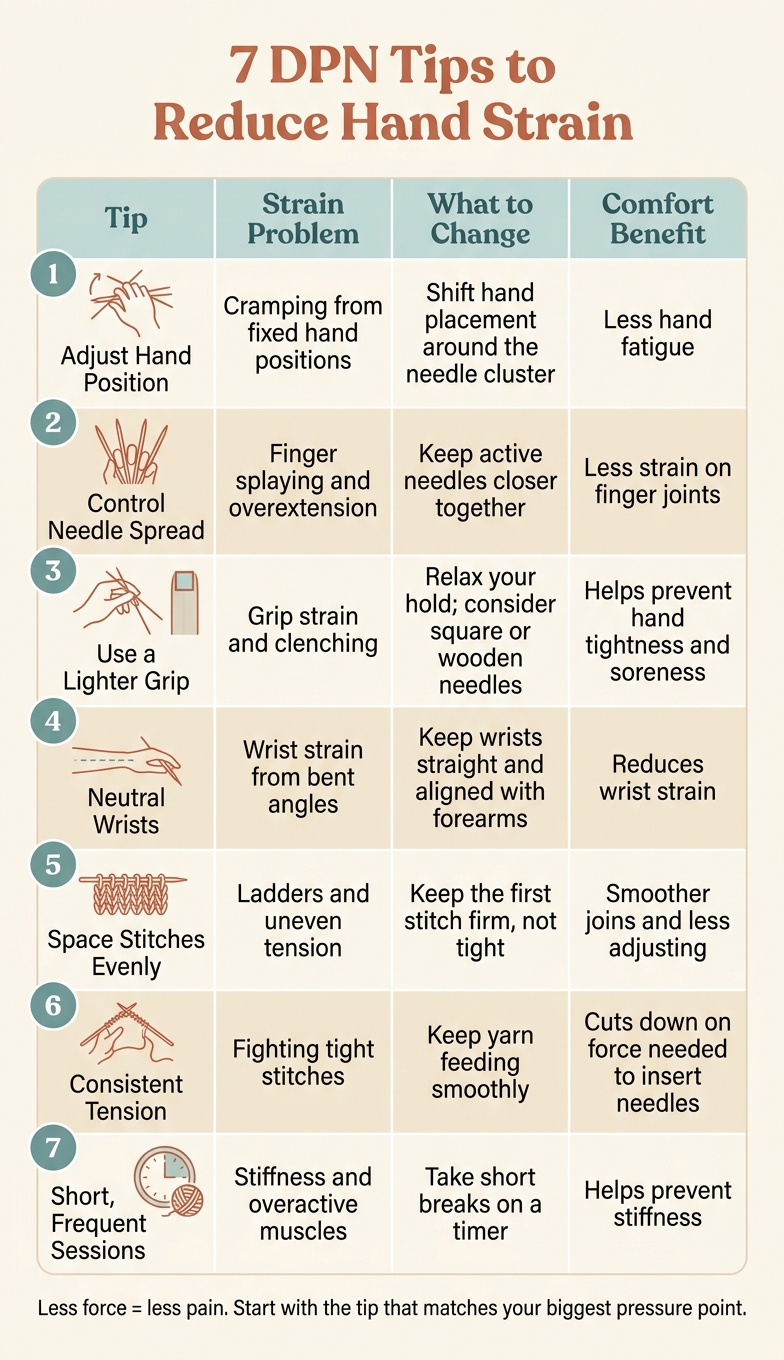
7 DPN Tips to Reduce Hand Strain: Quick Reference Guide
Use this quick reference to spot what's causing strain and the change that fits it. If your hands are sore, start with the row that matches the pressure point you notice first.
| DPN Tip | Strain Problem | What to Change | Comfort Benefit |
|---|---|---|---|
| 1. Adjust Hand Position | Cramping from fixed hand positions | Shift hand placement around the needle cluster | Less hand fatigue |
| 2. Control Needle Spread | Finger splaying and overextension | Keep the active needles closer together | Less strain on finger joints |
| 3. Use a Lighter Grip | Grip strain and clenching | Relax your hold; consider square or wooden needles | Helps prevent hand tightness and soreness |
| 4. Neutral Wrists | Wrist strain from bent angles | Keep wrists straight and aligned with your forearms | Reduces wrist strain |
| 5. Space Stitches Evenly | Ladders and uneven tension | Keep the first stitch firm, not tight | Smoother joins and less adjusting |
| 6. Consistent Tension | Fighting tight stitches | Keep yarn feeding smoothly | Cuts down on the force needed to insert needles |
| 7. Short, Frequent Sessions | Stiffness and overactive muscles | Take short breaks on a timer | Helps prevent stiffness |
When DPNs start to feel tense, the answer is usually a few small tweaks, not more force. If your hands feel sore after using DPNs, loosen your grip, keep your wrists neutral, and knit in shorter sessions. That usually helps more than trying to push through.
If the discomfort sticks around, stop and rest before your next session.
For a visual refresher, Alpaca Direct's YouTube channel shows these hand-position and tension basics in action: https://www.youtube.com/@AlpacaDirect
Hand cramping with double-pointed needles (DPNs) often happens because you’re juggling several needles at once while also supporting the weight of your project. Over a long knitting session, that can put extra strain on your hands and wrists. And if you grip the needles too tightly, the tension builds up even more.
To make things easier, take short breaks often, do a few simple hand stretches, and consider switching to bamboo or wooden needles. They’re usually lighter and can feel easier to hold, so you may not need as much gripping pressure as you would with metal needles.
Pull the second stitch after each needle change a bit tighter than the rest instead of tightening every stitch. That small tweak often helps more than trying to cinch down each one.
Also, keep the needle tips close together during the switch so the gap doesn’t stretch out.
If laddering still shows up, shift the transition point by a few stitches every few rounds. Another simple fix is to hold the working yarn and tail together for the first few stitches.
Bamboo DPNs are often the easiest choice for sore or sensitive hands. They’re light, warm to the touch, and often feel more comfortable during long knitting sessions.
Wooden needles offer that same warm feel, plus a grippy surface that can help keep stitches from sliding around. Ergonomic square knitting needles can also make things easier on your hands by giving you a steadier grip.

Comments will be approved before showing up.