Your Cart is Empty


If I had to give you the short answer first: alpaca often lasts longer on the surface, while merino wool holds its shape longer.
That means alpaca is often the better pick for scarves, shawls, and blankets, where less pilling and long fiber life matter most. Merino wool is often the better pick for socks, fitted sweaters, and ribbing, where stretch and spring-back matter more.
Here’s the whole comparison in plain English:
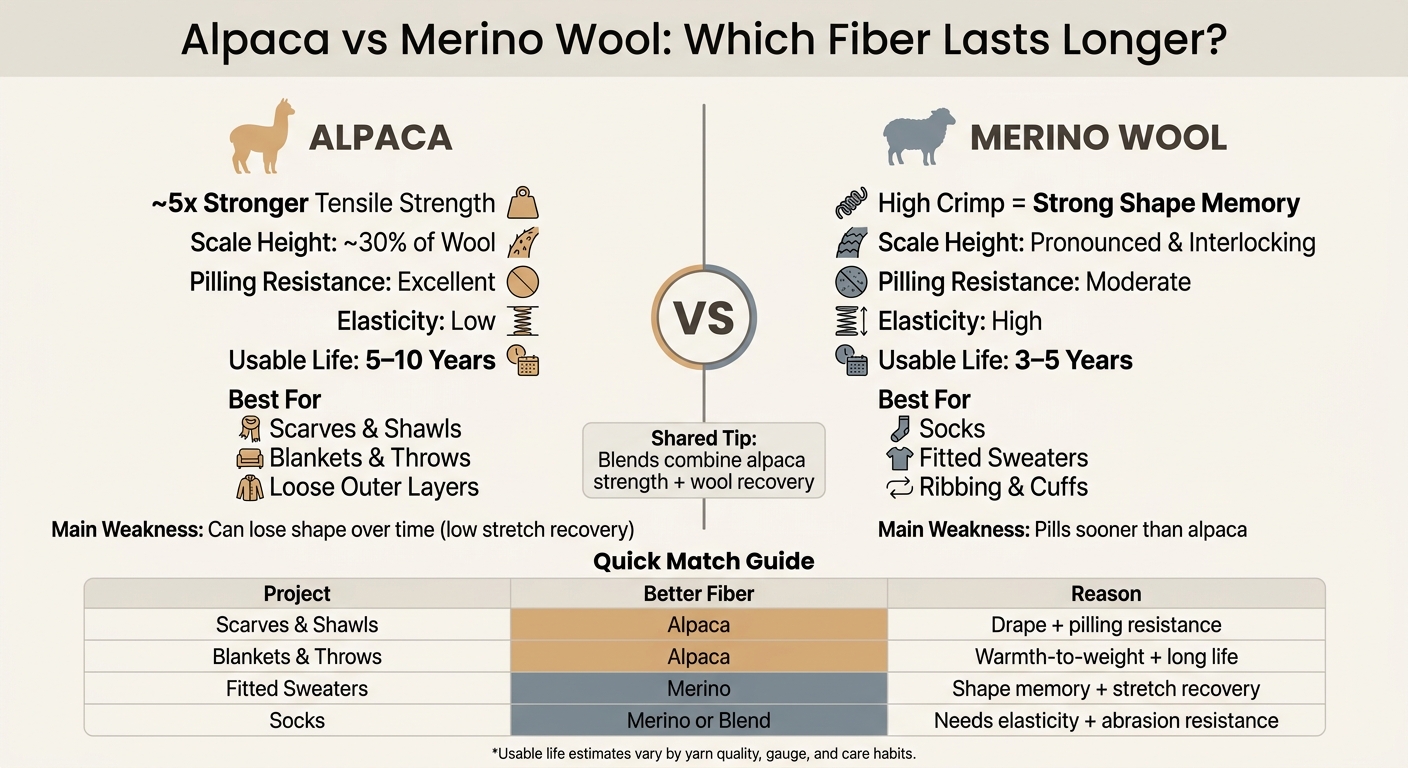
Alpaca vs Merino Wool: Durability, Strength & Best Uses
| Fiber | Best At | Main Weak Point | Best For | Typical Usable Life* |
|---|---|---|---|---|
| Alpaca | Low pilling, fiber strength, drape | Can lose shape over time | Shawls, scarves, throws, loose layers | 5–10 years |
| Merino wool | Stretch recovery, shape memory, daily fit | Pills sooner than alpaca | Socks, fitted sweaters, cuffs, ribbing | 3–5 years |
*Estimates vary by yarn quality, fabric density, and care.
If you want the simple rule, I’d put it like this: pick alpaca for drape and surface wear, and pick merino for bounce-back and fit. From there, washing gently, drying flat, and storing them properly, and using the right gauge do a lot of the work.
At the fiber level, durability comes down to three things: friction, stretch recovery, and how the surface breaks down over time. The wear gap between alpaca and sheep wool starts right at the fiber surface, where scale shape affects friction and pilling.
Alpaca fiber has cuticle scales that lie much flatter against the shaft than the scales on sheep wool. In fact, alpaca scale height is about 30% of sheep wool's scale height. That smoother surface creates less friction between fibers during wear, which helps cut down on pilling.
Unlike sheep wool, alpaca has very little natural crimp. So while it resists pilling well, it doesn't bounce back as well after stretching.
That's the trade-off. Alpaca's smooth, strong fibers hold up well against pilling and surface wear, but a 100% alpaca sweater can slowly lose its shape in spots that get stretched again and again, especially cuffs and ribbing.
That same smooth surface also changes how alpaca feels in use. Compared with wool, it has less bounce and more drape. It also features unique moisture-wicking properties that affect how it feels against the skin.
Merino wool works differently. Its more pronounced cuticle scales and natural crimp - the built-in waviness in each fiber - help it spring back into shape after wear. That's why a merino sock or sweater cuff can snap back after being pulled on and off many times. It also gives wool a more structured, springy feel, while alpaca tends to hang with a softer drape.
The drawback is simple: those raised scales create more surface friction, so merino is more likely to pill over time than alpaca.
| Characteristic | Alpaca | Merino Wool |
|---|---|---|
| Cuticle Scales | Smooth, low-profile (~30% height of wool) | Pronounced, interlocking |
| Elasticity | Low - stretches and stays stretched | High - springs back after wear |
| Pilling Resistance | Excellent | Moderate |
These differences show up most clearly in pilling, stretch, and long-term fit. And they matter even more once the fibers become yarn and fabric, where friction, stitch structure, and fit shape how the garment holds up.
Once yarn is spun and knitted, alpaca and sheep wool start to show their differences in a very practical way: how they handle rubbing, stretching, and day-to-day wear. That shows up most in pilling, fit, and which fiber makes sense for a given garment.
Alpaca usually pills less because its fibers are smoother, so they release less surface fuzz when the fabric rubs against itself or other materials. In spots that take a beating, like underarms, seams, and heels, you'll still see wear over time. It just tends to happen more slowly than it does with similar wool garments.
Merino is different. Its raised scales create more friction between fibers, so signs of wear tend to show up sooner in dense, high-contact areas.
"Alpaca resists pilling because of its fiber structure and elasticity. Alpaca fiber has superior tensile strength, meaning individual fibers are stronger and more resistant to breaking." - Purely Alpaca
This is where merino has the edge. Its crimp gives it natural spring-back. That matters a lot for cuffs, necklines, and ribbing that get stretched over and over. A merino cuff can stay snug after months of wear, while a 100% alpaca cuff may slowly widen and lose some of its hold.
Alpaca tends to relax and grow with time, especially in heavier garments where gravity pulls the fabric down. That's also part of what gives alpaca its soft, fluid drape. Nice for a shawl or a slouchy sweater. Not so nice if you want a sharp, close fit that stays put.
The best fiber depends on what the item has to do. Socks deal with friction and stretch, making it important to choose the best alpaca socks for cold weather to ensure durability. Shawls mostly need to hang well and look good. That’s why fiber choice is less about which one is "better" and more about matching the yarn to the stress points.
| Item | Better Fiber | Why |
|---|---|---|
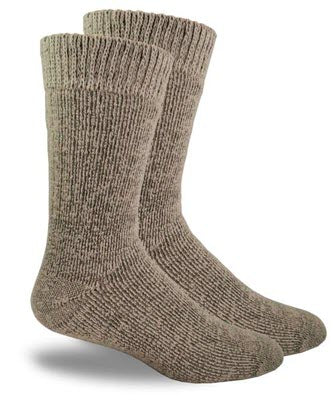
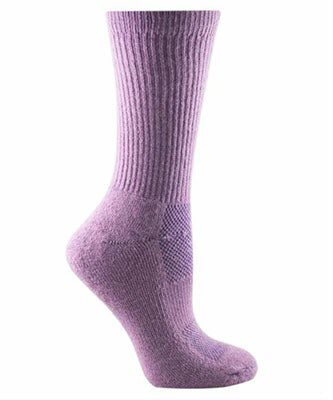
| Socks | Merino for better stretch and abrasion resistance | Heels and toes need elasticity and abrasion resistance; 100% alpaca lacks the stretch needed for this kind of wear and can felt, though choosing the best alpaca yarn for socks can help mitigate these issues |
| Fitted sweaters | Merino | Better shape memory keeps cuffs, necklines, and ribbing intact over time |
| Scarves & shawls | Alpaca | Superior drape and strong pilling resistance |
| Loose outer layers | Alpaca | Handles low-stress wear well because fit stability matters less than drape |
Even then, fiber is only part of the story. Gauge, stitch choice, and washing habits also play a big part in how long a garment keeps its shape and surface.
Care and construction matter just as much as fiber quality.
Both alpaca and sheep wool react badly to heat and agitation. Put either one in a hot wash, and it can felt or shrink. The safer move is simple: hand-wash in cool or warm water with a mild wool-safe detergent, then rinse in water that matches the wash temperature.
Alpaca needs extra care when wet. It stretches under its own weight pretty easily. So don't wring it out. Instead, press out the water, roll the item in a towel, reshape it, and lay it flat to dry.
Storage can make or break the life of a garment too. If you hang alpaca or wool, gravity can pull the fabric out of shape over time. Fold sweaters, scarves, and other garments instead, and keep them on a shelf or in a drawer.
Once care and storage are handled, the next big factor is stitch structure. That's what helps a piece hold its shape wear after wear.
Alpaca has low recovery, so fabric density matters even more here than it does with wool. A firmer gauge makes a denser fabric, which helps resist sagging and lets the garment keep its shape longer. Loose stitches work well if you want drape. But if shape retention is the goal, alpaca does better in a tighter fabric.
That's the tradeoff. Alpaca fiber has good strength, but it still needs tighter construction to keep sagging in check. Sheep wool behaves differently. Its crimp gives ribbing, cables, and cuffs the spring they need. And for socks or fitted sweaters, blends can supply the stretch that pure alpaca doesn't have.
So in practice, alpaca tends to work better when you want drape and a firm gauge to support it, while wool is the better pick for projects that depend on stretch and rebound.
After looking at structure, wear, and care, the short answer is this: it depends on what you're making.
Alpaca comes out ahead for fiber strength and pilling resistance. Its usable life is often estimated at 5–10 years, compared with 3–5 years for merino. That makes alpaca a smart pick for scarves, shawls, blankets, and other drapey, low-stress pieces where long-term fiber hold matters most.
Merino does better when a project needs stretch and bounce-back. Its natural crimp gives it shape memory that alpaca can't match. That's what helps socks, fitted sweaters, and ribbed cuffs keep their shape through regular wear.
When one fiber on its own doesn't quite work, a blend is often the practical fix. You get alpaca's strength and warmth along with wool's structural resilience, which gives you more room to match the yarn weight to the project.
Here's what that looks like in practice:
| Project Type | Better Fiber | Why |
|---|---|---|
| Scarves & Shawls | Alpaca | High tensile strength and strong pilling resistance |
| Blankets & Throws | Alpaca | Great warmth-to-weight ratio and long usable life |
| Fitted Sweaters | Sheep Wool (Merino) | Better shape memory and recovery after stretching |
| Socks | Sheep Wool or Blend | Needs stretch and recovery for high-friction wear |
The best move is to match the fiber to the project: alpaca for drape and abrasion resistance, merino for stretch and recovery. Then knit or crochet it at the right gauge and care for it well, and either one can hold up across all four durability factors.
No. Alpaca is often stronger and tends to pill less, but durability depends on how you plan to use it.
Alpaca is a good fit for soft goods that are meant to last, like scarves and blankets. Merino often works better for fitted garments and socks because it has more natural elasticity and shape memory. That helps it hold its form and resist sagging over time.
Alpaca fiber doesn’t have the natural crimp you get in sheep’s wool. That crimp works like a tiny spring, which gives wool more bounce and helps it return to its original shape.
That’s why 100% alpaca has less stretch recovery and can be more prone to stretching, sagging, or losing shape over time, especially in heavy garments or spots that get a lot of wear. Blending alpaca with nylon, spandex, or merino wool can help the fabric hold its shape better.
Yes. Alpaca-wool blends work well for everyday wear because they mix alpaca’s soft, warm, lightweight feel with wool’s natural stretch and ability to hold its shape.
That extra spring and structure help pieces like sweaters and socks keep their fit over time. For high-stress items like socks, nylon is often added for extra durability.

Comments will be approved before showing up.