
Mohair vs Alpaca: 7 Key Differences

If you want the short answer: alpaca is usually softer, warmer for the weight, and better for sensitive skin, while mohair is lighter, fuzzier, and springs back better.
If I were choosing fast, I’d break it down like this:
- Pick alpaca if you want less itch, more warmth, and clearer stitches
- Pick mohair if you want more halo, less bulk, and better shape hold
- Micron size matters: Royal alpaca is often under 18 microns, while kid mohair is often 24–29 microns
- For next-to-skin wear, alpaca is often the safer pick
- For airy shawls and fuzzy sweaters, mohair is often the better fit
This comparison comes down to 7 points:
- Softness
- Itch
- Warmth
- Weight
- Fuzz
- Stretch
- Care
Bottom line: if you want a soft, warm yarn that feels calm against skin, go with alpaca. If you want a light, hazy fabric with a glowing halo, go with mohair.
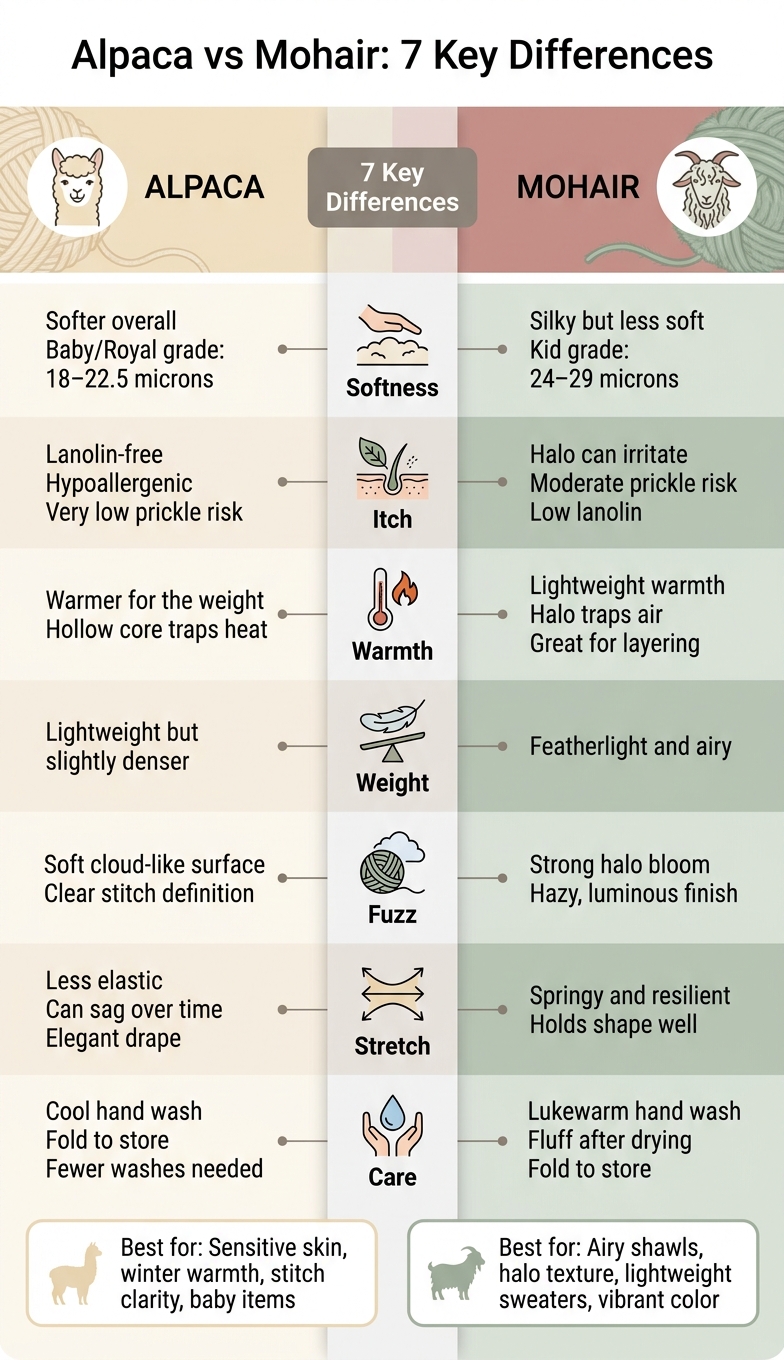
Alpaca vs Mohair: 7 Key Differences at a Glance
Quick Comparison
| Feature | Alpaca | Mohair |
|---|---|---|
| Softness | Usually softer, especially Baby/Royal grades | Silky, but often less soft than fine alpaca |
| Itch | Lower prickle risk; lanolin-free | Halo can feel scratchy on sensitive skin |
| Warmth | Warmer for the weight | Warm, but more airy than dense |
| Weight | Light, but a bit more dense | Very light and airy |
| Fuzz | Soft fluff, clearer surface | Strong halo, hazy finish |
| Stretch | Less bounce; can sag with wear | More spring; holds shape better |
| Care | Hand-wash and dry flat; avoid stretching | Hand-wash and dry flat; protect halo |
So if you’re buying for a scarf, sweater, shawl, or alpaca gift for a knitter, I’d start with one question: do you care more about skin comfort or airy texture? That answer usually points you to the right fiber.
1–2: Softness and Itch
Softness: Alpaca vs Mohair
Softness usually comes down to micron count. Lower numbers tend to feel finer and smoother. Alpaca in higher grades often falls between 18 and 25 microns, while kid mohair is usually around 24 to 29 microns and adult mohair can go as high as 45 microns. That difference shows up fast in pieces like cowls and sweaters that sit right against your neck.
Alpaca usually feels softer on skin because its cuticle scales are smoother and its finer grades - especially Baby and Royal - have a less grabby feel. Kid mohair can still feel silky, but it behaves a bit differently. Its halo gives it loft, so the finish doesn’t sit as flat against the skin. Those longer fibers lift away from the yarn, which gives mohair its soft, airy look. That same halo also changes how the fabric looks and how it drapes.
Itch: What Sensitive Skin Wearers Should Know
For sensitive skin, alpaca has a clear edge because it is lanolin-free. That makes it a stronger pick for scarves, cowls, and fitted layers worn close to the body. Mohair can feel itchy because its fine outer fibers may brush or poke through the fabric, which can come across as scratchy. Kid mohair is the softest choice if you want mohair next to skin, while adult mohair is often too coarse for people with sensitive skin.
If you still want mohair, a mohair-silk blend can help. The silk smooths the halo and gives the yarn more structure. In plain English: choose mohair when you want softness plus loft, not a flat, skin-close feel. For next-to-skin projects, it’s smart to swatch first and wear it for a bit before you commit.
Softness and Itch: Side-by-Side Comparison
| Feature | Alpaca (Baby/Royal) | Mohair (Kid) |
|---|---|---|
| Typical Micron Count | 18–22.5 µm | 24–29 µm |
| Skin Feel | Velvety, plush | Silky, airy, fuzzy halo |
| Lanolin Content | None - hypoallergenic | Very low, but present |
| Prickle Risk | Very low | Moderate; halo can irritate |
| Best Next-to-Skin Uses | Base layers, baby items, scarves, cowls | Lightweight shawls, airy sweaters |
Softness and itch shape comfort. Warmth, weight, and halo shape how the finished fabric wears and moves.
3–5: Warmth, Weight, and Fuzz
Warmth and Weight: How the Two Fibers Compare
Alpaca holds heat better than mohair and usually feels warmer at the same weight. The reason is simple: alpaca fibers have a hollow core, which traps tiny air pockets and keeps warmth close to the body. Mohair works in another way. Its long, fine fibers bloom outward from the yarn and trap air around the fabric, which helps it stay warm without feeling bulky.
So if your main goal is maximum warmth, alpaca is the better pick. If you want light warmth with less bulk, mohair makes more sense.
Fuzz and Fabric Look: Halo vs Stitch Definition
Mohair is known for its halo. Those long fibers float out from the yarn and give fabric a soft, hazy look. The trade-off is that stitch definition drops. Cables, lace, and other detailed patterns can fade behind the fuzz.
Alpaca looks different. It has a more matte surface, and the stitches stay easier to see. That makes it a better choice when the stitch pattern is part of the design, not just the structure. This visual contrast also changes how the fabric drapes and how well it holds stitch memory.
Warmth, Weight, and Fuzz: Side-by-Side Comparison
| Feature | Alpaca | Mohair |
|---|---|---|
| Warmth | Highest - hollow core traps air | Very high - halo traps air |
| Warmth for the weight | Superior | Excellent |
| Fabric feel | Low density, but more substantial | Very low density - airy |
| Halo | Moderate - fluffy, cloud-like | High - long, fine bloom |
| Stitch Definition | Clearer, more visible stitches | Low - stitches soften under the halo |
| Best Project Types | Winter sweaters, hats, blankets | Shawls, lace layers, lightweight sweaters |
These fiber traits also shape stretch, drape, and how the fabric wears over time. Next, stretch and care show what happens after knitting or crocheting.
6–7: Stretch and Care
Stretch and Drape: Mohair vs Alpaca
Once warmth and fuzz are settled, the next trade-off is shape. Mohair has a springy feel. Its long, smooth fibers bounce back, which helps garments keep their shape over time. That gives mohair an edge for fitted pieces or anything that needs to hold a clear silhouette.
Alpaca behaves in a different way. It has a silky, elegant drape, but not much bounce. Because of its hollow fiber structure, alpaca has less shape recovery than mohair, so heavier or longer garments like sweaters and shawls can stretch out with repeated wear, especially if they’re hung while wet. Alpaca drapes beautifully, but it has less recovery than mohair.
Care: Washing, Blocking, and Long-Term Use
That difference in shape recovery affects how each fiber should be washed, dried, and stored. Hand-wash in cool to lukewarm water (65–85°F) with a mild wool wash. Don’t wring the garment. Instead, roll it in a towel to press out water, then lay it flat to dry.
For mohair, drying flat also helps protect the halo. Once it’s dry, fluff the fibers with your fingers or a soft comb to bring back that signature halo. Alpaca is naturally antimicrobial and odor-resistant, so it often needs fewer washes. Store both fibers folded, not hung. Mohair handles regular handling a bit better, but alpaca needs more support so gravity doesn’t pull it out of shape over time. See Alpaca Direct's YouTube channel for care demos.
Stretch and Care: Side-by-Side Comparison
| Feature | Alpaca | Mohair |
|---|---|---|
| Elasticity | Lower - less bounce and more prone to stretching out | High - springy and resilient |
| Recovery | Lower - can stretch out with wear | Excellent - bounces back to shape |
| Drape | Heavy, silky, elegant | Structured and airy |
| Blocking Behavior | Can stretch out if unsupported | Holds shape better |
| Washing Routine | Cool hand wash, minimal agitation | Lukewarm hand wash, minimal agitation |
| Maintenance | Fewer washes needed; fold for storage | Fluff after washing; fold for storage |
Which Fiber Fits Your Project
Now that the main differences are on the table, choosing gets a lot easier.
When to Choose Alpaca
Alpaca is the better pick when comfort comes first. It's lanolin-free and hypoallergenic, so it works well for sensitive skin, wool allergies, and gift knitting when you don't know how the other person reacts to fiber. Alpaca Direct offers a variety of hypoallergenic options. If you want something that feels easy to wear, this is usually the safer bet.
It also stands out for warmth. Alpaca's hollow-core fiber structure traps heat well, which is why it's such a good fit for winter hats, gloves, and cold-weather socks. And because it resists pilling and abrasion well, it makes sense for pieces that get worn a lot.
If your main goal isn't softness and warmth, mohair starts to look more appealing.
When to Choose Mohair
Mohair makes the most sense when texture and lightness matter most. Its halo gives fabric a soft, luminous look, which is why it's often used for airy shawls, lace wraps, and lightweight sweaters. If alpaca feels like a warm blanket, mohair feels more like a sheer, glowing layer.
Color is another big reason people choose it. Mohair takes dye very well because the fibers are porous and don't have pronounced surface scales, so dye sinks in deeply and produces saturated color.
For garments worn close to the skin, Kid Mohair is the safest option, since it typically measures 24 to 29 microns. Pure mohair can also feel slippery, so blends are often used to add more structure.
Here's the quick side-by-side view.
Key Takeaways
| Difference | Alpaca | Mohair |
|---|---|---|
| Softness | Softer overall | Soft in Kid grade; scratchy in adult |
| Itch | Best for sensitive skin | Halo can irritate sensitive skin |
| Warmth | Warmer for the weight | Lightweight warmth; good for layering |
| Weight | Lightweight, slightly denser | Featherlight |
| Fuzz | Soft, cloud-like or silky | Distinct halo with high luster |
| Stretch | Less elastic; can sag over time | Springy; holds shape better |
| Care | Gentle hand wash; less pilling | Gentle hand wash; fluff after washing |
FAQs
Which is better for beginners to knit or crochet with?
Alpaca is usually the easier pick for beginners who knit or crochet. It has a smooth texture, so it tends to move through your hands with less fuss.
Mohair is a bit trickier. The fibers like to cling to each other, and that fuzzy halo can make stitches hard to see, count, and fix if you make a mistake. If you start with mohair, it’s often held together with another yarn to give it more structure and make the stitches easier to spot.
Do alpaca and mohair shed differently over time?
Yes. New mohair can shed loose fibers during the first few wears. That’s pretty normal. In most cases, the shedding drops off a lot after you’ve worn it a bit and washed it a few times.
Alpaca is a little different. It isn’t mainly known for that same early shedding pattern. Instead, the bigger long-term issue is shape: with repeated wear, it can stretch or lose its form in a different way.
Is a blend better than pure alpaca or pure mohair?
A blend often works better when you want a specific feel and performance.
Pure mohair can feel stiff or itchy, especially on sensitive skin. That’s why it’s often mixed with other fibers to make it softer and more comfortable to wear.
Pure alpaca is soft and warm on its own. But when it’s blended, you can get more stretch and bounce, which helps fitted knits keep their shape. A bit of mohair can also add a fuzzy halo and extra strength, while a higher alpaca content keeps that soft feel and fluid drape.