Your Cart is Empty


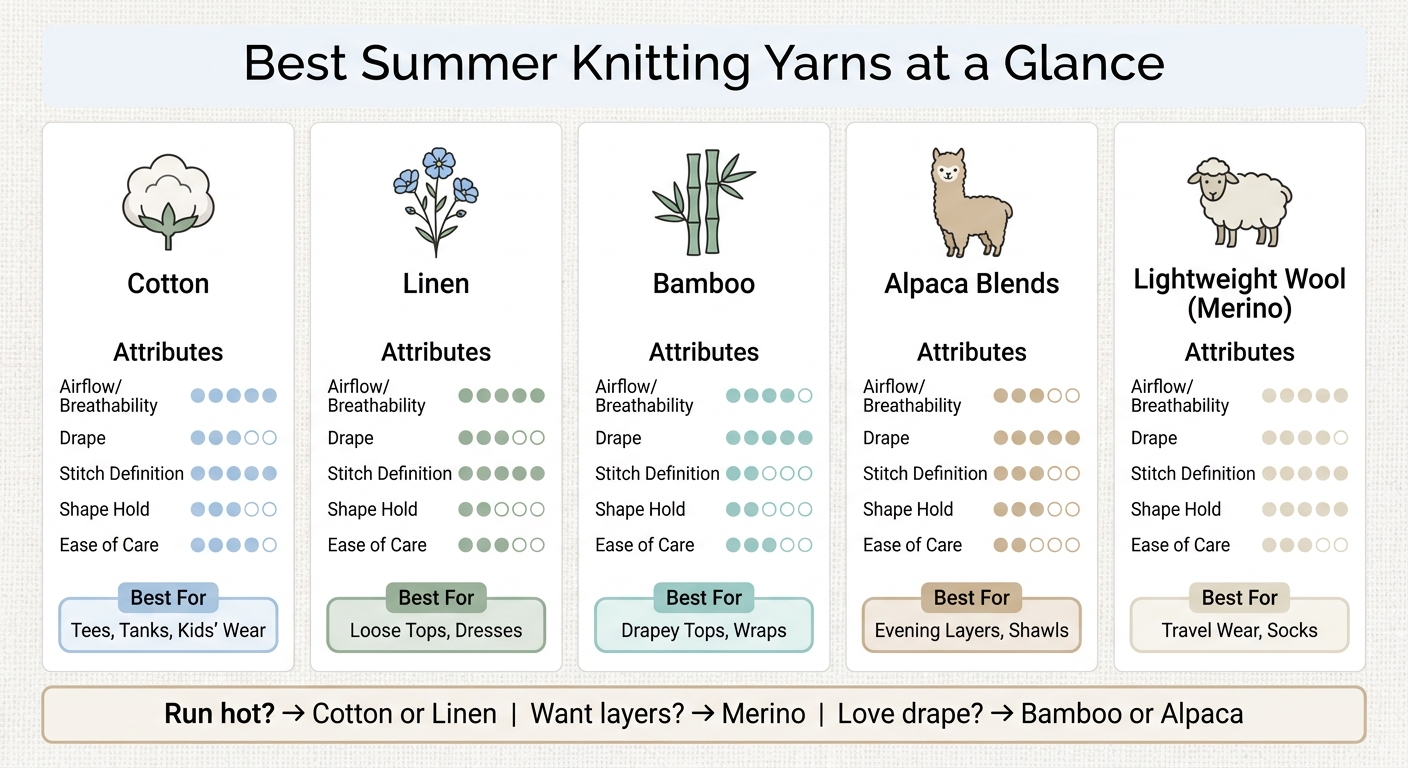
If I want the short answer: cotton and linen are best for hot days, merino works best for travel and active wear, bamboo is best for soft drape, and alpaca blends fit cool evenings and strong A/C.
Summer yarn is less about one “best” fiber and more about match. I’d pick yarn based on airflow, drape, stitch clarity, shape hold, and care. In this guide, the five main options are alpaca blends, cotton, linen, bamboo, and lightweight wool, with most summer projects worked in fingering, sport, or DK weights.
Here’s the plain-English breakdown:
If I were choosing by project, I’d keep it simple:
Quick Comparison
| Fiber | Airflow | Drape | Stitch Definition | Shape Hold | Best Use |
|---|---|---|---|---|---|
| Cotton | High | Crisp | Clear | Medium-low | Tees, tanks, kids' wear |
| Linen | High | Crisp, dry | Sharp | Low | Loose tops, dresses |
| Bamboo | Medium-high | Fluid | Soft | Low | Drapey tops, wraps |
| Alpaca Blends | Medium | Fluid | Medium | Low-medium | Evening layers, shawls |
| Lightweight Wool | High | Springy | Clear | High | Travel wear, socks, light sweaters |
The bottom line: if you run hot, start with cotton or linen. If you want a layer for changing temps, go with merino. If drape matters more than structure, look at bamboo or alpaca blends.
Best Summer Knitting Yarns: Fiber Comparison Guide
Pure alpaca is often too warm for summer. But when you blend it with cotton, linen, or silk, it becomes a much better fit for light warm-weather pieces. The main trade-off is simple: more warmth usually means less airflow.
An alpaca-cotton blend works well in summer because cotton brings a cool, breathable feel, while alpaca helps the fabric stay soft instead of heavy or stiff. Alpaca-linen blends are also a smart pick for lightweight garments since linen improves moisture handling and wear over time. In both cases, the fabric stays cool enough for layering in warm weather.
Alpaca has lovely drape because the fibers move smoothly and don’t cling. Add silk, and that drape gets even better. That makes alpaca-silk yarns a strong fit for elegant shawls and evening wraps.
There is a catch, though. Alpaca has less stretch recovery than wool. So if you use it for fitted pieces, the shape can relax too much. It tends to shine in fluid garments instead of anything structured or close-fitting.
Pure alpaca has a soft halo, which can blur stitch definition, especially in brushed yarns. Blend it with cotton, and you get more crispness. Eyelets, cables, and other decorative textures show up more clearly. When alpaca is mixed with a firmer fiber, it handles structured stitch patterns much better.
Alpaca blends are best for shawls, lightweight wraps, and layering pieces where drape matters more than firm structure. They’re a good match for cool summer evenings or heavily air-conditioned spaces, when you want warmth without extra weight.
Skip 100% alpaca for large or heavy garments. Since it doesn’t bounce back like wool, those pieces can stretch out over time.
| Blend Type | Best Summer Project | Key Benefit |
|---|---|---|
| Alpaca / Cotton | Summer throws, tees, wraps | Cool, breathable, and adds stitch crispness |
| Alpaca / Silk | Elegant shawls, evening wraps | Maximum drape and subtle luster |
| Alpaca / Linen | Lightweight garments | Better moisture handling and durability |
| Alpaca / Wool | Shoulder-season sweaters | Adds elasticity and stretch recovery to prevent sagging |
For visual examples, see Alpaca Direct's YouTube tutorials. Next, compare cotton, the coolest baseline for summer knitting.
Cotton is one of the go-to fibers for summer. It’s breathable, comfortable, and easy to live in. On the Natural Fiber Performance Index (NFPI), cotton scores 5/5 for breathability and 5/5 for next-to-skin comfort.
Cotton shines in hot weather because air moves through it well. That said, there’s a tradeoff. Cotton absorbs moisture with ease and dries slowly, so a garment can start to feel heavy or a bit clammy while it dries. That’s why stitch choice matters. A loose stitch pattern gives the fabric more room to breathe.
Cotton has a crisp drape. It lies flat and holds its shape well through wear and washing, which makes it easy to count on for day-to-day pieces. The catch is that it doesn’t spring back much on its own, since it has little natural stretch recovery.
If you want your stitch work to show, cotton is a safe bet. Its smooth surface makes texture stand out, so seed stitch, ribbing, basketweave, and simple cables all come through clearly in cotton. When stitch definition is high on your list, cotton is a dependable choice.
Cotton fits best with easy summer staples: T-shirts, tanks, kids' clothes, table runners, and lightweight throws. For ribbed pieces that need to keep their shape, a cotton blend with wool or elastane can help by adding stretch recovery.
All ratings below come from the Natural Fiber Performance Index (NFPI).
| Performance Metric | Cotton Rating |
|---|---|
| Breathability | ★★★★★ |
| Next-to-Skin Comfort | ★★★★★ |
| Durability | ★★★★ |
| Ease of Care | ★★★★ |
| Moisture Management | ★★★ |
| Odor Resistance | ★★ |
Next, compare linen, which also breathes well but tends to feel drier and less structured.
If cotton feels a bit too absorbent, linen gives you that same airy feel with a drier touch. It comes from flax and shines in hot weather. Linen matches cotton on breathability, but it deals with moisture better.
Linen offers strong breathability, good moisture control, and high tensile strength. Air moves through it with ease, and it pulls moisture away instead of letting it sit against your skin. It also has an interesting feel over time: linen starts out crisp, then gets softer with wear and washing, while still keeping its strength.
Linen has very low elasticity, so the drape feels crisp and structured. It tends to lie flat and doesn't bounce back much after stretching. It wrinkles with little effort too, which is part of the deal. That makes it a better fit for relaxed, casual styles than close-fitting pieces.
Linen's firm hand gives stitches a clean, sharp look. The texture shows up clearly in the finished fabric, which can make simple stitch patterns stand out.
Linen works best for loose-fitting garments where airflow matters most. Think breezy tops, shirts, dresses, and loose pants. It's not the best pick for ribbed cuffs or anything that needs to stretch and spring back. If you want a little more give, a linen blend is usually a better bet than 100% linen.
All ratings below come from the Natural Fiber Performance Index (NFPI).
| Performance Metric | Linen Rating |
|---|---|
| Breathability | ★★★★★ |
| Moisture Management | ★★★★ |
| Durability | ★★★★★ |
| Temperature Regulation | ★★★★ |
| Next-to-Skin Comfort | ★★★ |
Next, bamboo brings a softer, silkier hand.
Bamboo yarn has a smooth, cool feel with an almost silky touch. Most bamboo yarn sold today is rayon or viscose made from bamboo pulp. That makes it a good pick for knitting in humid weather.
Bamboo is breathable and works especially well in humid conditions. It absorbs moisture well and pulls it away from the skin, which can help you feel cooler in warm weather.
Bamboo has a fluid drape that gives finished pieces a silk-like hang. That’s why it works so well in loose summer garments. One thing to watch, though: bamboo doesn’t have much spring back, so it can stretch or sag over time in heavier pieces or garments that need more structure.
Because bamboo has a smooth surface, it tends to soften stitch detail and add a slight sheen. In plain terms, it usually looks better in simple textures than in tight, structured stitch patterns. If the yarn feels slippery in your hands, bamboo or wooden tools can give you more grip and help you keep steadier tension.
Bamboo works well for dresses, lightweight shawls, wraps, and shirts where a smooth feel against the skin and moisture control matter most.
Next, compare lightweight wool, which gives you more bounce and a bit more warmth for summer layering.
After the softer, drapier fibers above, lightweight wool brings more spring and better odor control. That’s a big deal in summer. Lightweight wool, especially Merino, can work very well in warm weather when breathability, moisture handling, and shape recovery matter. On the Natural Fiber Performance Index, it earns 5/5 for breathability, temperature regulation, moisture management, and odor resistance.
Merino wool helps regulate body temperature and move moisture vapor away from the skin before it turns into sweat. When you compare alpaca vs. cotton, cotton absorbs liquid moisture and can start to feel heavy when you’re active. Lightweight wool tends to stay drier while you wear it.
Lightweight wool has a natural crimp that gives it spring and shape memory. So it drapes nicely, but it also bounces back instead of stretching out and sagging.
"Where Merino has a tight crimp that creates springy bounce, fine alpaca is more likely to have a gentle wave. This creates more drape and less memory." - Kate Larson, Editor, Spin Off magazine
Because wool has loft and crimp, it gives stitches a clean, matte look. That makes it a good pick for lace, ribbing, cables, and other textured patterns where you want the stitch work to stand out.
Lightweight wool fits projects like base layers, T-shirts, socks, and travel clothes you may want to wear more than once between washes. Its 5/5 odor resistance is especially handy for multi-day trips and active summer wear.
There is one tradeoff: wool can felt or shrink with heat and agitation, so it needs gentler washing than cotton.
Use this summary to match each fiber to the kind of project you want to make and the weather you’ll wear it in. It pulls the main things into one place: breathability, drape, stitch definition, care, and how well the fabric keeps its shape.
The chart below sums up the main trade-offs: airflow, drape, care, and shape retention.
| Fiber | Pros | Cons | Best Fit |
|---|---|---|---|
| Cotton | Breathable, machine-washable, clear stitch definition | Absorbs moisture, dries slowly, can feel heavy or clammy in humidity | Everyday tees, baby blankets, kids' garments |
| Linen | Excellent airflow, strong, sharp stitch definition | Wrinkles easily, very low elasticity, little spring-back | Breezy dresses, loose tunics, hot-weather tops |
| Alpaca Blends | Soft, light warmth, fluid drape | Can sag if overused, often needs hand-washing | Evening wraps, shawls, AC layers |
| Bamboo rayon | Very soft, fluid drape | Softens stitch detail, processing affects quality | Drapey shawls, lightweight summer tops |
| Lightweight Wool (Merino) | Odor-resistant, temperature-regulating, springy stitch definition | Can felt or shrink; requires gentle hand-washing | Travel tees, base layers, transition pieces |
For U.S. knitters, cotton is usually the simplest machine-wash pick. Many alpaca and lightweight wool yarns need cool hand-washing unless the label says superwash.
Cotton and linen usually keep their width well, but they can stretch longer in open stitch patterns. Alpaca tends to shift more after blocking, so it’s smart to swatch and wet-block before you cast on. That extra step can save you from a project that looks great off the needles, then drops two inches the next day.
After care and blocking, climate becomes the last filter. In humid weather, cotton and linen usually feel coolest. In dry conditions or air-conditioned spaces, lightweight wool and alpaca blends tend to work better. If your project needs to handle both, alpaca/cotton and alpaca/wool blends are often the easiest middle ground.
Use these pairings to narrow your yarn choice by project, not just by fiber.
| Project Type | Best Yarn | Why It Works |
|---|---|---|
| Summer Tops & Tees | Cotton or Linen | Both are highly breathable; linen also manages moisture better in extreme heat |
| Shawls & Wraps | Alpaca/Silk or Alpaca/Cotton | Drape and elegance matter most here, so shape retention is less critical |
| Light Sweaters | 50/50 Alpaca/Wool or Merino Wool | Wool's natural crimp helps the garment spring back and resist sagging over time |
| Summer Socks | Wool-nylon blend | Wool adds the memory needed for shape retention, and nylon adds durability in high-friction areas |
| Travel Wear | Merino Wool | It offers strong temperature regulation and odor resistance across changing conditions |
Shape retention matters most in sweaters. That’s why pure alpaca is better saved for fluid pieces like shawls and wraps, where drape is the whole point. But for fitted garments, a wool blend gives you more memory and helps the piece keep its shape over time.
If two fibers can work for the same project, let your climate and care habits make the call. Summer yarn choice usually comes down to airflow, drape, stitch clarity, and how much structure the fabric needs to hold. Use the table above as the quick-match guide: cotton or linen for tops, alpaca blends for drape, wool for structure, bamboo for soft fluidity. For travel, merino wool is the most flexible option.
Choose your yarn based on the project and the way you want the fabric to behave.
Cotton is an easy-care fiber that works for all kinds of projects. It feels soft, and it gives you smooth, crisp stitch definition.
Linen shines in hot weather. It has great airflow, handles moisture well, and drapes with a cool, relaxed feel. The tradeoff is simple: it wrinkles more.
If you’re stuck between the two, a cotton blend can give you good breathability with a bit more structure and drape.
Yes - you can knit summer garments with wool, especially if you use a lighter gauge or an open-knit pattern. That said, pure wool can still feel a bit heavy or warm once the weather heats up.
A wool-alpaca blend, or another lightweight fiber, is often a better pick. Alpaca is breathable and helps regulate temperature, while a blend can give you more elasticity and better stitch recovery.
It also helps to choose drapey styles instead of dense, structured ones. And before you commit, swatch first. A small test can tell you fast whether the fabric feels good enough for warm-weather wear.
For summer projects, blends tend to hold their shape better than a single fiber. Linen and cotton feel light and airy, but on their own they don't have much stretch.
Alpaca blends, especially when mixed with wool or cotton, add better memory and elasticity. That helps prevent sagging and keeps the piece structured over time.

Comments will be approved before showing up.