Your Cart is Empty


Lost your cable needle? For most small cables, you can keep knitting. In my view, the best stand-ins for 1x1 and 2x2 crosses are no-tool cabling, a spare knitting needle, a DPN, a crochet hook, a stitch holder, and a locking stitch marker.
Here’s the short answer:
The article compares each option using 3 points:
A few takeaways stand out right away:
If you want the shortest path: use no-tool cabling for grippy yarn and tight little crosses, and switch to a DPN, hook, or holder when stitch control matters more.
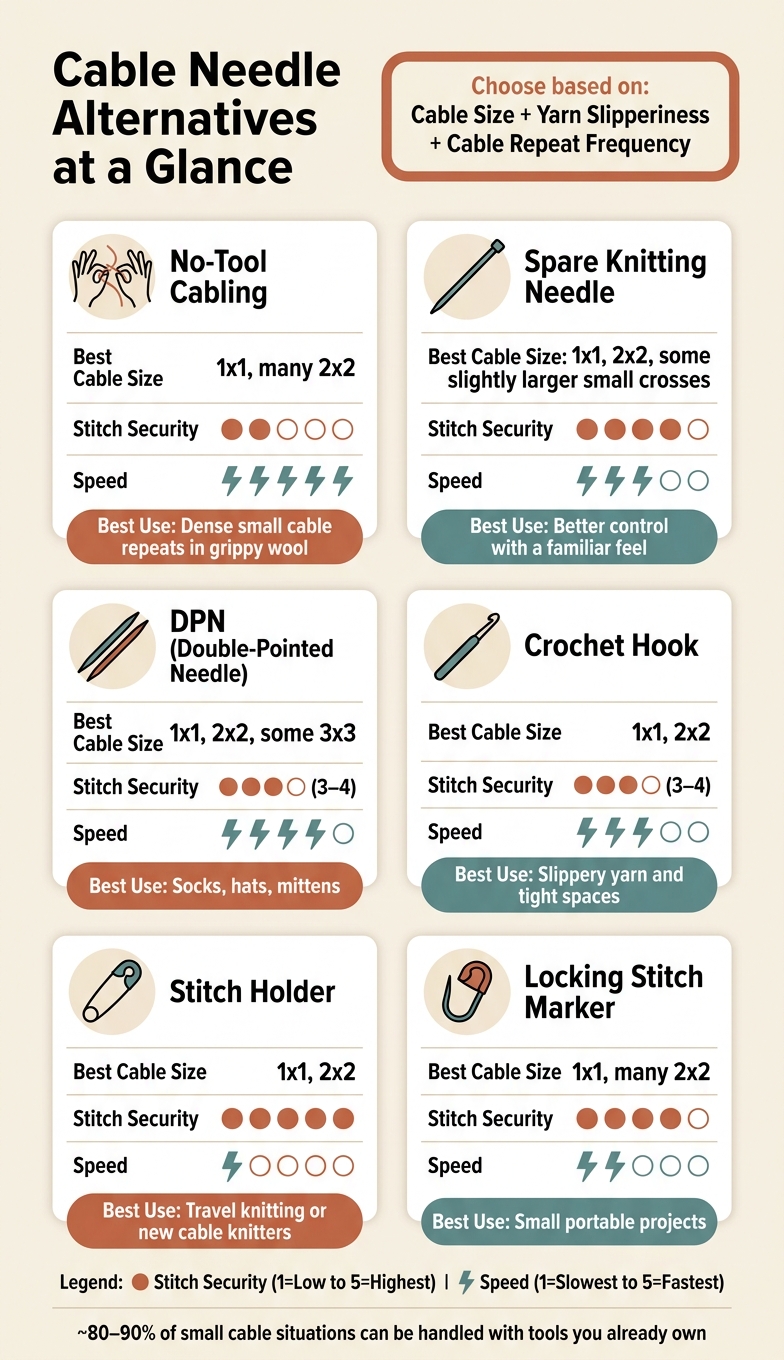
Cable Needle Alternatives: Quick Comparison Guide for Knitters
| Option | Best Cable Size | Stitch Security | Speed | Best Use |
|---|---|---|---|---|
| No-tool cabling | 1x1, many 2x2 | Low to medium | Fastest | Dense small cable repeats |
| Spare knitting needle | 1x1, 2x2, some slightly larger small crosses | High | Medium | Better control with familiar feel |
| DPN | 1x1, 2x2, some 3x3 | Medium to high | Medium-fast | Socks, hats, mittens |
| Crochet hook | 1x1, 2x2 | Medium to high | Medium | Slippery yarn and tight spaces |
| Stitch holder | 1x1, 2x2 | Highest | Slowest | Travel knitting or new cable knitters |
| Locking stitch marker | 1x1, many 2x2 | High | Medium-slow | Small portable projects |
So if I had to boil it down: pick based on cable size, yarn slip, and how often the cable repeats. That simple check will usually tell you whether to go tool-free or use a small stand-in.
No-tool cabling is the fastest choice for small cables, but it works best when the stitches are easy to control. You slip a small group of stitches off the left needle, hold them for a moment with a finger or thumb, knit the next stitches, then place the held stitches back on the needle and finish the cable.
This method is best for 1x1 and many 2x2 cables - usually about 2 to 4 stitches total. Once the cable gets bigger, things get a bit dicey because more live stitches are sitting off the needle at the same time.
How safe this feels depends a lot on your yarn and needles. Wool and alpaca-blend yarns usually grip the stitches better while they’re off the needle for a moment. Slick yarns, like silk, mercerized cotton, and tightly spun superwash blends, can slip more easily. Wooden or bamboo needles help because they add friction, and sharp needle tips make it easier to grab a dropped stitch if one gets away. When you put the stitches back on the needle, keep the right leg in front and the left leg in back.
No-tool cabling is often faster than using a cable needle for frequent small cables. Why? You skip the extra step of moving stitches onto another tool and then back again. That time savings shows up most in rows packed with 1x1 twists or 2x2 cables.
This is a good fit for hats, socks, or mittens when you want a fast, tool-free method. If the stitches start to feel loose, switch to a spare needle for the next cable.
If holding cable stitches in your fingers feels a little too loose, switch to a spare needle. It gives you more control and feels familiar because it works much like your main needles. For small cable crosses, it’s simple: slip the cable stitches onto the spare needle, hold it in front or in back, knit the next stitches from your main needle, then move the held stitches back and keep going. Short straight needles or DPNs are usually the easiest to handle.
For small crosses, size and grip matter more than the exact needle style. Use a spare needle in the same size as your working needles, or go one size smaller. A slightly smaller needle lets stitches slide on and off more cleanly, which helps a lot with high-friction yarns. Skip a larger spare needle. It can stretch the held stitches and leave loose spots where the cable turns. Slip stitches purlwise, and keep them on the shaft instead of the tip.
A spare needle works well for 1x1 and 2x2 cables, including reversible 1x1 or 2x2 rib cables. It can also handle slightly wider small crosses without much trouble.
Because the cable stitches rest on a solid needle instead of hanging loose, stitch security is high. That extra control helps most with slippery yarns like silk blends, superwash wool, or alpaca blends.
A spare needle is slower than cabling without a tool, but it’s faster and steadier than moving stitches by hand. If you want that same control with less bulk, the next options are even smaller.
It’s a good fit for hats, socks, mittens, and small sweater cables, especially if you already carry DPNs.
If a spare needle feels a bit clunky, a DPN is a slimmer option. It’s one of the easiest cable needle stand-ins, especially if you already toss one in your bag for socks, different methods for knitting a hat, or sleeves.
Slip the cable stitches purlwise onto the DPN and hold it to the front or back. Knit the next stitches from your working needle, then knit the held stitches off the DPN. Keep the DPN parallel to your working needle so the stitches stay close and don’t stretch out. That puts a DPN in a nice middle spot between holding stitches with your fingers and using a full spare needle.
DPNs feel best for 1x1 and 2x2 cables. They can also handle 3x3 cables if the yarn has enough grip. Use a DPN in the same size as your working needles, or go one size smaller.
Stitch security is strong for small cables, where you’re only parking 2–4 stitches at a time. The main issue is that stitches can slip off either pointed end. Bamboo or wood tends to hold slippery yarn better than metal. If you’re using metal, keep the held stitches centered so the tips don’t sit right at the fabric edge.
Once you get used to the motion, a DPN is almost as fast as a cable needle. It’s still slower than no-tool cabling, but you get more consistency, which helps in patterns with cables every few rows.
DPNs work especially well for socks, mittens, hats, and sleeve cables worked in the round, mainly when you already have a matching spare DPN on hand. I’d skip them for very slippery lace-weight yarns.
If your fingers feel a bit too loose for cabling, but a DPN feels clunky, a crochet hook lands right in the middle. You get more control than going tool-free, and it’s still small enough for tight repeats. And because most knitters already have one in their bag, it’s an easy stand-in for a cable needle.
Slip the stitches onto the hook, knit the next stitches, then place the held stitches back onto the left needle in the right orientation.
Crochet hooks are best for 1x1 and 2x2 cables. Pick a hook within one size of your working needles. Go too big, and the cable can stretch out of shape. Go too small, and moving stitches back and forth gets fiddly.
A crochet hook holds each stitch in place, which helps a lot with slippery yarns like alpaca or silk blends. With those fibers, a bamboo or wooden hook gives you a bit more grip. For stickier wool, a smooth metal hook helps the stitches slide without snagging.
Using a crochet hook adds a little more movement than cabling with no tool. Still, that trade-off makes sense when your yarn wants to slip away or your pattern brings cables around every few rows.
Crochet hooks are a good fit for hats, cowls, mitts, and narrow scarves with 1x1 or 2x2 cables.
When you want more security than a hook or DPN, a locking stitch holder gives you a firmer backup. It keeps held stitches fully enclosed until you're ready to move them back to the needle. Slip the stitches onto the holder, close it, knit across the remaining stitches, then open it and return those stitches to your needle to finish the cross.
Stitch holders work best for 1x1 and 2x2 cables. Stick with 1x1 and 2x2 cables because bigger crosses can get bulky and pull on the fabric.
The locking closure makes this the most secure option. The stitches stay fully enclosed, which helps a lot with slippery fibers like alpaca or smooth superwash wool. It's also handy for travel knitting, when a project gets bumped around in a bag.
This is the slowest option because each cross means opening, loading, closing, and unloading the holder. It fits occasional cable motifs better than dense all-over cable fabric.
Use it for beginner cable projects and patterns, baby garments, and accessories with occasional crossings. If you want a bit less security for tiny crosses, the locking stitch marker is the next option.
For knitters who want the smallest secure stand-in, a locking stitch marker is a handy pick for small cables. It works like a tiny clip: load the stitches, snap it shut, knit the background stitches, then move the stitches back to finish the cross. You get more control than finger cabling and less bulk than a stitch holder.
Locking stitch markers work best for 1x1 cables and many 2x2 cables. They hold 1x1 and most 2x2 crosses neatly. For 3x3 cables, wider crosses, or layered cables, they're usually too cramped.
The closed latch keeps stitches secure in a smaller, lighter tool. That's especially helpful with slippery fibers like alpaca or silk blends. When loading and unloading the marker, always slip stitches purlwise so the cable cross stays lined up the right way.
This option is smaller than a stitch holder, more secure than finger cabling, and slower than cabling with no tool at all. Once the latch motion feels natural, it moves along pretty well on repeated small cables.
This tool is a great fit for socks, mittens, and hats, plus baby garments with delicate cables, or any project you toss in a bag and carry around a lot.
The table below lays out the main trade-offs, so you can compare each option at a glance.
| Alternative | Pros | Cons | Best Fit |
|---|---|---|---|
| No-tool cabling | Fastest; no extra tool | Stitches hang loose; risky with slippery yarn | Frequent 2x2 cables in grippy wool |
| Spare knitting needle | Familiar feel; good tension control | Full length feels awkward on small, frequent crosses | Narrow cable panels needing extra control |
| DPN | Shorter and easier to hold than a spare needle | Can slip out; risk of knitting from the wrong end | Socks, mittens, and hats where DPNs are already in use |
| Crochet hook | Hook tip grabs stitches; good for slippery fibers | Requires care when returning stitches to avoid twisting | Superwash merino or silk-blend socks; occasional sweater cables |
| Stitch holder | Maximum security; stitches stay enclosed | Slow to load and unload; too bulky for dense repeats | Occasional decorative crosses on hats or narrow panels |
| Locking stitch marker | Compact, lightweight, already in most project bags | Fiddly to open and close; holds only 1–2 stitches comfortably | Occasional 1x1 or 2x2 crosses on mittens, hats, or travel projects |
If you want pure speed, no-tool cabling comes out on top. If keeping stitches locked down matters more, stitch holders and locking stitch markers give you the most control. DPNs and crochet hooks land somewhere in the middle, which is why so many knitters keep coming back to them.
A simple way to choose: start with the table, then match the tool to the size of the cable, how grippy or slippery the yarn feels, and how often that cable repeat shows up. A tool that feels fine once or twice can get annoying fast in a dense repeat.
Start with what you already have in your project bag: a spare needle, DPN, crochet hook, or locking stitch marker. Any of those can handle most 1x1 or 2x2 crosses.
A simple way to choose is to look at three things: yarn grip, needle material, and how often the cable repeat shows up. Those three details usually tell you whether to start with no-tool cabling or reach for a small handheld tool.
On grippy wool with bamboo or wood needles, no-tool cabling tends to work well when small crosses repeat often. With slick yarn or smooth metal needles, a spare DPN or crochet hook usually gives you better control. If that still feels a bit loose, step up to a tool with a more secure hold.
For cables that show up less often, go with something steadier. A locking stitch marker or small stitch holder works well for occasional accent cables. If you’re making the same cross again and again, a short DPN is often the easier pick.
When you’re knitting on the go, security matters more. If you’re commuting or getting interrupted, use a crochet hook, locking stitch marker, or stitch holder so the stitches stay put.
If a tool’s shape, length, or material is slowing you down, switch it out. The best option is usually the one that fits your yarn and cable pattern without making the process feel clumsy. If you run into issues like dropped stitches or uneven tension, check out this cable needle troubleshooting guide. For technique demos, see Alpaca Direct tutorials and YouTube videos.
Your yarn is probably too slippery for no-tool cabling if the stitches keep sliding off the needle or feel tough to control during the transfer.
This happens a lot with silk, bamboo, mercerized cotton, or alpaca blends, especially when you're using metal needles. If you keep dropping stitches during cable crosses, switch to a wooden or notched cable needle for a bit more grip.
For small cables, use a crochet hook that matches your working needle size. It helps keep stitches from sliding off, and it can save you from dropped stitches, which matters even more with slippery yarn.
If you’re using a spare DPN instead, go with a short one. It usually gives you better control during the move.
Always slip stitches purlwise when moving them to your holder. Then, before you knit them off, take a second to check the mount: the right leg should sit in front.
If a stitch ends up twisted, put it back on the needle so the right leg is in front before knitting it. That small fix can save you a lot of hassle later.
If the fabric feels tight and hard to manage, switch to a shorter needle or a short DPN. It usually gives you better control.

Comments will be approved before showing up.