
Stranded Colorwork Charts: How to Read Each Round

Read stranded colorwork charts from right to left, one full round at a time. Each square represents one stitch. In the practice chart, a 6-stitch repeat worked four times makes a 24-stitch round - not four chart rounds.
- Check the key: Match MC (main color) and CC (contrast color) to the yarns.
- Track each repeat: Use stitch markers every 6 stitches and a separate beginning-of-round marker.
- Finish before moving up: Complete all four repeats before marking the round done.
- Check mistakes and floats: Find the first wrong stitch, confirm stitch counts, and leave enough slack in the yarn carried behind the work to prevent puckering.
The 4-round practice chart puts these steps together, with checks for wrong colors, misplaced markers, and tight floats.
Check the Chart Key and Find Round 1
Match Chart Symbols to Yarn Colors
Start with the key. MC means main color, and CC means contrast color. Match those labels to your yarns - not the colors of the chart squares. Symbols vary between patterns, so check the key every time.
Each square represents one stitch. If the chart includes purl, increase, or decrease symbols, check whether each one changes the stitch, the color, or both.
Once you’ve matched the symbols to your yarns, find Round 1 and begin tracing the row.
Read Rounds From Right to Left
Look for Round 1, usually at the bottom right. Confirm the starting point against the written instructions.
On the practice chart, each marker marks the end of one 6-stitch repeat and the start of the next.
Check brackets, shaded boxes, and written instructions for stitches outside the repeat. Work those stitches once, exactly where the pattern places them.
Read each round right to left. Circular charts do not reverse direction. This differs from how you read double knitting charts, which track front-and-back stitch pairs.
3 Challenges To Overcome With Your Knitting
Knit the Practice Chart With Repeat Markers
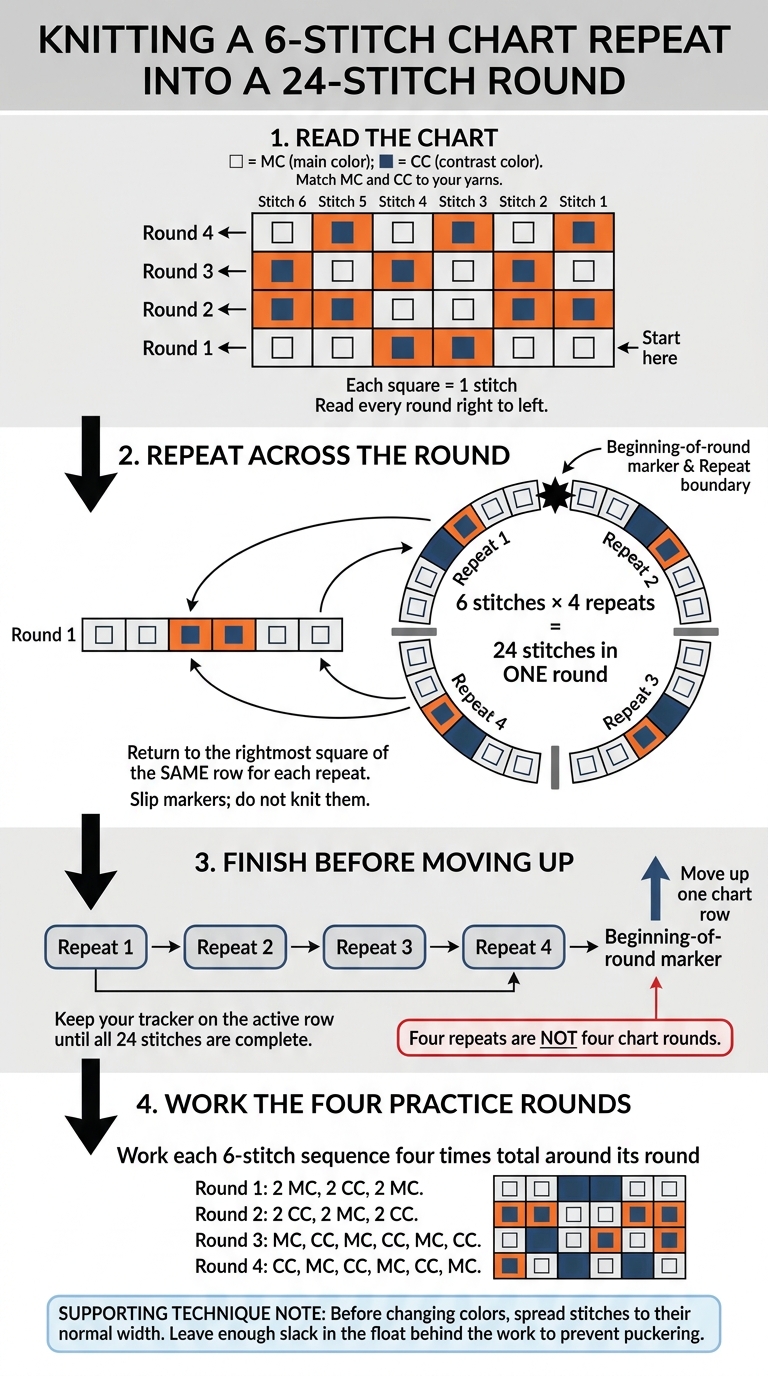
How to Read Stranded Colorwork Charts in the Round
Use this chart to knit the 24-stitch practice round. □ = MC (main color); ■ = CC (contrast color). The six stitch columns make one complete repeat. Start at the bottom-right square, labeled Start here, and read each row from right to left.
| Round | Stitch 6 | Stitch 5 | Stitch 4 | Stitch 3 | Stitch 2 | Stitch 1 (Start here) |
|---|---|---|---|---|---|---|
| 4 | MC | CC | MC | CC | MC | CC |
| 3 | CC | MC | CC | MC | CC | MC |
| 2 | CC | CC | MC | MC | CC | CC |
| 1 | MC | MC | CC | CC | MC | MC |
Place Markers Every 6 Stitches
Start with the 24-stitch setup from the practice section. Keep your beginning-of-round marker and place markers every six stitches to divide the round into four repeats.
Slip each marker from one needle to the other without knitting it. Each marked section represents one six-stitch repeat, and all four sections should match the same chart row before you move up.
Read and Knit Each Square in Round 1
Follow the bottom row for all four repeats, similar to how you would approach top colorwork knitting patterns.
Round 1 - Start here: Knit 2 MC, 2 CC, 2 MC. Repeat this six-stitch sequence three more times, in each remaining repeat.
Carry the unused yarn behind the work as a float. Before changing colors, spread the stitches to their normal width - don't bunch them together or stretch them too far apart. The floats need enough slack to let the fabric open without puckering.
Complete All 4 Repeats Before Moving Up
At each marker, check that your six stitches match the current sequence. Keep your tracker on the active row until you've worked all 24 stitches and reached the beginning-of-round marker. Then move the tracker up one row.
Round 2: Knit 2 CC, 2 MC, 2 CC. Repeat this sequence three more times.
Round 3: Alternate MC and CC across all 6 stitches. Repeat 3 more times.
Round 4: Alternate CC and MC across all 6 stitches. Repeat 3 more times.
Work each sequence four times total around its round. Repeat across the round, not down the chart.
Find and Fix Chart-Reading Mistakes
Find the First Wrong Color
Use the repeat markers to locate the round where the mistake starts. Before undoing stitches, check the round, chart key, repeat boundaries, and any stitches outside the repeat. Compare the repeat with the current row and the row below. Lost your place? Count up from the last correct round.
Starting at the beginning-of-round marker, follow the stitches in knitting order (refer to knitting video tutorials if you need a refresher) to find the first wrong stitch, not just the one that stands out. Mark it with a locking marker, then tink back - undoing one stitch at a time - to that point and rework it. If you spot a loose strand on the front, check whether you accidentally caught the unused yarn.
Check Stitch Counts and Markers
Count 6 stitches per repeat and 24 stitches total. Uneven spacing between markers may point to a misplaced marker, an added stitch, or a missing stitch. Check the stitches on both sides of each boundary before making changes. Move a marker only if its position is wrong - not to make an incorrect stitch count fit.
Check for Tight Floats
If the colors match the chart but the fabric puckers, check your tension rather than your chart reading. Spread the stitches along the needle and look at the back. A float is too short if it pulls neighboring stitches together or keeps the fabric from stretching comfortably.
Undo the affected stitches or round, then reknit while carrying the yarn loosely across the back. Avoid pulling the unused yarn snug after a color change. Blocking may smooth small uneven spots, but it won’t reliably fix a float that’s too short.
Conclusion: Check Each Round Before Moving Up
Before every round, confirm the round number. Read right to left, match each square to the key, finish every repeat, check your markers and stitch count, and keep floats loose.
Repeat markers divide the round into 6-stitch repeats. To keep each repeat aligned with the chart row, return to the rightmost square of that same row for each repeat. Move the tracker only after you’ve completed all four repeats and reached the beginning-of-round marker.
Practice the checklist until it feels automatic. Place a sticky note below the active row to track your place, and move it only after finishing the full round.
FAQs
How do I adapt a chart for knitting flat?
When adapting a colorwork chart for knitting flat, alternate the direction you read each row rather than reading every round from right to left. Read right-side (RS) rows from right to left and wrong-side (WS) rows from left to right.
Check your pattern’s legend for how to work each symbol - including knit and purl stitches - on the wrong side. This keeps the design looking as intended.
What if my stitch count doesn’t fit the repeat?
First, check your total stitch count against the pattern’s requirements. If it doesn’t match, add or remove stitches to fit the repeat, or choose a pattern that works with your current count, such as a basic knit-one, purl-one rib.
Place stitch markers between repeats to help spot extra or skipped stitches early.
When should I catch long floats?
Secure long floats as needed - the length that needs catching depends on your tension. Techniques like Stranded Ladderback Jacquard can help hold floats in place. To see how it works, watch Alpaca Direct’s tutorial on its YouTube channel.