Your Cart is Empty


Cascade 220 yarn is a popular choice for spring knitting projects, thanks to its lightweight feel, vibrant color options, and excellent stitch definition. Made from 100% Peruvian Highland wool, this worsted-weight yarn balances softness and durability, making it ideal for creating shawls, cardigans, and home decor items. Each 100g skein offers 220 yards for $11.75, providing great value for knitters.
Key highlights:
Cascade 220's breathable properties and spring-ready palette make it perfect for transitional weather. Whether you're crafting a lace cardigan, a sleeveless top, or a mitered square throw, this yarn delivers reliable results. For more ideas and free patterns, check out Alpaca Direct's blog and YouTube channel.
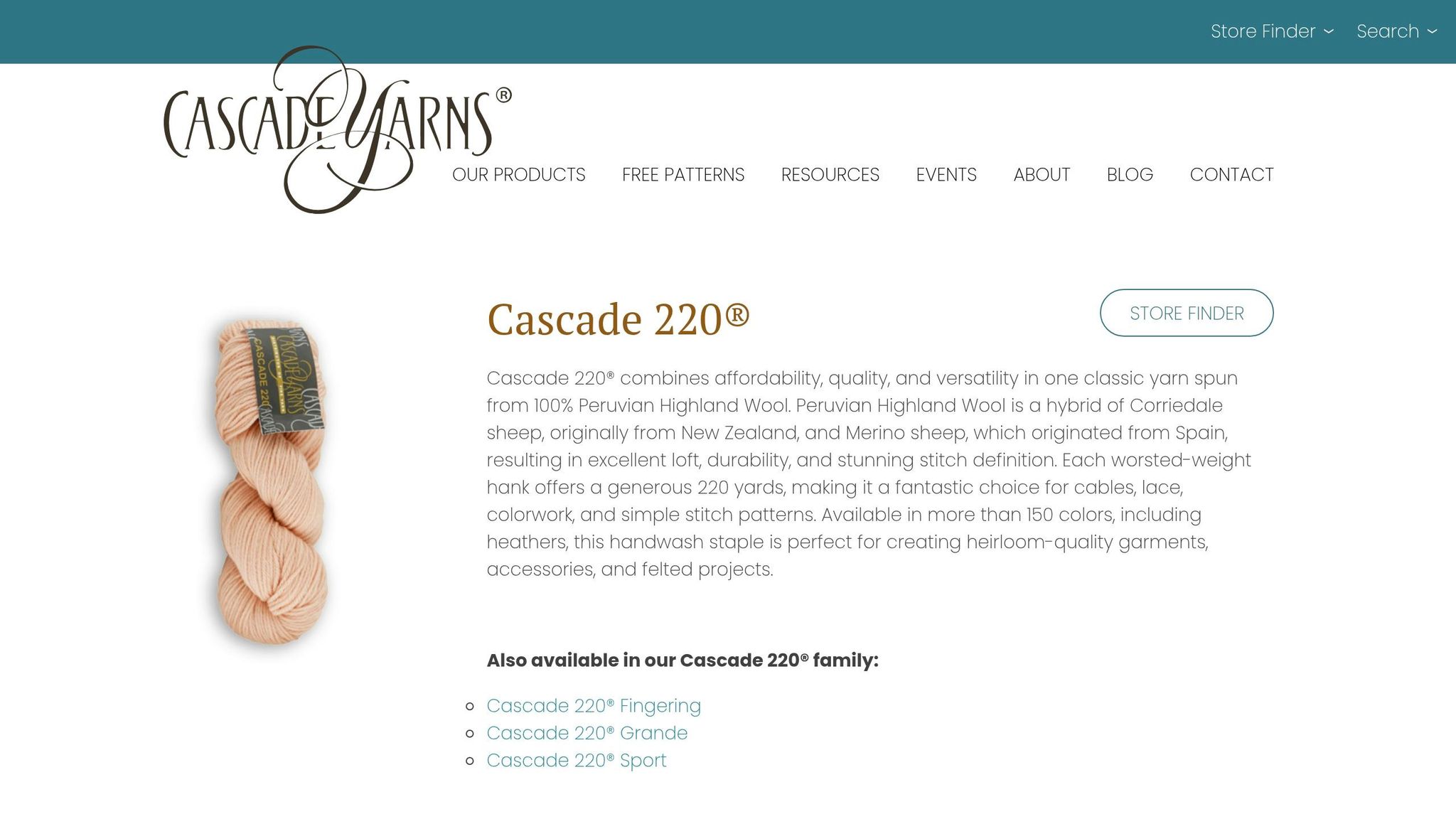
Cascade 220 stands out as a fantastic choice for spring knitting, largely due to its pure Peruvian Highland wool composition. This yarn, a blend of Corriedale and Merino fibers, offers a mix of softness and durability. The resulting fabric is warm yet lightweight - ideal for those unpredictable spring days when the weather can't make up its mind.
Its price point is another key advantage. At $11.95 to $16.00 for 220 yards, Cascade 220 provides great value for knitters tackling multiple projects in a single season. As Swanky Mountain puts it:
Cascade 220 is the perfect combination of durability, softness, and affordability, making this a no-brainer for all walks of knitter, crocheter, weaver, and beyond
With over 250 shades to choose from - including solids, heathers, and multi-colored "paints" - this yarn accommodates everything from simple cardigans to intricate colorwork designs. Plus, its excellent stitch definition makes it a go-to for lace panels and openwork patterns, which are perfect for spring garments that need to balance warmth and breathability.
Cascade 220's loft creates a fabric that feels light and airy. Cast On Yarn Shop highlights this quality:
Peruvian Highland Wool resulting in loft, durability and fabulous stitch definition
This makes the yarn a great choice for transitional pieces like shawls, wraps, and lightweight sweaters - perfect for those cool spring mornings.
For warmer days, using larger needles can help create a more open, drapey fabric. This technique works particularly well for spring accessories and garments where you want coverage without feeling overheated.
Cascade 220's extensive color palette is perfectly suited to springtime vibes. Pastel shades like Tutu (#9477), Rose Cloud (#1065), and Peach Dust (#1049) evoke the soft, delicate feel of the season. For a bolder look, brighter hues like Sunflower (#1026), Lemon Yellow (#4147), and Poppy Red (#1021) bring a cheerful energy. If you're inspired by nature, greens such as Tender Greens (#1034), Primavera (#8903), and Jasmine Green (#9623) are excellent choices for botanical-themed projects.
For something extra special, the Springtime colorway in the 220 Superwash Wave line offers a color-shifting effect with bright blues, greens, yellows, and pinks specifically designed for spring. Heathered shades also add subtle depth and texture, making them a favorite for simple yet elegant garment designs. With such a vibrant range and great stitch definition, Cascade 220 is a natural fit for creating beautiful spring-ready pieces.
Discover two stylish garment patterns that strike the perfect balance between warmth and breathability - just what you need for those unpredictable spring days. Thanks to the lightweight and airy qualities of Cascade 220, these designs are both functional and seasonally appropriate.
A spring cardigan featuring lace panels offers a breathable yet cozy layer. Using lace stitches like Irish Mesh or a 16-row repeat with yarn overs, k2tog, and ssk creates intricate openwork that promotes airflow. Designer Ashley Lillis describes it best:
"The lace stitch gives the cardigan a delicate look with a fun texture and provides a light, airy layer for spring and summer."
Materials: Plan for 5–7 skeins of Cascade 220, depending on the size. Use US 7–9 needles for the main body to achieve a loose, breathable fabric, and switch to smaller needles (US 4–6) for ribbed edges. Aim for a gauge of around 22 stitches per 4 inches after wet blocking to preserve the airy texture. The cardigan’s design includes a relaxed V-neckline, drop shoulders, and 3/4 sleeves, making it an easy-to-layer piece. Wet blocking is essential to fully open up the lace panels and enhance the drape.
For a lighter option, a sleeveless shell top offers minimal coverage with a stylish touch. Incorporate eyelet rows or lattice stitches (Row 1: *yo, k2tog; Row 2: Knit) to add geometric texture and improve ventilation. Designer Laura Ferguson shares:
"This sweater is a delightfully quick project to welcome spring and to wear right through summer."
Materials: Use 2–4 skeins of Cascade 220, depending on the size. Knit the pieces flat using US 6–8 needles, then seam them together for added structure. Begin with a non-rolling edge, such as ribbing or garter stitch, and transition into your chosen lightweight stitch pattern. Shape armholes with simple decreases like ssk and k2tog, and finish with a clean edge - either by picking up stitches for a knit border or adding a simple crochet trim around the armholes for a polished look.
Spruce up your spring wardrobe with accessories that blend style and simplicity. These projects are perfect for knitters looking for quick, rewarding creations without the commitment of a larger garment. Using Cascade 220 yarn, you can craft practical and stylish pieces that work up quickly while highlighting the yarn’s versatility. Whether it’s a linen stitch scarf or a pair of fingerless mitts, these patterns require minimal materials and easy techniques, making them ideal for building your knitting skills.
The linen stitch creates a fabric with a dense, woven appearance and a graceful drape. As Gianna Mueller from Purl Soho describes, it’s a "meditative stitch pattern that creates a dense, woven-looking fabric with a beautiful, flowing drape". For spring, use US 8–10 needles to produce a light, airy texture.
How to Begin: Start by casting on an odd number of stitches using the Long Tail Cast On - 31 stitches will give you a scarf about 6 inches wide. To maintain the correct stitch orientation, always slip stitches purlwise. Follow this two-row pattern:
Continue until the scarf measures 50–60 inches, or your preferred length.
Finishing Touches: Bind off using a needle one or two sizes larger to avoid a tight edge. Wet block the scarf by soaking it in lukewarm water for 15–20 minutes, then lay it flat to dry. Wet blocking is especially important for the linen stitch as it relaxes the fibers and enhances the drape. For an extra flourish, add fringe by cutting 4-inch strands of Cascade 220, folding them in half, and attaching them to the edge using a crochet hook.
If you’re ready for more, consider knitting fingerless mitts to complement your scarf.
Fingerless mitts are a great next step after a scarf, offering a quick and functional project. When knit flat on two needles, they’re especially beginner-friendly, as this method avoids the gaps or "ladders" that can occur when knitting in the round. Louise from Handy Little Me points out that this technique ensures "you would not see any ladders or gaps at the side seams of the gloves". These mitts combine 2x2 ribbing with a simple broken rib stitch for texture without added difficulty.
How to Make Them: Use US 8 (5.0 mm) needles and cast on 32 stitches. Start with 1 inch of 2x2 ribbing (K2, P2) for a snug wrist band. Then switch to the broken rib stitch:
Repeat these two rows until the piece measures 11 inches from the cast-on edge. When finished, the mitt will measure about 11.5 inches long and 6.5 inches wide when laid flat, with a gauge of 16 stitches and 26 rows per 4 inches.
Seaming and Thumb Opening: Fold the rectangle in half lengthwise with the right sides together. Use mattress stitch for a nearly invisible seam, sewing up from the wrist edge for 7.5 inches. Leave a 2-inch gap for the thumb opening, then seam the remaining 2 inches to the top. Turn the mitt right side out and lightly steam or wet block for a polished finish.
For step-by-step demonstrations of these techniques, check out our YouTube channel: https://www.youtube.com/@AlpacaDirect.
Welcome spring into your home with decor projects that showcase Cascade 220's versatility. Whether it's a mitered square throw or a textured pillow cover, these projects bring seasonal colors to your space while offering knitters a chance to try new techniques without committing to large, single-piece designs.
Mitered squares, knit from the edges inward, feature a distinct diagonal line that creates a clean, geometric look. Kristen McDonnell from Studio Knit explains:
Mitered squares are typically knit in the beginner-friendly Garter Stitch. This texture is the most popular choice because of its structural integrity.
The garter stitch's natural 1:2 stitch-to-row ratio simplifies the process, producing a perfect square without the need for complex math.
How to Start: To make an 8-inch square, cast on 76 stitches with Cascade 220. Begin by knitting 38 stitches, placing a center marker, and knitting the remaining 38 stitches. For right-side rows, knit to 2 stitches before the marker, k2tog, slip the marker, ssk, and knit to the end. On wrong-side rows, knit all stitches. Repeat this pattern until only 4 stitches remain, then knit k2tog and ssk, break the yarn, and pull the tail through the last 2 stitches.
Spring Color Ideas: Choose colors that capture the vibrancy of the season. Jake Canton from Purl Soho shares:
The Mitered Corner Blanket pattern remains a truly artful next-level project, a masterful study in color and construction that is as close to painting as knitting gets.
For a fresh spring palette, try "Dawn" with yellows, whites, pinks, and oranges, or "Mountain" with purples, turquoise, eggshell blue, and lavender. Pair one bold, vibrant color with a neutral shade in each square to achieve balance and visual interest.
Assembly Tips: Knit each square individually and join them using mattress stitch or whipstitch for portability. Alternatively, pick up stitches along the edge of a finished square to join as you go, eliminating the need for seaming. Wet-block each square before assembly to ensure uniformity and clean edges. For a polished look, finish with an i-cord edging around the entire throw.
If you're looking for another way to refresh your space, the textured basketweave pillow cover is a great option.
A basketweave pillow cover combines simple knit and purl stitches to create a textured, woven appearance. Kathy Lewinsky from Just Crafty Enough highlights its appeal:
Buying pillow covers is a thing of the past when you can just as easily knit up a beautiful Basket Weave Pillow of your own.
This project is beginner-friendly but delivers a polished, professional result that can be swapped out seasonally.
How to Make It: Use US 7 (4.5 mm) needles with Cascade 220 or Cascade 220 Superwash for crisp stitch definition. The basketweave pattern alternates blocks of knit and purl stitches, creating a textured effect that complements spring colors. Knit two panels - the front and back - to fit a 16- or 18-inch square pillow form.
Finishing Touches: Seam three sides using mattress stitch. For the fourth side, pick up stitches to create a button tab. Add buttonholes by binding off 3 stitches and casting them back on with a backward loop increase in the next row. This design makes it easy to remove the cover for washing or to swap it out with new designs throughout the year.
For more tips on blocking and seaming, check out our YouTube channel: https://www.youtube.com/@AlpacaDirect.
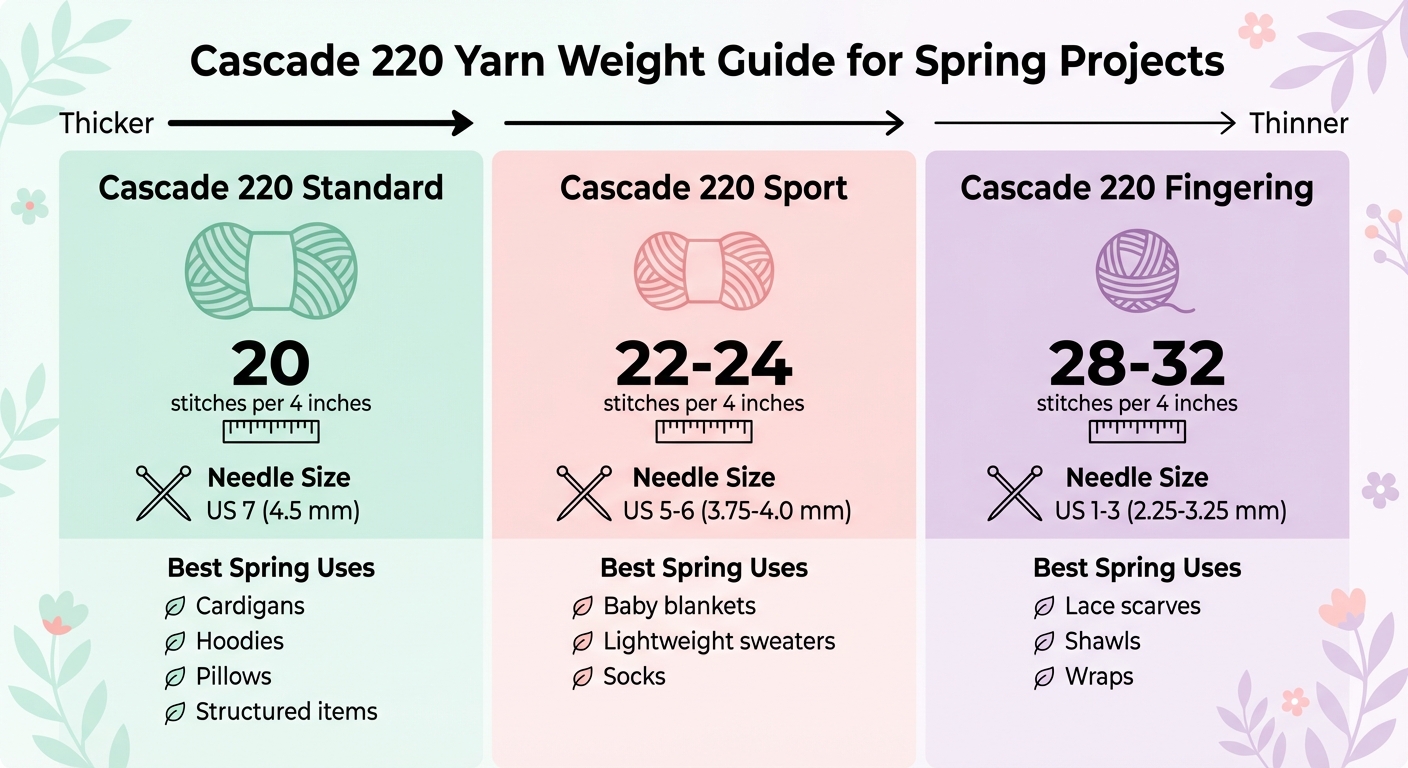
Cascade 220 Yarn Weight Comparison Guide for Spring Knitting
Let’s dive deeper into how to fine-tune your color choices with Cascade 220 to make your spring projects stand out. The right color selection can elevate even the simplest pattern, turning it into something eye-catching. Cascade 220’s broad palette captures the essence of spring while staying subtle enough to complement intricate stitchwork.
Spring is all about soft, fresh tones. Pastels like Robin Egg, Baby Blue, Lavender, Lilac Mist, Soft Pink, and Cotton Candy bring a light and airy feel to your garments. For a nature-inspired vibe, muted greens like Sage, Pistachio, Primavera, and Citron work beautifully.
Want to play around with your palette? Try blending Cascade 220 with lace-weight kid-mohair. A lighter mohair softens the overall color, giving it a dreamy, springtime feel. On the other hand, pairing it with a brighter mohair can make speckles in hand-painted yarns stand out more vividly. Heathered shades are another great option - they add layers of depth and texture, making your project visually dynamic.
Color is just one piece of the puzzle - getting the right gauge is equally important. The gauge you choose affects how your project drapes and breathes, which is especially key for spring wear.
| Yarn Type | Gauge (per 4") | Needle Size | Best Spring Uses |
|---|---|---|---|
| Cascade 220 Standard | 20 sts | US 7 (4.5 mm) | Cardigans, hoodies, pillows, structured items |
| Cascade 220 Sport | 22–24 sts | US 5–6 (3.75–4.0 mm) | Baby blankets, lightweight sweaters, socks |
| Cascade 220 Fingering | 28–32 sts | US 1–3 (2.25–3.25 mm) | Lace scarves, shawls, wraps |
If your project prioritizes breathability - like lace scarves or wraps - stick with Fingering or Sport weights. For items that need more durability and structure, the standard worsted weight is your best bet.
Cascade 220 is an excellent choice for spring knitting, offering a lightweight worsted weight yarn, vibrant color options, and a fabric that works beautifully for transitional garments. Whether you're crafting an airy cardigan or a textured throw, this yarn stands out in spring projects.
Priced at $11.95 per 100g skein, Cascade 220 combines affordability with versatility. Plus, the Superwash option adds the convenience of being machine-washable. Its lightweight nature makes it ideal for creating pieces like wraps and cardigans that provide just the right amount of warmth on those cooler spring days.
Ready to start your next project? Visit the Alpaca Direct website to explore the collection, and enjoy free shipping on U.S. orders over $75. Don’t miss the free spring patterns on the blog, featuring everything from lightweight shawls to breezy cardigans.
For extra inspiration and guidance, check out our YouTube channel at https://www.youtube.com/@AlpacaDirect. You'll find tutorials on techniques like mosaic knitting and advanced finishing methods. Plus, consider joining Kelley’s Knit Club to sharpen your skills and take advantage of our loyalty program to earn rewards on every purchase.
Cascade 220 yarn is a great choice for springtime projects, thanks to its soft and comfortable feel. The slightly cushy texture makes it perfect for creating lightweight garments and accessories that are gentle against the skin. Its versatility means you can use it for a wide range of spring designs.
When determining how many skeins you'll need, it all comes down to your size and the specific pattern you're following. Most patterns will include the required yardage based on size, which makes planning much easier. For example, if you're making an adult sweater or cardigan with Cascade 220 (a worsted weight yarn), you’ll likely need about 8–12 skeins. On the other hand, lighter spring projects typically require fewer skeins. Always refer to your pattern for precise yardage and skein requirements to avoid running out mid-project.
When deciding between Cascade 220 and Cascade 220 Superwash, it all comes down to your project’s requirements.
Cascade 220 Superwash is a machine-washable option that’s more durable, making it a great choice for items like spring accessories, lightweight clothing, or anything that will need frequent washing. On the other hand, Cascade 220 provides the classic wool feel with a rich variety of colors, making it perfect for traditional projects where machine washing isn’t necessary.
Think about how the finished piece will be used and cared for to choose the right yarn for your needs.

Comments will be approved before showing up.