Your Cart is Empty


Alpaca yarn is a natural, biodegradable fiber with low environmental impact, making it a better choice over synthetic materials. Alpacas require less water, emit fewer greenhouse gases, and their soft grazing habits protect the soil. Additionally, alpaca yarn is hypoallergenic, softer, and longer-lasting compared to traditional wool. Below are seven brands that prioritize ethical sourcing, animal welfare, and sustainable practices while delivering high-quality alpaca yarn:
These brands combine ethical practices with premium yarn quality, offering a sustainable option for knitters and crafters.
| Brand | Certifications | Sourcing & Practices | Key Features | Price Range |
|---|---|---|---|---|
| Fluff Alpaca | None | U.S.-based farm-to-fiber | Natural colors, hypoallergenic | $$ |
| Alpaca Warehouse | None | Peruvian farms | Soft, durable, hypoallergenic | $ |
| Amano Yarns | OEKO-TEX, RAS, GOTS | Traceable baby alpaca fiber | Chemical-free, premium softness | $$$ |
| Indigenous Designs | OEKO-TEX, WFTO | Fair wages, pesticide-free | Low-impact dyes, heirloom quality | $$$ |
| Hushabye Alpaca | None | Vermont family farm | Natural fertilizer, soft fibers | $$ |
| PAKA | Certified B Corp | Solar-powered production | Biodegradable, odor-resistant | $$$ |
| Arms of Andes | GOTS | Peruvian Royal Alpaca | Compostable, long-lasting garments | $$$ |
Choose a brand that aligns with your values and enjoy crafting with eco-friendly alpaca yarn.
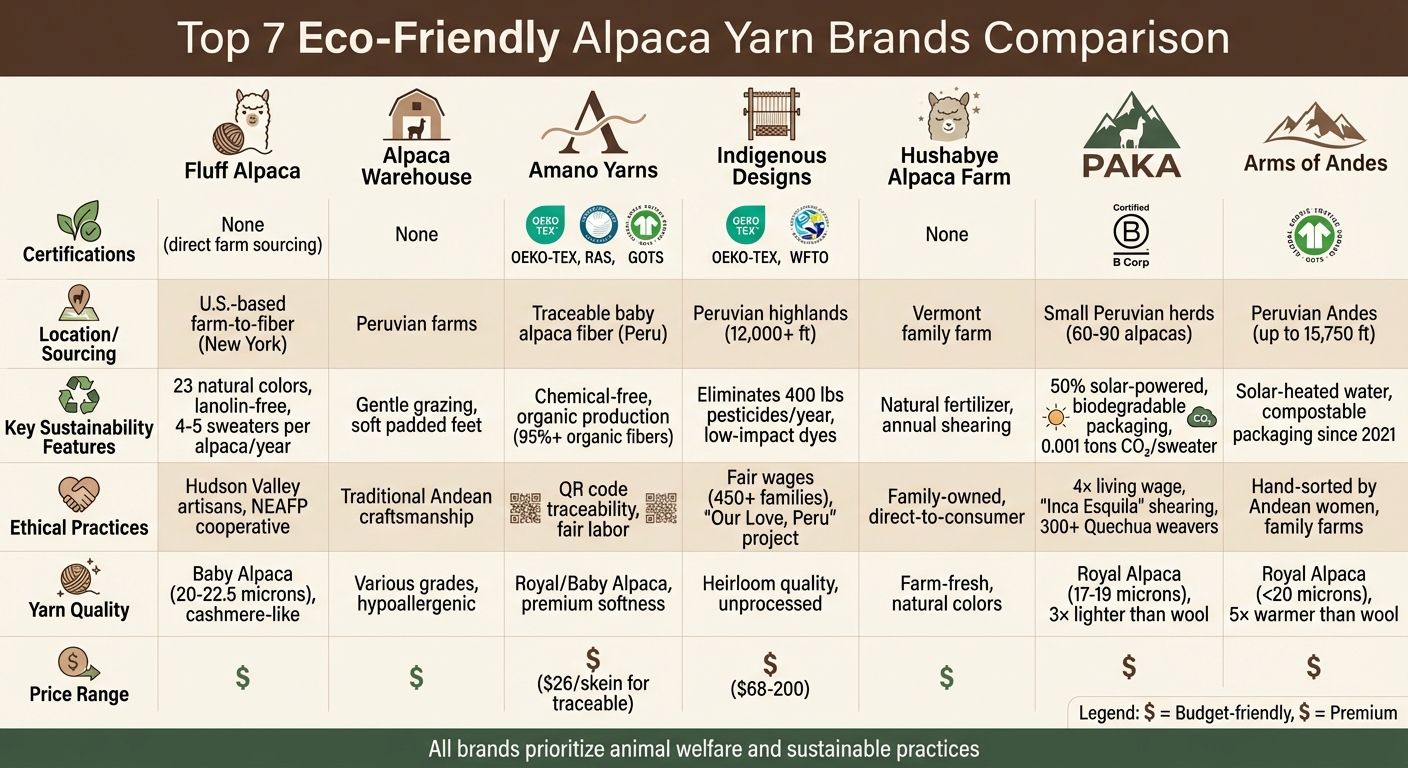
Eco-Friendly Alpaca Yarn Brands Comparison: Certifications, Practices & Quality
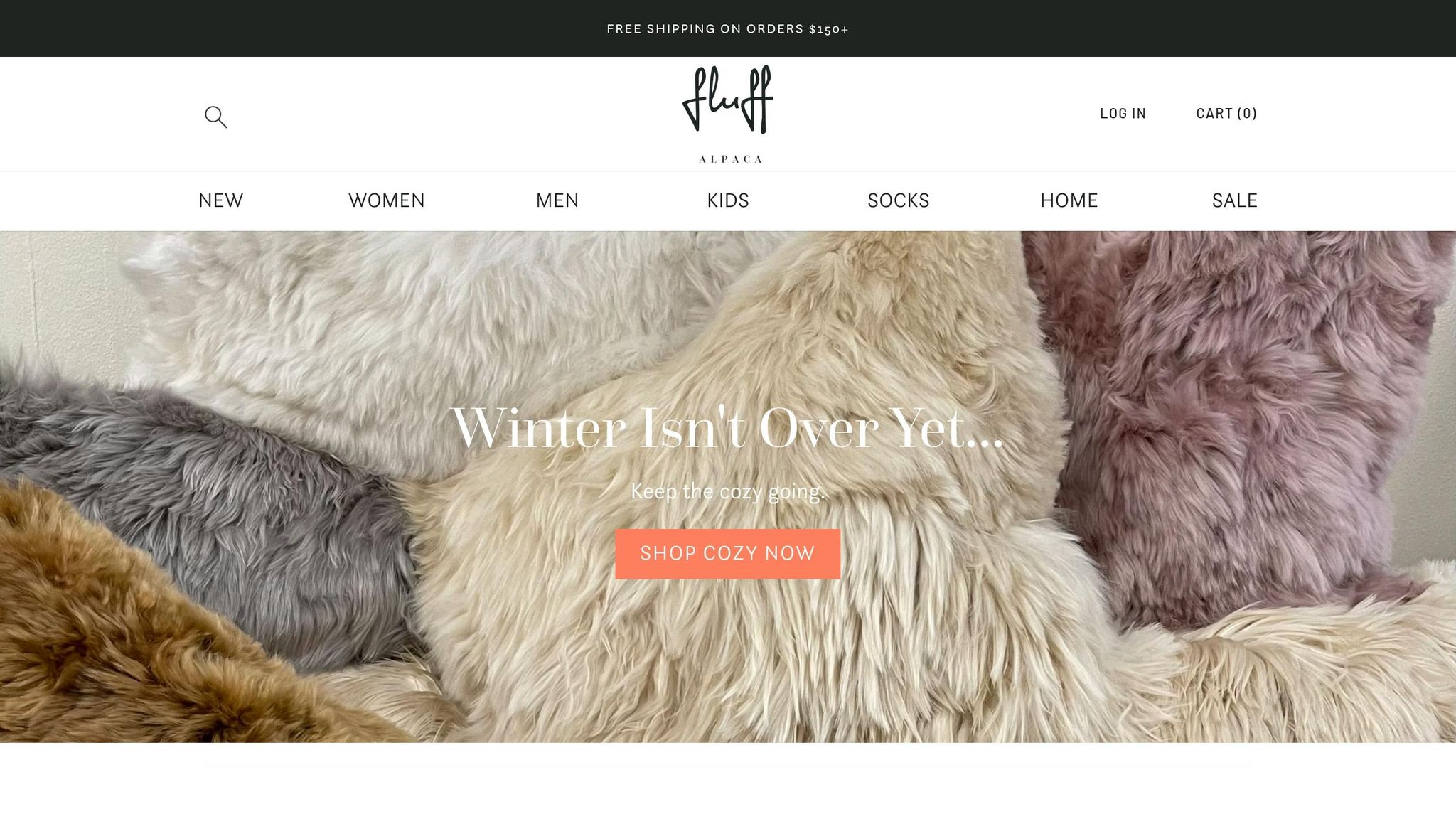
Fluff Alpaca operates Green River Hollow Farm in Hillsdale, New York, where alpacas are raised with organic, chemical-free farming methods. Each April, the alpacas are shorn locally, and their fiber is sent to America's Natural Fiberworks in Ohio for milling. This ensures that every step of the process stays within the United States.
At Green River Hollow Farm, the alpacas roam freely and are shorn once a year to ensure their health and comfort. Fluff Alpaca is part of the New England Alpaca Fiber Pool (NEAFP), a cooperative that combines fiber from thousands of U.S. farms to support local farmers and domestic textile mills. Additionally, they collaborate with Hudson Valley knitters to create hand-knit, farm-to-fiber products.
Fluff Alpaca incorporates eco-conscious practices into every stage of production. By using 23 natural alpaca colors and lanolin-free fiber, they avoid synthetic dyes and harsh chemical treatments. Impressively, a single alpaca can produce enough fiber annually to make 4 to 5 sweaters while requiring only 1–2% of its body weight in daily food consumption.
Fluff Alpaca yarn is crafted with a hollow core, providing excellent heat retention while remaining lightweight. Its lanolin-free fiber is naturally hypoallergenic, making it smoother than traditional wool. Additionally, it is naturally flame-resistant, water-repellent, and biodegradable when untreated, offering both comfort and sustainability.
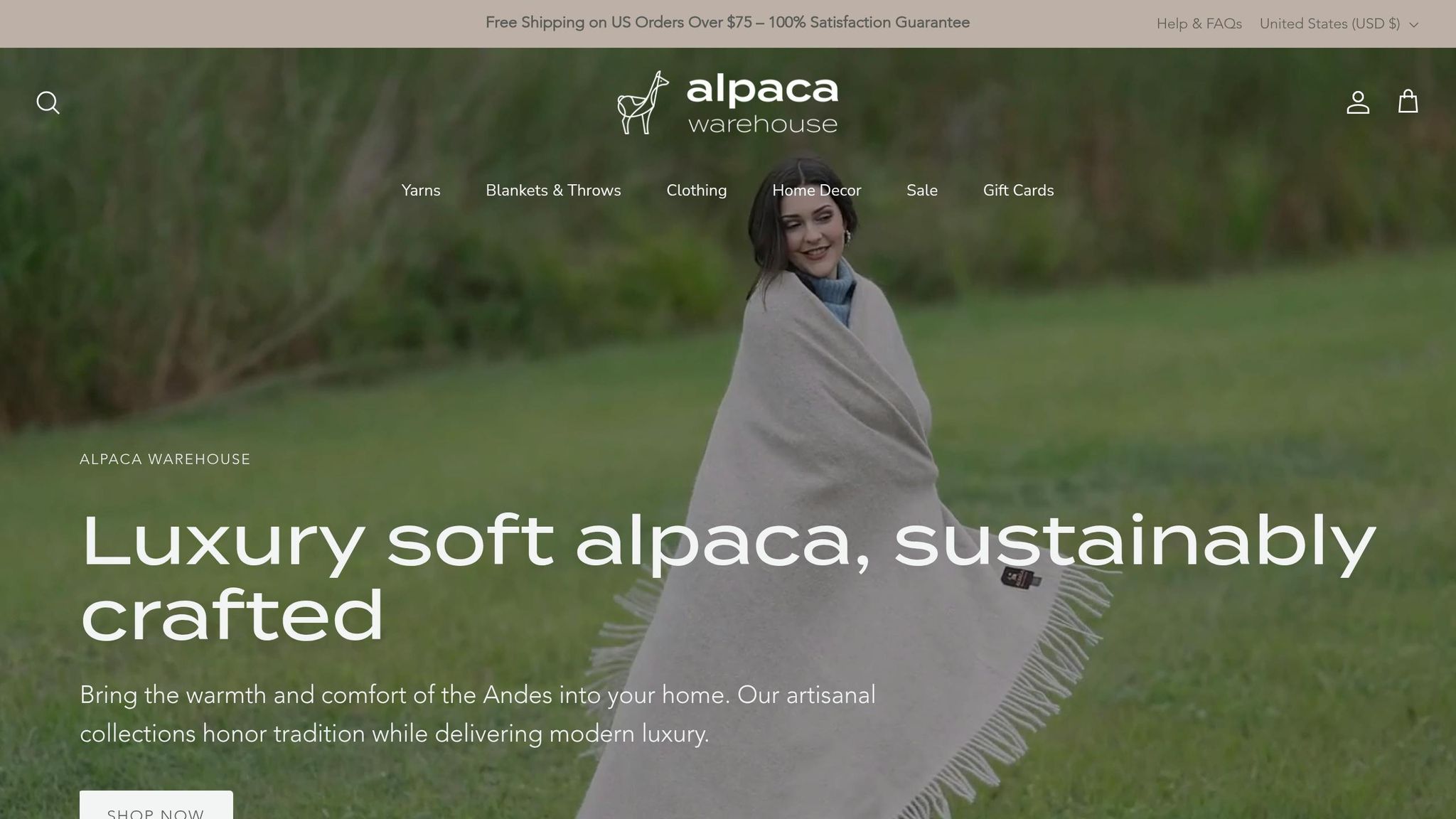
Alpaca Warehouse brings premium alpaca yarn straight from Peru, where the rich heritage of Andean craftsmanship has been preserved for generations. Their yarn reflects a deep respect for tradition and a commitment to responsible, eco-conscious sourcing practices throughout their supply chain. This dedication ensures their products honor both the environment and the artisans behind them.
The alpacas providing fiber for Alpaca Warehouse are native to the Andes, where they’ve thrived for millennia. Unlike sheep or goats, alpacas graze gently, nibbling only the tops of grasses without uprooting them. This allows vegetation to regenerate naturally. Plus, their soft, padded feet minimize soil damage, making them a more environmentally friendly choice. These natural grazing habits not only safeguard the ecosystem but also contribute to the exceptional quality of the fiber.
Alpaca Warehouse yarn is prized for its unmatched softness and durability, making it a favorite among knitters and crocheters. Alpaca fiber offers warmth without being heavy and is hypoallergenic, making it a great option for people with sensitive skin. On top of that, producing alpaca yarn requires less land and water compared to other fibers, and the finished product is long-lasting when cared for properly. It’s a perfect blend of comfort, quality, and sustainability.
Amano Yarns backs up its commitment to eco-consciousness with three international certifications that focus on chemical safety and animal welfare. This Peruvian brand relies on third-party audits to confirm its environmentally friendly practices. As the brand puts it: "These certifications are not decorative. They are concrete proof that each product has undergone audits, controls, and processes that guarantee real sustainability."
A large portion of Amano's fiber offerings comes with the OEKO-TEX Standard 100 certification, which ensures the yarn is free from harmful chemicals and safe for skin contact. Their Puna and Puna Light lines meet the Responsible Alpaca Standard (RAS), which emphasizes animal welfare, responsible land use, and full fiber traceability. Additionally, the Sami and Sami XL lines are certified under the Global Organic Textile Standard (GOTS), which ensures organic production processes and fair labor conditions throughout the supply chain. These certifications align seamlessly with Amano's transparent sourcing practices.
Amano's Puna Traceable line raises the bar for transparency. Each skein, priced at $26.00, includes a QR code that allows customers to trace the 100% baby alpaca fiber back to the specific farm where it originated. Designer Luis Lopez-Preciado highlights the importance of this approach:
"I love premium fibers sourced from people who truly value and care for their animals, that's why Amano Yarns is my go-to brand."
Amano is known for its premium alpaca grades, including Royal Alpaca (the finest grade available), Imperial Alpaca, and Baby Alpaca. Knitters frequently rave about the yarn's unmatched softness. Designer Laura Zukaite shared, "100% Royal Alpaca melts between your fingers!" Beyond its luxurious texture, alpaca fiber is naturally hypoallergenic since it lacks lanolin, and the OEKO-TEX certification provides additional peace of mind for those with sensitive skin. Professional knitting instructors also emphasize how Amano's high-quality fibers enhance the final product, offering a touch of luxury without the hefty price tag.
Indigenous Designs has earned its place among eco-friendly alpaca yarn brands with a clear focus on ethical production and environmental responsibility. With over 20 years of collaboration with Peruvian artisan cooperatives, the brand has built a reputation for producing ethically made, environmentally conscious products. Their commitment is backed by certifications like OEKO-TEX® STANDARD 100, which guarantees their low-impact dyes are free from harmful chemicals. Additionally, their adherence to World Fair Trade Organization (WFTO) standards ensures fair trade practices are at the core of their operations. Let’s take a closer look at how their ethical sourcing, environmental initiatives, and dedication to quality set them apart.
Indigenous Designs sources its alpaca fiber from small-scale ranchers in the Peruvian highlands, located over 12,000 feet above sea level. This approach helps sustain a 1,400-year-old pastoral tradition. Through their "Our Love, Peru" project, the company supports over 450 families in the Arequipa region with fair wages and investments in their communities. They use a transparent revenue-sharing model that ensures artisans are fairly compensated:
"The artisan makes a fair, living wage well above what they might earn working independently."
This focus on ethical practices not only uplifts local communities but also preserves traditional craftsmanship.
By using organic, pesticide-free fibers, Indigenous Designs eliminates approximately 400 pounds of pesticides annually. Their PURE Collection highlights undyed alpaca products, showcasing the natural color variations of the species. This approach reduces chemical usage while promoting genetic diversity within alpaca populations. The brand also employs an Azo-dioxazine-free dyeing process and advanced wastewater filtration systems to minimize environmental harm.
Indigenous Designs prioritizes creating heirloom-quality pieces built to last. Their cardigans start at around $68.00, with most products priced between $100 and $200. The alpaca fiber they use is naturally lanolin-free and unprocessed, which helps preserve its color and makes it hypoallergenic, durable, and long-lasting. These features ensure that their products are not only beautiful but also practical for everyday wear.
Hushabye Alpaca Farm is all about creating eco-friendly alpaca fiber while keeping things simple and sustainable. Their approach combines traditional techniques with a focus on minimizing environmental impact, making them a go-to for environmentally conscious knitters.
At Hushabye, alpacas are sheared just once every year to year and a half, typically in the spring or early summer, ensuring high-quality fiber while keeping the animals cool and comfortable. These gentle creatures have padded feet that cause far less damage to the soil compared to other livestock, helping to prevent erosion and land degradation. Plus, their manure is collected into communal piles, which can be used as a natural fertilizer, giving back to the land in a meaningful way.
Hushabye’s dedication to sustainability goes beyond ethical farming. Alpacas require significantly less food and water than many other animals, making them a resource-efficient choice, especially in areas where resources are scarce. On top of that, alpaca fiber is naturally odor-resistant, meaning garments made from it need less frequent washing. This small detail can lead to big savings in water and energy over the product’s lifespan.
Alpaca fiber stands out for its silky feel, thanks to its unique microscopic structure. Unlike sheep wool, alpaca fibers have smoother scales that sit closer to the surface, which eliminates that itchy, prickly sensation. Another bonus? Alpaca yarn is hypoallergenic because it doesn’t contain lanolin - the substance in sheep wool known to cause allergic reactions and skin irritation. Hushabye Alpaca Farm takes full advantage of these natural benefits to offer yarn that’s not only eco-friendly but also incredibly soft and perfect for sensitive skin.
PAKA stands out as a Certified B Corp with an impressive B Impact Score of 105.0 - more than double the median score of 50.9. The brand ensures its alpaca wool meets the highest safety standards, with OEKO-TEX certification confirming it’s free from harmful substances, and GOTS-certified dyes used throughout its products [15,29].
PAKA’s "Origin" program offers complete traceability for every garment. By scanning a product’s QR code, customers can confirm its Andean roots [29,30]. The brand partners exclusively with small, family-run herds of 60–90 alpacas, which roam freely in their natural environment [28,30]. To ensure animal welfare, PAKA uses the "Inca Esquila" shearing method, a low-stress technique officially recognized as Peru’s national technical standard (NTP 231.370-2014). Additionally, over 300 Quechua weavers are paid four times the local living wage, creating a direct positive impact on their communities [29,30]. These practices align with PAKA’s commitment to ethical sourcing and reducing its environmental footprint.
Sustainability is woven into every step of PAKA’s production process. Half of the spinning process is powered by solar energy [15,29], and the handmade garments crafted by Peruvian weavers result in production that’s nearly carbon-neutral. Shipping a single PAKA sweater generates just 0.001 tons of CO₂ - comparable to driving 2.5 miles in a car. Alpacas are also incredibly fiber-efficient: a single shearing yields enough material for 4 to 5 sweaters, unlike cashmere goats, which require four shearings to produce just one [15,24]. Even the packaging is thoughtfully designed, being fully biodegradable and compostable [15,24].
PAKA’s commitment to sustainability doesn’t compromise quality. The "Royal Alpaca" fiber, measuring 17–19 microns, is incredibly soft, lightweight, and durable, with a strength rating of 50 N/ktex [28,30]. This fiber is thermoregulating, moisture-wicking, odor-resistant, and three times lighter than sheep’s wool. Plus, since alpaca fiber contains no lanolin, it’s hypoallergenic and doesn’t require harsh chemical treatments before spinning. These qualities make PAKA’s yarn both luxurious and environmentally friendly.
Arms of Andes takes a hands-on approach to production, managing every step - from sourcing raw alpaca fleece to crafting finished garments - entirely in Peru. This localized process helps reduce the brand's carbon footprint by relying mostly on overland transport, with air freight reserved only for final delivery [31, 37, 39]. The company uses Royal Alpaca wool, which has a partially hollow structure, making it five times warmer than sheep's wool. It’s also naturally hypoallergenic since it lacks lanolin [32, 35, 36].
Arms of Andes prioritizes eco-conscious practices with GOTS-certified reactive dyes that are free from heavy metals, formaldehyde, and azo compounds. Their products are also PFAS-free, avoiding the use of "forever chemicals" commonly found in water-repellent fabrics. The brand’s "Leave No Trace" collection incorporates natural dyes sourced from Peru - cochineal for red, indigo for blue, and eucalyptus for gray - and uses 100% alpaca fiber combined with 100% cotton thread to ensure complete biodegradability [31, 33]. Since 2021, shipments have been packed in 100% compostable bags with recycled cardboard hangtags [31, 37]. These steps highlight the company’s dedication to environmentally responsible production.
The alpaca fiber used by Arms of Andes comes from small, family-operated farms in the Peruvian Andes, where alpacas roam freely at altitudes as high as 15,750 feet (about 4,800 meters) [31, 33]. The animals are sheared once a year using either traditional or approved mechanical methods that ensure their well-being and prevent bacterial infections [33, 35]. Supporting indigenous communities is a key part of the brand's mission, employing Andean women to hand-sort fibers using time-honored techniques. Peru produces about 80% of the world’s alpaca wool, with 85% of it coming from small, indigenous farming communities. This ethical sourcing approach not only benefits local communities but also contributes to environmental conservation.
The brand’s suppliers adopt water-saving measures, such as heating water with solar panels and using biodegradable detergents - an improvement over traditional wool dyeing processes, which can use up to 120 cubic meters of water per ton [33, 36]. Alpacas themselves are eco-friendly animals; their padded feet help prevent soil erosion [31, 33]. The fiber’s 8–12 inch length enhances durability and resists pilling, extending the lifespan of garments from 109 to 400 wears, which can lower environmental impact by up to 68% [35, 36].
Arms of Andes focuses on creating high-performance garments that last. Royal Alpaca wool is naturally odor-resistant and moisture-wicking, allowing for multiple wears between washes [34, 39]. It’s also nonflammable, meeting U.S. Consumer Product Safety Commission Class 1 standards. Customers have praised the apparel for its ability to regulate temperature in extreme conditions. Andy B., a satisfied customer, shared:
"Alpaca performs on par with merino - sometimes even better - and is far more eco-friendly."
The table below highlights the standout features of each brand, focusing on certifications, ethical practices, environmental efforts, and yarn quality. This summary complements the detailed descriptions provided earlier.
| Brand | Key Certifications | Ethical Practices | Eco Impact | Yarn Quality |
|---|---|---|---|---|
| Fluff Alpaca | None (direct farm sourcing) | Own-farm control; employs Hudson Valley artisans | Farm-to-fiber model eliminates intermediary transport | Baby Alpaca (20–22.5 microns); cashmere-like softness |
| Alpaca Warehouse | Not specified | Partners with small Peruvian farms | Standard alpaca production | Various grades; affordable pricing |
| Amano Yarns | OEKO-TEX Standard 100, RAS, GOTS | Full traceability; fair labor conditions | Organic production (95%+ organic fibers); responsible land management | Baby Alpaca and Superfine grades; chemical-free processing |
| Indigenous Designs | Not specified | Fair wages; community grants for clean water and education | Organic, pesticide-free fibers; Azo-dioxazine-free dyes | High-quality hand-knit garments |
| Hushabye Alpaca Farm | Not specified | Family-owned Vermont farm; direct-to-consumer | Annual shearing cycle; natural fertilizer use | Farm-fresh fiber; natural colors |
| PAKA | Not specified | Pays weavers 4× living wage; on-site daycare (Wawa Wasi); "Inca Esquila" shearing | Solar-powered spinning; nearly carbon-neutral handmade production | Premium Baby Alpaca; moisture-wicking and odor-resistant |
| Arms of Andes | Not specified | Sourced from high-altitude family farms with hand-sorted fibers | Solar-heated water; biodegradable detergents; compostable packaging since 2021 | Royal Alpaca (<20 microns); ultra-soft, silky texture |
Amano Yarns stands out with its certifications, including OEKO-TEX, RAS, and GOTS. Fluff Alpaca ensures full control over its farm-to-fiber operations, while PAKA supports artisans by paying four times the living wage and offering childcare. Arms of Andes takes eco-consciousness further with solar energy and compostable packaging. For yarn quality, Arms of Andes’ Royal Alpaca, measuring less than 20 microns, offers unmatched softness, while Fluff Alpaca and PAKA deliver Baby Alpaca fibers (20–22.5 microns) with a luxurious, cashmere-like feel.
Opting for eco-friendly alpaca yarn is more than just a crafting choice - it's a step toward protecting both people and the planet. Synthetic yarns like acrylic and nylon are notorious for their environmental toll, with one nylon manufacturer in Florida alone producing emissions equivalent to over 1,000,000 cars in 2019. Alpaca fiber, on the other hand, is entirely biodegradable and sourced from animals whose padded feet help reduce soil erosion.
The seven brands highlighted here showcase how sustainability and quality can coexist beautifully. From Amano Yarns' OEKO-TEX and GOTS certifications to PAKA's efforts, such as funding 24 scholarships for young women in Cusco by 2025, these companies are setting a high standard for ethical practices. Fluff Alpaca's farm-to-fiber model further demonstrates how thoughtful innovation can lower environmental impact while maintaining a sense of luxury.
"Choosing alpaca fabrics means you're choosing one of the world's most sustainable fabrics on the planet, and also supporting the Andean people and their cultural history." - Alpaca Collections
By supporting these brands, you're contributing to the care of over 60,000 alpacas in the Andes and helping preserve centuries-old fiber craftsmanship. To make the most eco-conscious choice, look for certifications like GOTS or Fair Trade, explore brands with transparent supply chains, and consider natural, undyed alpaca shades to limit chemical use.
Every skein of alpaca yarn you purchase not only enhances your projects but also pushes the textile industry toward a more ethical and sustainable future. With every choice, you're supporting animal welfare, fair wages, and environmental responsibility - one skein at a time. For more tips on sustainable knitting, visit our YouTube channel: https://www.youtube.com/@AlpacaDirect.
The Responsible Alpaca Standard (RAS) and the Responsible Mohair & Alpaca Standard (RMS) are two key certifications to look for when choosing eco-friendly alpaca yarn. These certifications guarantee ethical treatment of animals, responsible land management practices, and complete traceability throughout the supply chain - from farm to finished yarn. They provide assurance that the yarn meets strict environmental and ethical guidelines.
To verify that a brand's alpaca fiber is genuinely traceable, check for certifications such as the Responsible Alpaca Standard (RAS) or GOTS. These certifications guarantee ethical sourcing practices and transparency throughout the production process.
Alpaca yarn stands out as a great option for those with sensitive skin. Its hypoallergenic nature, combined with its softness and the absence of lanolin, makes it less likely to cause irritation or allergic reactions. Plus, it’s naturally odor-resistant and provides excellent insulation. On the other hand, sheep wool can sometimes lead to itching or discomfort, particularly if it contains lanolin or hasn’t been processed to enhance softness. When it comes to comfort and skin-friendliness, high-quality alpaca yarn is often the better choice.

Comments will be approved before showing up.