Your Cart is Empty


If I want the easiest baby crochet gift, I’d pick a hat set. It usually takes about 1 to 3 hours, uses 100 to 200 yards of yarn, and sizing is more forgiving. A bootie set can use under 100 yards, but fit is harder because the booties need to stay on tiny feet and both pieces need to match.
Here’s the short answer:
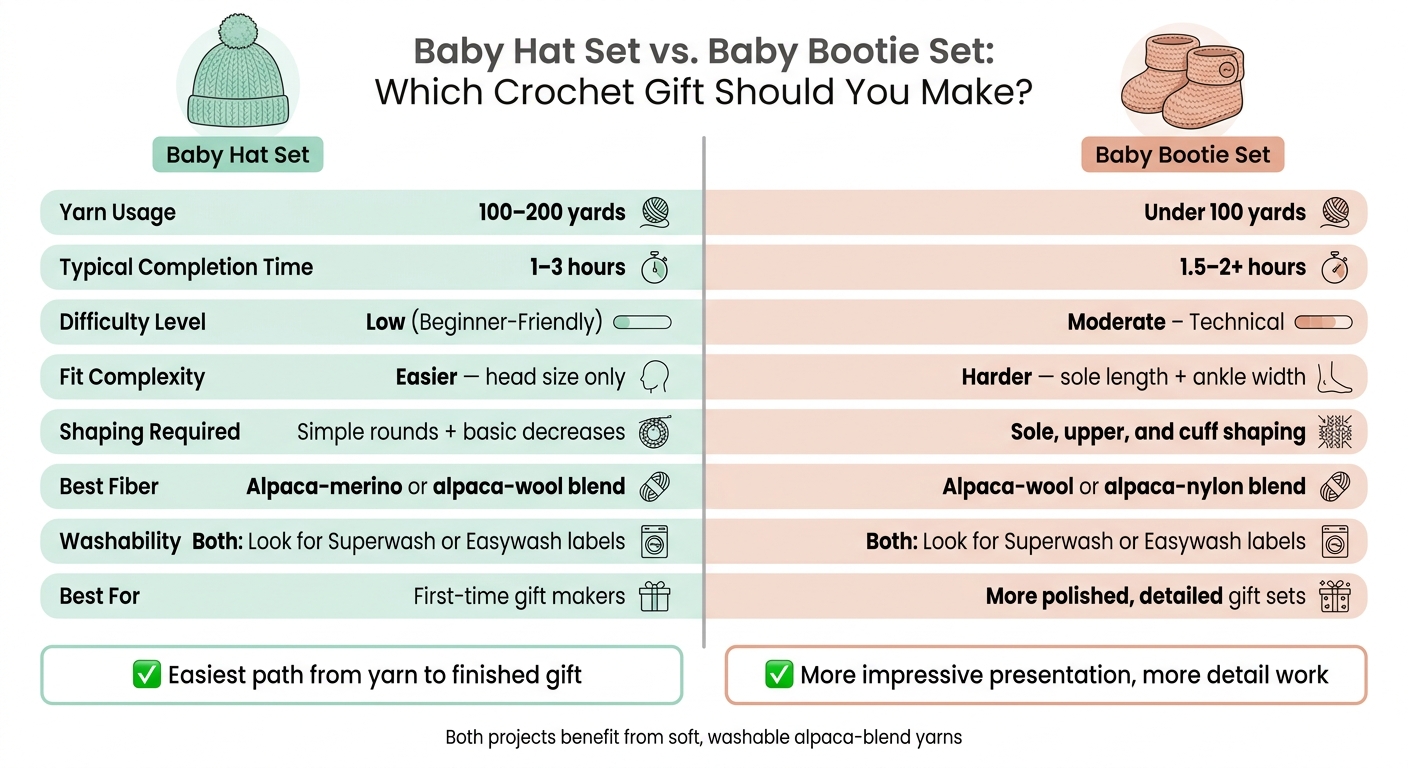
Baby Hat Set vs. Baby Bootie Set: Crochet Gift Comparison
| Point | Baby Hat Set | Baby Bootie Set |
|---|---|---|
| Yarn use | 100–200 yards | Under 100 yards |
| Fit | Easier | Harder |
| Main sizing check | Head size | Sole length + ankle width |
| Stitch work | Simple rounds | More shaping |
| Time | 1–3 hours | 1.5–2+ hours |
| Best for | First-time gift makers | More polished gift sets |
My takeaway: if I want the smoothest path to a handmade baby gift, a hat set is the safer pick. If I want a small gift that looks extra put-together, booties can be worth the extra work.
For baby gifts, yarn choice usually comes down to three things: yardage, softness, and shape retention. A hat needs a bit more structure so it stays put. Booties take more rubbing and movement, so the yarn has to handle wear a little better. Start with yardage, then look at how the fiber acts once it's knit or crocheted.
Both projects are small, which is part of the appeal. A baby hat usually takes about 100–200 yards. Booties need even less, often under 100 yards.
If you're making a matching set, buy enough yarn from the same dye lot so the color stays consistent from piece to piece. That matters even more with lighter shades, where small shifts are easier to spot.
Baby alpaca is soft and lanolin-free, which helps reduce itchiness.
Pure alpaca doesn’t have much elasticity. For hats that need to stay snug, an alpaca-wool or alpaca-merino blend gives you better stretch and bounce-back. For booties, a blend with wool or nylon adds durability and helps the fabric stand up to movement and wear.
Merino adds stretch and clear stitch definition. Cotton-alpaca blends are a good pick when you want a more breathable baby gift. And if easy care is high on your list, check for superwash or easywash labels. The differences are easier to compare side by side in the chart below.
Alpaca Direct also offers alpaca yarns, hooks, patterns, and tutorials to help match fiber to project.
| Feature | Baby Hat Set | Baby Bootie Set |
|---|---|---|
| Typical Yarn Weight | Worsted/Medium Weight 4 or DK/Light Weight 3 | DK/Light Weight 3 or Fingering |
| Approx. Yardage | 100–200 yards | Under 100 yards |
| Primary Need | Warmth & softness | Elasticity & durability |
| Best Fiber Choice | Alpaca/merino blend | Alpaca/nylon or wool blend |
| Stretch/Recovery | Moderate | High |
| Washability | High priority | High priority |
Before you start the full set, test the yarn against your inner wrist to check for itchiness.
Fiber choice shows up most in the brim and cuff. That’s where stretch and bounce-back matter most. And for baby gifts, fit is a big deal. A hat has to stay snug. Booties have to stay on.
Baby hats are easier to size because age-based head measurements give you a bit more room to work with. In most cases, the stretch in the fabric covers a range of sizes within the same age group. A ribbed brim helps with that, but in yarns with less stretch, the ribbing can loosen sooner. That’s why a snugger brim or a slightly smaller size often helps the hat stay put.
Booties don’t give you that same margin for error, which makes their fit harder to dial in.
Booties need to line up with sole length, ankle width, and cuff tension. Unlike a hat, they have to follow the foot more closely and stay put on a baby that kicks and moves.
Since booties get more motion, the cuff needs firm ribbing that holds its shape. Deep ribbing tends to work better than a simple repeat when the goal is keeping the bootie on. And there’s one more thing: both booties need to match closely, or the pair can look a little off.
The table below gives a quick side-by-side view of the main fit differences.
| Fit Factor | Baby Hat Set | Baby Bootie Set |
|---|---|---|
| Primary Sizing Metric | Head circumference and hat depth | Sole length and ankle width |
| Fit Target | Snug fit so it stays in place | Slight room for comfort |
| Common Fit Problem | Ribbing relaxing and becoming too loose | Slipping off due to lack of ankle structure |
| Fiber Recommendation | Wool-alpaca blends for better recovery | Wool-dominant blends for elasticity and shape retention |
| Symmetry Importance | Low - single item | High - both pieces should match closely |
| Simple Fix | Size down or work the brim at a tighter tension | Use deep ribbing and check gauge before starting |
Construction is where the time difference starts to stand out.
Most baby hat patterns rely on one main move: working in the round. You repeat the same stitch - usually single crochet, half double crochet, or double crochet - until the hat reaches the right depth. From there, the crown decreases are usually simple and easy to track.
That’s why hats are often the faster pick for a first baby gift. A typical baby hat made with worsted weight yarn can be finished in 1 to 3 hours, depending on your skill level and how much stitch detail the pattern includes. If you want a fast gift, hats give you the most direct path from yarn to finished piece.
Booties feel different right away. They may be small, but they usually have a sole, an upper, and a cuff, and each part needs its own shaping. So even though the project looks tiny, the work is a bit fussier.
That extra shaping makes booties more technical than hats, especially when both pieces need to match. A beginner can expect 1.5 to 2+ hours for a pair, mainly once seaming and finishing are part of the job. Booties take more time, but they also tend to look more polished as a set. In plain terms: the shaping is the main reason they take longer than hats.
Here's the quick comparison.
| Feature | Baby Hat Set | Baby Bootie Set |
|---|---|---|
| Common Stitches | Basic stitches | Single crochet, slip stitch, half double |
| Shaping Demands | Simple rounds and basic decreases | Soles, uppers, and cuffs |
| Finishing Steps | Weaving in ends; optional pom-pom | Seaming, weaving ends, matching both pieces |
| Beginner Difficulty | Low | Moderate - Technical |
| Typical Completion Time | 1–3 hours | 1.5–2+ hours |
For most first-time gift makers, a hat set is the easier place to start.
Why? It comes down to sizing, shaping, and time. Hats are more forgiving. If you're a little off, the fit often still works within the same age group. That takes a lot of pressure off, especially when you're making a gift and want it to look neat without wrestling with tricky construction.
Hats are simpler to size and faster to finish. The stitch pattern is usually straightforward, and the fit has a bit more wiggle room within the same age range.
That means you can get a polished result without spending extra time on complex shaping. If you want the smoothest path from yarn to finished gift, a hat set is often the safer bet.
Booties make a strong impression when presentation matters more than speed. They often look extra special as a gift, but matching both booties is the hard part.
You'll need to watch your gauge and stitch count closely so both pieces come out the same size and shape. That tradeoff makes booties a better fit for gift makers who don't mind a bit more detail work in exchange for a more polished finish.
Hats give you the simplest path to a finished gift: easier sizing, less time, and still plenty of charm in a soft alpaca or alpaca-blend yarn.
Booties are a smart next step once you feel comfortable with shaping and gauge. Either way, put soft, washable fibers first. For technique help, Alpaca Direct's YouTube channel offers tutorials and project ideas.
First, check whether the pattern uses the baby’s body measurements or the item’s finished dimensions. If that’s not clear, standard sizing charts such as CYCA or ASTM can give you a good average to work from.
For wearable gifts, make a gauge swatch and block it the same way you plan to finish the project. That extra step helps you get a more accurate fit.
For a secure fit, start with sizing. Alpaca yarn has less natural stretch than wool, so booties may loosen over time. An alpaca-merino blend can help them keep their shape and stay snug.
It also helps to make and block a gauge swatch before you begin. That gives you a better read on sizing from the start. If the booties loosen with wear, going down a size may be the better call.
Choose yarn labeled superwash if you want a machine-washable baby set. That small detail makes day-to-day care a lot easier.
Many alpaca fibers are more delicate and should be hand-washed in cool water to help avoid felting, so always check the yarn’s care instructions before you start.
If you go with non-superwash alpaca, hand-wash it with a gentle wool wash. Skip wringing, twisting, and heat drying.

Comments will be approved before showing up.