Your Cart is Empty



If you’re using a 16 in. circular needle, the safest cowl choice is usually an 18–22 in. finished circumference. That range fits the needle well, keeps stitches from pulling, and works for most of the six free pattern types covered here.
I’d boil the article down like this:
You’ll also see the main tradeoffs right away:
Quick Comparison
| Pattern type | Best circumference on 16 in. circular | Stretch/texture | Common yarn weight | Ease in the round |
|---|---|---|---|---|
| Garter | 16–20 in. | Low stretch, ridged | Worsted to bulky | Easy |
| Ribbed | About 20 in. | High stretch, close fit | DK to worsted | Very easy |
| Stockinette | 20–24 in. | Smooth, moderate drape | Worsted | Very easy |
| Broken rib / seed stitch | 16–20 in. | Textured, low curl | DK to worsted | Medium |
| Eyelet lace | 16–20 in. | Open, airy | Fingering to bulky | Medium |
| Chunky bulky | 16–20 in. | Warm, low drape | Bulky to super bulky | Easy |
So if you want the short answer: pick a cowl with enough circumference for the needle, match the stitch pattern to your skill level, and use yarn weight to control warmth, drape, and speed.
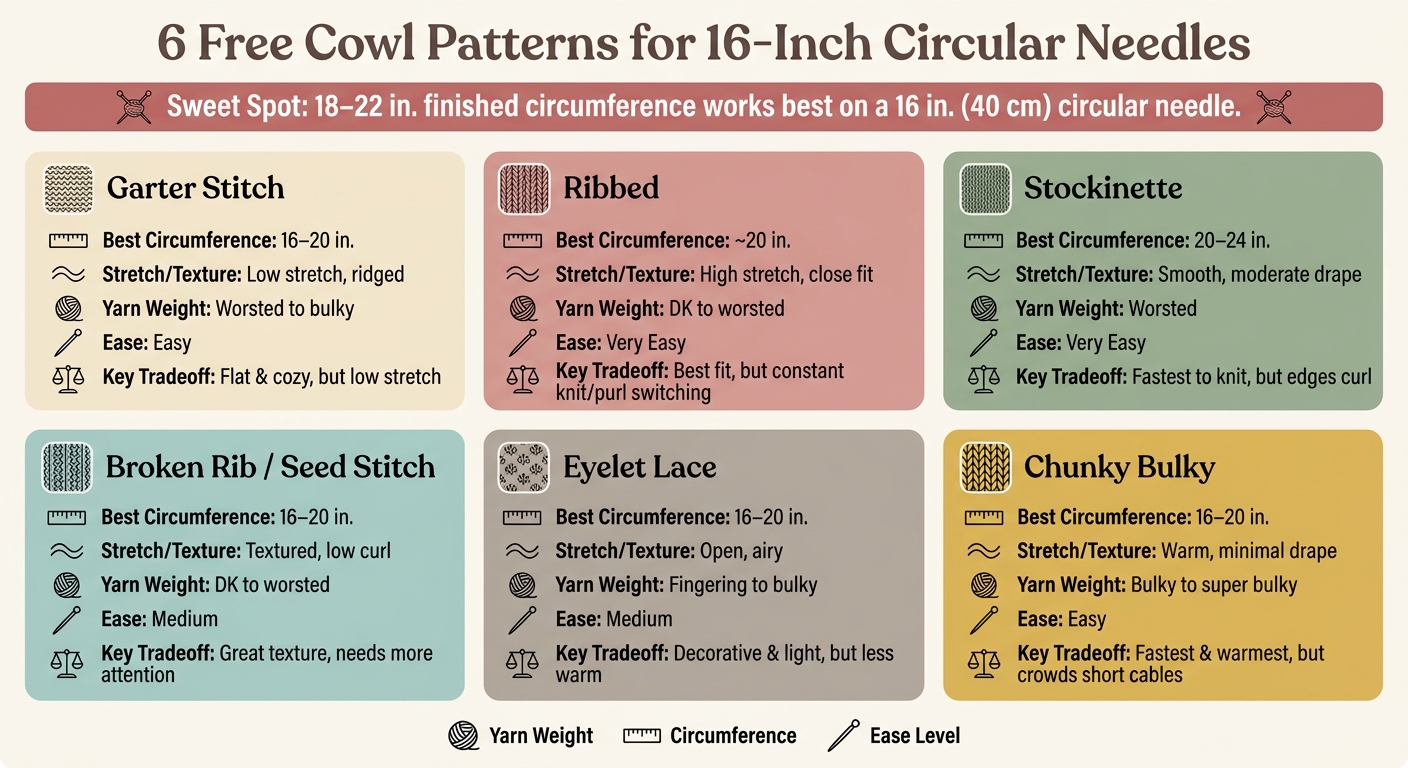
6 Free Cowl Patterns for 16-Inch Circular Needles: Quick Comparison Guide
This is the most basic starting point for a cowl. It's easy to fit on a short circular needle, easy to memorize, and handy when you want to compare it with other patterns later on. A simple garter stitch cowl usually works best at 16 to 20 in. in circumference on a 16 in. circular needle. That size keeps the stitches sitting well on the cord without too much bunching or pull.
Garter stitch in the round means you alternate knit and purl rounds. That gives you the same ridged texture you see in flat garter stitch.
Worsted is a good pick, but bulky and super bulky yarns give this cowl more warmth and loft.
This is one of the easiest cowl styles to handle on a 16 in. circular needle.
Tradeoff: it's simple and cozy, but it has less stretch and shape than ribbed or textured cowls.
If you want more stretch and a neater edge, the next pattern adds ribbing.
Ribbing is a step up from garter stitch when you want more stretch and a fit that sits closer to the neck. A basic ribbed cowl works well at about 20 in. around on a 16 in. circular needle, which gives you a snug neck warmer.
Because ribbing stretches, it hugs the neck more on a fixed-length needle than garter stitch does. The fit is about the size of a standard adult hat.
2x2 ribbing (K2, P2) is usually the easiest rhythm to keep in the round. You shift the yarn position less often than with 1x1 ribbing, so the motion feels steadier as you knit.
Before joining, lay the cast-on edge flat and make sure it isn't twisted. If you join with a twist, there's no fixing it later. Your cast-on count also needs to be a multiple of 4 so the 2x2 rib lines up cleanly at the join.
To cut down on the gap at the start of the round, pull the first two stitches a bit tighter. That helps stop the small ladder that can show up at the join.
If you want less structure and more drape, the next pattern switches to stockinette.
Worsted and DK yarns give ribbing clear stitch definition and feel easy to handle on short needles. If you want extra warmth, try an alpaca-blend worsted.
A stockinette tube cowl doesn’t get much simpler: knit every round. That’s it. No purling. No chart to follow. No constant pattern check.
The one catch is edge curl. Stockinette likes to roll, so most free patterns add 1–2 in. of ribbing, seed stitch, or garter stitch at both ends. That extra bit helps the edges lie flatter and keeps the cowl sitting closer to the neck.
A finished circumference of 20–24 in. fits most adults and works well on a 16 in. circular needle. It gives your stitches enough room without cramming the cable.
If you want a closer fit, go with 18–20 in. for more of a neck-warmer feel.
Worsted weight (#4) is the easiest pick here. It knits up fast, gives the tube some body, and about 200 yd. is often enough for a single-loop cowl.
If softness matters most, especially around the neck, alpaca or an alpaca-blend worsted is a nice option.
Stockinette works well on short circulars because small tension changes don’t stand out as much in the smooth fabric. Put a stitch marker at the start of the round, then just keep knitting at a steady pace.
If you’d like more texture and less curl, the next pattern adds more shape without much extra effort.
If you want texture without the curl that comes with stockinette, broken rib and seed stitch are about as simple as it gets.
Both stitches add texture without making the project harder.
Broken rib works by alternating:
Seed stitch alternates knit and purl stitches so each knit sits over a purl.
The feel is a bit different between the two. Broken rib stretches more and pulls in across the width, which gives it a more elastic fit. Seed stitch stays flatter and firmer, with very little pull-in.
| Feature | Broken Rib | Seed Stitch |
|---|---|---|
| Texture | Vertical ridges broken by flat rounds | Small, textured bumps |
| Elasticity | Higher horizontal stretch | Stable, firm, low contraction |
| Simplicity | Very easy; one round is just knitting | Easy, but requires attention to stitch position |
| Edge Behavior | Lays flat; no curling | Lays flat; no curling |
Aim for 16–20 in. around if you want a snug neck warmer. Use a stretchy cast-on, especially for seed stitch, because it has less give than ribbing. Low-stretch fabrics need a size that fits the cable cleanly without forcing the stitches.
Worsted weight (#4) or DK weight yarns are a good place to start because they show the knit-purl texture clearly. Bulky yarn can work too if you want more squish, but it may hide some of that texture.
For seed stitch in the round, use an even number of stitches. Work each stitch opposite its appearance on every round. A stitch marker at the start of the round helps, and it also pays to tighten the first two stitches after joining.
If you want a lighter fabric next, the next cowl uses eyelets instead of dense texture.
Eyelets come from pairing yarn overs with decreases like K2tog or SSK. In this set, this is the most open and decorative choice. It looks dressier than stockinette, but it’s still easy to knit. You get more pattern and more visual charm, though lace won’t feel as warm as the textured cowls above.
A simple eyelet repeat uses a yarn over (YO) and a decrease to make neat openwork in the round. A slim garter edge can help cut down on curl. Sharp metal needles can also make lace knitting smoother, since the decreases slide more cleanly and with less drag.
Fingering yarn gives you a light, airy lace fabric. Bulky yarn makes the same idea feel softer, puffier, and more pronounced. If warmth matters, a bulky alpaca or alpaca-wool blend works well. Blocking the finished cowl helps open the eyelets and smooth out the stitches. If you want the thickest, warmest option, the next cowl moves into bulky yarn.
Aim for about 16–20 in. around for a close fit on a 16 in. circular needle. That range also helps keep the lace even as you work.
A 16 in. circular needle keeps the lace compact and lets you knit in the round without Magic Loop or DPNs.
If you want more warmth and less openwork, the next cowl uses bulky yarn.
After the lighter, more open cowls above, bulky yarn is the warmest option and the fastest to finish.
Bulky and super bulky yarns work up fast, so this style is great when you want a cowl that feels cozy right away.
Bulky (weight 5) or super bulky (weight 6) yarns are the best match for this style. Alpaca and wool blends are a smart pick here: alpaca brings softness, while wool adds bounce and durability.
Simple stockinette lets the yarn do the talking. Garter stitch adds structure and helps stop edge rolling. And 1x1 or 2x2 ribbing adds stretch, which helps the cowl sit closer to the neck.
With bulky yarn, simple stitch patterns tend to work best because the texture shows up clearly without much extra effort. You don't need anything fancy to make the fabric look good.
Bulky fabric takes up space fast, so it's best to keep the cowl fairly snug on a 16 in. circular needle. Aim for 16–20 in. around for a close fit at the neck. The yarn already brings plenty of warmth, so you usually don't need extra width.
On a 16 in. circular, bulky yarn can crowd the cable in a hurry, so a smaller circumference matters. If the yarn feels slippery in your hands, wood or bamboo needles can give you more grip than metal. Blocking helps even out the stitches and softens the drape a bit.
Compared with garter, ribbing, and lace, bulky yarn gives you the fastest knit and the warmest fabric, but also the least drape. That's the main tradeoff: more speed and warmth, less flexibility than the lighter options above.
Once you look at each cowl type on its own, the differences become much easier to compare side by side. The big things to watch are fit, texture, yarn bulk, and join comfort.
On a 16 in. circular, the best-fitting cowls stay close enough to the needle size that you can knit cleanly without having to wrestle the stitches. Ribbed cowls give you a little more room to breathe. A pattern written with a snug circumference can still stretch several inches when worn and remain comfortable to cast on.
In terms of ease, stockinette and basic ribbing are the simplest to follow. Broken rib is close behind. Seed stitch and eyelet lace ask for a bit more focus, especially at the join where small mistakes tend to show up fast.
For yarn, worsted and aran hit a nice middle ground between stitch detail and drape. Bulky yarn cuts down the stitch count and makes the project move faster, but it also gives the fabric less drape.
Join comfort usually comes down to a few plain things: a flat cord, a stable cast-on, and repeats that are easy to spot. Stockinette and ribbing are the most forgiving when you start. Seed stitch and lace are less forgiving, so join errors stand out sooner.
| Pattern Type | Fit on 16 in. Circular | Texture & Stretch | Yarn Weight | Join Comfort |
|---|---|---|---|---|
| Garter | Good; stable circumference | Low stretch, firm | Worsted to bulky | Easy |
| Ribbed | Excellent; stretch adds forgiveness | High stretch, close fit | DK to worsted | Easiest to start |
| Stockinette | Good; needs border to control curl | Smooth, moderate drape | Worsted | Easiest to start |
| Broken Rib / Seed Stitch | Good; seed stitch needs even count | Textured, low curl | DK to worsted | Moderate |
| Eyelet Lace | Good at snug circumference | Open, decorative | Fingering to bulky | Requires more care at join |
| Chunky Bulky | Best at smaller circumference | Warm, minimal drape | Bulky to super bulky | Easy; low stitch count |
The next section turns these tradeoffs into quick pros and cons for each pattern type.
Each pattern gives you a different mix of fit, texture, and knitting speed. So if you're trying to pick the right one, it helps to think about three things: your comfort level, your yarn, and the look you want at the end. The table below makes that choice a lot easier.
Stockinette is the fastest option, but it curls. Ribbing adds stretch and helps the edges stay flatter. Garter stitch lies flat and is easy to knit, though it doesn't stretch as much as ribbing.
Broken rib and seed stitch bring in texture without becoming a headache. They sit in a nice middle zone: more texture than ribbing, but still easy to manage in the round.
Eyelet lace tends to work best with sharp metal tips, since yarn overs and decreases slide into place more cleanly on a 16-inch circular needle.
Bulky cowls are the fastest to finish and give you the most warmth. The trade-off is that thicker stitches can crowd a 16-inch cable and start to feel stiff when the gauge is tight.
| Pattern Type | Main Pros | Main Cons | Best For |
|---|---|---|---|
| Stockinette | Fastest to knit; smooth surface shows off variegated yarn | Edges curl without a border; very plain texture | Absolute beginner |
| Garter Stitch | Lays flat; reversible; great for borders | Requires alternating knit/purl rounds in the round | Beginner |
| Ribbed | Excellent stretch and fit; does not curl | Constant knit/purl switching | Beginner/intermediate |
| Broken Rib / Seed Stitch | Adds texture without much complexity; moderate visual interest | Requires more attention to keep the repeat on track | Beginner/intermediate |
| Eyelet Lace | Airy, decorative look; lightweight | Requires sharper tips; higher risk of mistakes | Patient beginner |
| Bulky | Extremely fast; warm and squishy | Can feel stiff at tight gauge; stitches crowd short cables | Speed-focused knitter |
After looking at all six options, the main takeaway is pretty simple: for beginners, stockinette, basic ribbing, and garter stitch are the easiest short-circular cowl choices because the repeats are easy to follow. A finished circumference of about 18–22 in. usually works well on a 16 in. circular needle.
Go with alpaca blends if you want softness and drape. Pick bulky yarn if you want speed and warmth.
The best approach is to line up three things: circumference, stitch pattern, and yarn weight. Match the cowl circumference to your needle, choose a repeat you can knit without checking a chart every few minutes, and then decide whether you want drape or faster progress from your yarn. If you want a bit more help, Alpaca Direct's tutorials and YouTube videos at youtube.com/@AlpacaDirect can walk you through joining in the round and working these stitch patterns.
Watch how the stitches sit on the needle as you knit in the round. Your needle should be a bit shorter than the circumference of the cowl, so the stitches can rest on the cable without being stretched out.
If the stitches feel tight or look forced onto the needle, that 16-inch cable is probably too short for the project. And if the whole thing feels clumsy in your hands, switch to a different needle length.
Ribbing patterns are a smart pick for a cowl that needs both stretch and warmth. 1x1 or 2x2 ribbing forms elastic vertical columns, which helps the cowl fit well and feel comfortable.
For more warmth and sharp stitch definition, pair ribbing with alpaca yarn. It adds softness and insulation without extra bulk, and it works well on short circular needles.
First, figure out whether you’re dealing with a twist or just a gap. If the cowl is twisted, you’ll have to start over. If the join is only loose, pull the working yarn and tail snugly after the first stitch to close it up.
If the gap is still there after the first round, don’t panic. Sometimes it settles after a few more rounds. If it doesn’t, knit the first 5 to 10 stitches of the next round with needles that are one or two sizes smaller, then switch back to your usual needle size.

Comments will be approved before showing up.