Your Cart is Empty


You can check dyed alpaca at home in under 30 minutes for wash bleed, a few minutes for rub-off, and a few weeks for sun fade. If the water stays clear, a white cloth stays clean, and the sun-exposed sample matches the covered half, the dye is likely safe for normal gentle care.
Here’s the short version:
A few points matter most:
If I wanted one simple plan, I’d do this:
| Test | What I’m checking | Fast pass sign | Warning sign |
|---|---|---|---|
| Wash | Bleeding in water | Clear water, no transfer | Tinted water or stained cloth |
| Rub | Color transfer from friction | No color on cloth | Damp cloth picks up dye |
| Light | Fading in sun | No change after weeks | Exposed half looks lighter or duller |
This guide is a simple home check, not a lab test. But it gives you a clear way to spot dye problems before washing, gifting, selling, or pairing dark alpaca with light fabrics.
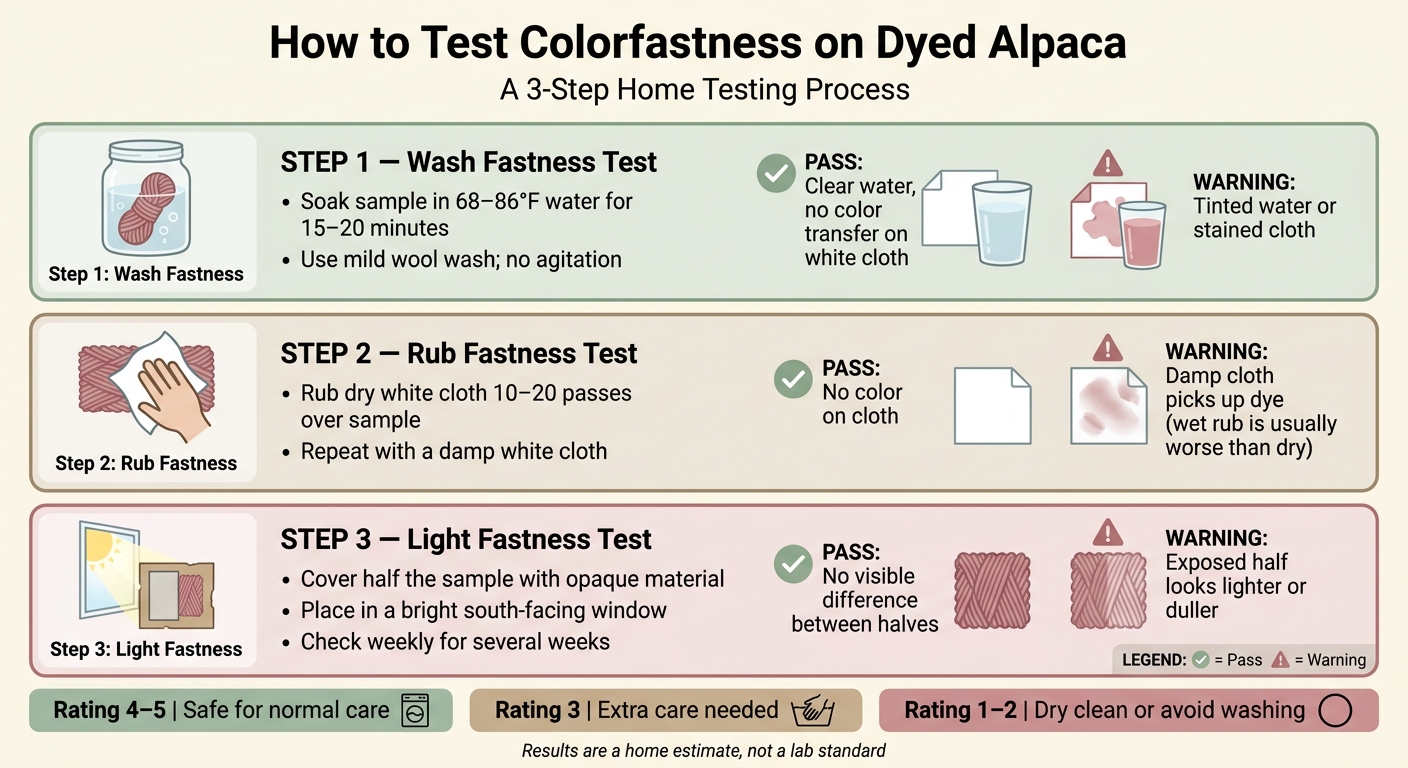
How to Test Colorfastness on Dyed Alpaca: 3-Step Home Testing Guide
Before you test anything, get your supplies together. That makes the whole process smoother and helps you compare results without second-guessing what changed from one sample to the next.
| Tool | Purpose |
|---|---|
| White cotton cloths or paper towels | Check for rub-off |
| Clear jars or bowls | Watch for bleeding |
| Cool to lukewarm water (68–86°F) | Keep water in range |
| Mild wool wash or pH-neutral detergent | Cleanses fiber without triggering extra bleeding |
| Cardboard and tape | Secure swatches for light fading tests |
| Notebook | Record results for each sample |
| Eyedropper (optional) | Apply small drops of water for precise spot tests on finished items |
Work on a clean, well-lit surface so you can spot even small signs of color transfer. Bright light helps a lot here. In your notebook, label each sample by color, project, or dye lot. That sounds simple, but it can save you from mixing up results later.
Keep both wash and rinse water between 68–86°F. That helps lower the risk of felting and keeps your test conditions steady from start to finish.
With everything set up, start with the wash test first.
Be as gentle as possible while handling alpaca. If you get rough with the fiber during testing, the results may not reflect how the item would behave under careful washing.
Use a pH-neutral wool wash. Harsh detergents can damage alpaca fiber.
Wet alpaca needs extra care. Press out water gently, roll the sample in a dry towel, and dry it flat. Never wring, twist, or hang wet alpaca.
Start with the wash test first. It’s the easiest way to catch wet dye transfer at home, and it can save you a headache later. Wash fastness tells you if the dye bleeds in water. If you test before the first wash, you can catch that bleed before it spreads to other fibers or fabrics.
Fill a clear jar or bowl with cool or lukewarm water. Add a small amount of mild wool wash, then place your yarn sample or swatch in the water. Let it soak for 15–20 minutes without agitation so the fiber gets fully saturated.
As it soaks, watch for any tint in the water or any sign of dye bleed. When the soak is done, lift the sample out gently and rinse it in fresh water at the same temperature. Don’t stir, wring, or scrub it. Alpaca can felt if it gets agitated or hit with a sudden temperature shift.
After rinsing, press out extra water gently without twisting. Roll the sample in a towel to pull out moisture, reshape it, and dry it flat away from direct sunlight.
If you’re testing a finished garment or accessory, don’t soak the whole piece right away. Try a hidden area first, like an inside seam or hem. Put a clean white cloth or paper towel behind the spot, then add a few drops of cool water to the alpaca. Wait 5–10 minutes, then press a clean white cloth against the damp area.
Check both cloths for any dye transfer. Then repeat the test once more with diluted wool wash to see how the dye reacts to detergent.
What shows up in the water or on the white cloth gives you a good sense of how the item may act in later washes.
| Test Result | Likely Wash Behavior | Recommended Care Approach |
|---|---|---|
| Clear water; no transfer | Colorfast | Standard gentle hand wash in cool water |
| Slightly tinted water | Minor bleeding | Wash separately; use cold water to minimize further loss |
| Visible staining on cloth | Significant bleeding | Wash separately in cold water with minimal handling; avoid soaking with other items |
| Texture matting or shrinking | Felting from agitation or temperature shock | Retest in cooler water with less agitation |
A faint tint on the first wash can be normal. Heavy bleeding or clear staining is a red flag and points to poor wash fastness. Naturally dyed alpaca can also vary based on the mordant used, such as alum or oxalic acid.
If the sample passes, move on to rub and light fastness tests. Alpaca can still lose color in those areas even when the wash test looks fine.
Once your wash test is done, it helps to run two more checks at home: a rub test for color transfer and a window test for fading. These tests show how the dye holds up against everyday friction and sunlight.
Rub testing shows whether dye comes off onto another fabric when there’s friction.
Take a clean, dry white cotton cloth and rub it over the dyed alpaca 10–20 times with light pressure. Go easy here. Too much force can cause pilling or felting, which can throw off the result. Then repeat the test on another area with a lightly damp white cloth. Keep the sample flat the whole time so it doesn’t stretch.
Now compare both cloths side by side. In most cases, wet rub fastness is lower than dry rub fastness, so the damp cloth tends to pick up more color. That gap gives you a pretty clear picture of how the item may act in rain or humid weather.
| Transfer Level | Staining Risk | Best For |
|---|---|---|
| None (Rating 5) | Negligible | High-friction items: sweaters, leggings, base layers |
| Slight (Rating 4) | Low | Outerwear: scarves, hats, mittens worn over darker colors |
| Moderate (Rating 3) | Medium | Decorative items: throws, wall hangings, dark-colored accessories |
| Heavy (Rating 1–2) | High | Not recommended for apparel; requires further rinsing or dye-setting |
If the cloth shows little or no color transfer, the next step is to check how the dye handles light.
After the rub test, check for fading. Alpaca can still lose color when it sits in sunlight.
Cut a small yarn sample or swatch and tape it to a piece of cardboard. Cover exactly half of it with something opaque, like heavy foil or thick cardstock. This gives you a protected control side. Then place the cardboard in a bright south-facing window and check it once a week for several weeks. Each time, compare the exposed half with the covered half under the same lighting.
Darker shades often hold their color longer than pale shades.
| Degree of Fading | Sunlight Exposure Risk | Storage & Drying Recommendations |
|---|---|---|
| No Change | Low | Suitable for daily outdoor wear and bright rooms |
| Slight Muting | Moderate | Store in dark closets; avoid drying in direct midday sun |
| Noticeable Shift | High | Keep away from windows; wear primarily for evening or indoor events |
| Severe Fading | Extreme | Store in opaque garment bags; display only in low-light areas |
After each check, dry the sample flat in the shade.
Use your test notes to decide how each item should be washed, worn, and stored.
After each test, write down the date, yarn brand, color name, dye lot, water temperature, soak time, alpaca base color, and any changes you saw so you can compare future washes. The base color matters because it changes how fading looks. If you're testing a finished item, also note any prior wear.
If the wash test left tinted water, wash that item by itself in cold water and skip long soaks. If the wet rub test showed clear color transfer, don't pair the item with light-colored fabrics while it's damp. If the window test showed fading, keep the piece in a dark drawer or cedar chest.
Write down the water temperature too. That way, you can repeat the same cool wash and rinse setup next time.
Use this quick scale when you log each test.
| Test Type | Rating 4–5 | Rating 3 | Rating 1–2.5 |
|---|---|---|---|
| Wash Fastness | Safe to wash with like colors | Wash separately; use cold water | Avoid washing; dry clean only |
| Rub Fastness | Normal gentle handling | Keep away from light-colored fabrics when damp | Avoid friction; handle minimally |
| Light Fastness | Normal gentle alpaca care | Store in a dark area; dry in the shade | Keep in a dark area or cedar chest; avoid direct sun |
Use a 1–5 rating for each test type when you record results. A rating of 5 means no visible change and strong fastness. A 3 means the item is in the middle and needs extra care. Anything below 3 points to instability, so that piece will likely need dry cleaning or only very limited handling.
Four rules should carry forward every time:
Yes. Test a small, discreet area instead of soaking the whole garment.
Dab an inconspicuous spot - like an inside seam or hem - with a white cloth and mild detergent, then check for dye transfer. That gives you a simple way to assess colorfastness without the risk of fully submerging the garment, which can lead to felting or stretching.
Not always. A bit of color in the soak water doesn’t automatically mean the dye is unstable.
Dark-dyed alpaca items can let out some extra dye during the first few washes, especially if the dyeing process wasn’t fully finished during manufacturing. To play it safe, wash dark pieces separately in cold water for the first few cleanings.
If your alpaca item passes the wash test but fails the rub or light fastness tests, the dye likely isn’t bonding well enough to the fiber or standing up to day-to-day exposure.
To get better results next time, start with properly scoured yarn so the dye can take more evenly. You can also use a mordant like alum to help the dye attach better. In the dye bath, don’t overcrowd the yarn, and keep the temperature where it needs to be throughout the process.
If light fastness is still weak, switch to dyes that hold up better in light.

Comments will be approved before showing up.