Your Cart is Empty


Transform alpaca yarn into vibrant colors with natural dyes derived from plants, insects, and other organic sources. These recipes use eco-conscious materials like cochineal, turmeric, walnut hulls, onion skins, and indigo to create stunning hues ranging from reds to blues. Alpaca yarn’s porous structure makes it ideal for absorbing these dyes deeply, resulting in rich and lasting colors.
These recipes combine simplicity and creativity, offering a step-by-step guide to dyeing alpaca yarn with natural ingredients. Let’s dive into each method.
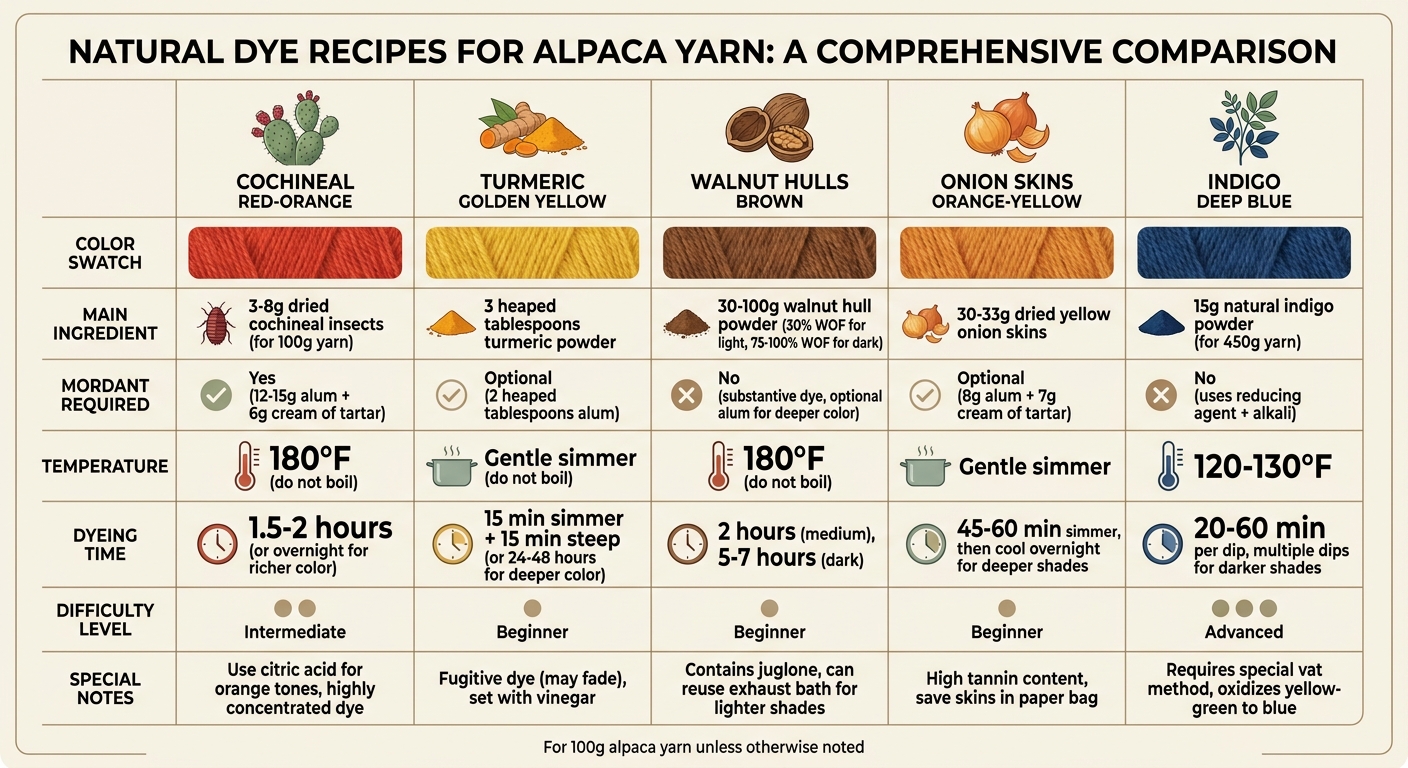
5 Natural Dye Recipes for Alpaca Yarn: Colors, Ingredients & Process Overview
Cochineal, a small scale insect found on prickly pear cacti, is the source of carminic acid - a pigment that delivers bold, long-lasting reds and purples. As Shepherd Textiles describes:
"The female produces a bright red substance called carminic acid to discourage predation. Carminic acid also happens to be an excellent textile dye that produces color-fast, light-fast reds and purples."
This dye is incredibly concentrated: about 4,000 insects are required to make just one ounce of extract. Despite this, only a small amount - 3% to 8% of the yarn's weight in dried insects - is needed to achieve a medium shade on alpaca yarn.
To dye 3.5 ounces (100 grams) of alpaca yarn, you’ll need:
Begin by grinding the dried cochineal insects into a fine powder. A finer grind ensures better color extraction. Be sure to wear a dust mask to avoid inhaling the powder.
Once your materials are ready, follow these steps to achieve your desired color.
Add citric acid gradually, testing the shade on a small yarn sample until you achieve the desired tone. Once the pH is adjusted, the dye bath is ready."A lower acid pH (citric acid) will shift the color more orange, and higher more alkali pH (soda ash) will shift the color to bluer/darker hues."
This process showcases how natural dyeing, with careful preparation and sustainable materials, can create striking and lasting colors.
Turmeric is a go-to natural dye for beginners, offering bright yellows and warm oranges on alpaca fiber. This common kitchen spice is easy to use and doesn’t require hard-to-find ingredients. However, it’s worth noting that turmeric is a "fugitive" dye, meaning its color may fade over time, especially when exposed to sunlight. As Ellie from Petalplum shares:
"Turmeric is sometimes a fugitive dye, which means it doesn't last as long as some other natural dyes; but I have found that some fabrics take the colour and keep it better than others..."
Despite this, you can extend the color's vibrancy with proper setting techniques. Turmeric remains a favorite for its simplicity and the stunning golden tones it brings to soft alpaca fibers.
To dye 3.5 ounces (100 grams) of alpaca yarn, you’ll need:
Make sure to work in a well-ventilated area. The standard ratio for the dye bath is 1 tablespoon of turmeric powder per cup of water.
For a low-energy option, try solar dyeing. Place your yarn and dye bath in lidded glass jars and leave them in the sun for several days to a week. Alternatively, a slow cooker provides consistent heat, making it a great choice for delicate alpaca fibers.
Walnut hulls are a fantastic natural dye option for creating earthy, rich browns on alpaca yarn. The magic ingredient here is juglone, a natural compound found in walnut trees. Not only does it produce vibrant browns, but it also acts as a natural herbicide by suppressing the growth of competing plants. One of the best parts? Walnut hulls are perfect for beginners since they are a substantive dye. This means they naturally bond to alpaca fibers without needing a mordant, though adding one (like alum) can deepen the color and improve its resistance to fading.
The final shade depends on the ratio of walnut hull powder to the weight of your yarn. For instance:
Fiber artist Devin Helmen says it best:
"Black walnut dye is the easiest natural dye I know of and one I always recommend to people who want to start out with dyeing using materials from nature."
Here's how to prepare and use walnut hulls for dyeing.
For 3.5 ounces (100 grams) of alpaca yarn, you’ll need:
Wear gloves and use dedicated tools like a stainless steel pot and spoon, as walnut dye can permanently stain surfaces.
Start by soaking your alpaca yarn in water for several hours to ensure the dye penetrates evenly. Meanwhile, combine the walnut hull powder with water in a separate container. Heat the mixture to 180°F for about an hour to extract the juglone. Be careful not to boil it, as high heat can damage the protein fibers. For richer colors, let the dye bath steep overnight, then strain it through cheesecloth.
Once your dye bath is ready, it’s time to color your yarn. Place the pre-soaked yarn into the strained dye bath and gently simmer it at 180°F. Test the dye strength hourly by dipping a small yarn sample. As Amy from DoodleDog Designs suggests:
"Keep cooking the walnuts until the dye is the strength and color you want for your project."
For medium browns, simmer the yarn for about 2 hours. For darker shades, extend the simmering time to 5–7 hours. If you want a grey-brown tone, add 2% iron sulfate during the last few minutes of simmering. Once you’ve achieved the desired color, remove the yarn and rinse it with a pH-neutral detergent to set the dye and minimize bleeding.
Don’t toss out the leftover dye bath! Known as an exhaust bath, it can be reused to dye another skein in lighter tan shades. Finally, hang your yarn to dry in a shaded area, keeping your work surfaces protected.
This natural dyeing process not only enhances the beauty of your alpaca yarn but also supports sustainable and eco-friendly crafting practices.
Onion skins are an easy and beginner-friendly option for naturally dyeing alpaca yarn. Yellow (or brown) onion skins, in particular, create beautiful warm hues ranging from orange to golden tones. Thanks to their high tannin content, these skins bond well with fibers without needing extra fixatives.
As Julie's Yarn Blog explains:
In depending on the mordant used, yellow-skinned onions will yield burnt and bright orange, yellow, brass, and brown colors, while red-skinned onions will yield reddish-orange, pink, salmon, gold, tan-brown, and dark tan dyes.
For a classic warm orange-yellow, stick to yellow onion skins, as red onion skins can produce unexpected shades.
To dye approximately 3.5 ounces (100 grams) of alpaca yarn, you'll need about 30 to 33 grams of dried yellow onion skins. Prepare around 4 liters (16 cups) of water for your dye bath. For more vibrant colors, you can optionally include 8 grams of alum and 7 grams of cream of tartar as mordants.
Store your collected onion skins in a breathable container, such as a paper bag, to avoid moisture and mold. Before you begin dyeing, scour the alpaca yarn with a gentle detergent to remove oils and dirt, then soak it in lukewarm water for about 30 minutes. Sam from All Natural Dyeing emphasizes:
In wet wool, dye distributes itself much more uniformly. About half an hour of soaking is usually enough.
Once your yarn and ingredients are ready, you can move on to creating the dye bath.
To prepare the dye bath, place the onion skins in a stainless steel or enamel pot with the water. Bring the mixture to a gentle simmer and let it cook for 45 to 60 minutes to extract the pigment fully. Afterward, strain out the skins to avoid uneven coloring.
Let the dye bath cool to room temperature before adding your pre-soaked yarn. Sam from All Natural Dyeing advises:
Never add wool to a boiling pot of water as it will felt with the dramatic temperature change.
Add the yarn to the cooled dye bath and maintain a gentle simmer, turning it every 5 to 10 minutes to ensure even color absorption. For deeper, richer shades, allow the yarn to cool overnight in the dye bath after simmering. Once the desired color is achieved, rinse the yarn in lukewarm water until the water runs clear, then hang it to dry in a shaded area.
Indigo dyeing is a fascinating process that relies on a special vat method. Since indigo isn't water-soluble, it needs to be chemically reduced to bond with fibers. Once removed from the vat, the dye reacts with oxygen in the air, transforming the fiber's initial yellow-green color into the rich, deep blue indigo is known for.
To dye 1 pound (450 grams) of alpaca yarn a deep blue, you'll need:
Before dyeing, scour your yarn thoroughly. Use Orvus Paste soap at around 140°F (60°C) and soak for one hour without agitation to avoid felting.
Safety Tips and Equipment:
Once your materials are prepped, you're ready to create the indigo vat.
Start by mixing indigo powder with warm water to form a paste. Gradually add the alkali and reducing agent while maintaining the vat temperature between 120°F and 130°F. A properly prepared vat will appear clear green-yellow with a bronzy sheen and blue bubbles, often called the "indigo flower." If the vat looks opaque blue, it means too much oxygen is present, and additional reduction is needed.
Temperature control is crucial throughout the process. Submerge your pre-scoured, wet alpaca yarn in the vat for 20–60 minutes, stirring gently to limit oxygen exposure. Initially, the yarn will emerge yellow-green, but as it reacts with oxygen, it will deepen into blue. For darker, richer shades, use multiple short dips (30 seconds to 5 minutes each), allowing 20–30 minutes of oxidation between dips, rather than one prolonged soak.
After the final oxidation, neutralize the yarn with a vinegar rinse (mix 1/4 cup vinegar per pound of alpaca in 110°F water, soaking for 15 minutes). Follow with a hot water wash (170°F) using neutral soap until the water runs clear. Once cleaned, let the dyed yarn rest in a dark place for two weeks to allow the color to fully stabilize .
Getting your yarn ready before you start dyeing is key to achieving even color and vibrant results. Start by scouring your alpaca yarn to remove oils and impurities that can block dye absorption. Alpaca fiber has a unique advantage over sheep’s wool - it doesn’t contain lanolin, which makes it more receptive to dyes. Plus, its larger and less dense cortex provides more spots for dye molecules to bind.
To prepare, boil your spun yarn with a mild detergent at 140°F (60°C). Rinse it thoroughly afterward, and keep the yarn wet to ensure the dye penetrates evenly.
Using fixatives, also known as mordants, can help lock in color and make it last. Pairing these tips with dyeing recipes will help you achieve rich, durable hues on your alpaca yarn.
Proper storage is crucial to maintaining the potency of your natural dyes. For cochineal insects, dry them completely in the sun, then grind them into a fine powder using a mortar and pestle or a hand grinder. This powdered form stores well and stays effective for future use.
Fresh materials like chipped Yanali bark should go straight into the dye bath for the best results. You can often reuse leftover dye baths for lighter shades. For example, a lichen bath that once produced orange might yield a light brown in a second round. Always make sure your dyed yarn is completely dry before winding it into balls or storing it. Any leftover moisture can damage both the fibers and the color.
Natural dyeing brings alpaca yarn to life with rich, eco-conscious colors. This guide covered five recipes that yield beautiful results: cochineal for red-orange, turmeric for golden yellow, walnut hulls for earthy browns, onion skins for warm orange-yellow, and indigo for deep blues.
Alpaca fiber stands out for its lack of lanolin and its porous nature, which allows it to absorb dyes deeply, creating vivid, durable colors.
"It is generally accepted that natural dyes are better for human health and the environment than synthetic ones." - Threads of Peru
Dyeing alpaca yarn blends creativity with chemistry. You can tweak colors by adjusting factors like boiling times, the amount of dyestuff, or the type of fixative used. For instance, cochineal gives a crimson shade when paired with alum but turns purple with iron. Experimentation is key - taking notes on your process ensures you can recreate your favorite shades or refine your techniques over time.
Explore more tips and tools to keep your dyeing journey exciting below.
To elevate your natural dyeing projects, Alpaca Direct offers a wide range of high-quality yarns and tools. From alpaca yarn in various weights to knitting needles and crochet hooks, they have everything you need. Visit alpacadirect.com to find materials tailored to your next project.
For more ideas and techniques, head over to the Alpaca Direct YouTube channel at youtube.com/@AlpacaDirect. There, you'll find knitting tutorials, creative project ideas, and a weekly show packed with new techniques to inspire your sustainable fiber art journey.
To keep alpaca yarn from felting during the dyeing process, it's essential to handle it with care. Use lukewarm water instead of hot, as higher temperatures can encourage felting. Avoid excessive agitation or friction, which can damage the fibers. Sticking to traditional dyeing techniques, including the use of fixatives like mineral salts, can help preserve the yarn's structure. By following these steps, you can achieve vibrant, lasting colors while keeping the yarn soft and intact.
Most natural dyes rely on a mordant to adhere properly to fibers, particularly protein fibers like alpaca, wool, and silk. Alum is one of the commonly used mordants. While some dyes, like cochineal and avocado pits, generally require a mordant, others, such as red cabbage, can sometimes work without one. That said, incorporating a mordant often enhances both the durability and intensity of the color.
To make your colors last longer and keep them from fading, you can use mordants - substances that help dyes bond to fibers more effectively. Safe choices like alum or iron are often suggested for this purpose. Following proper mordanting methods and rinsing thoroughly after dyeing are key steps to locking in those colors. These practices help your natural dyes stay bright and durable over time.

Comments will be approved before showing up.