Your Cart is Empty



I’d start with Flax for a first kids’ sweater or Little Coffee Bean for an easy-to-open baby cardigan. These 10 patterns skip sewn side and shoulder seams, but you’ll still need to weave in ends, close underarm gaps, or add buttons.
My first check: <u>finished chest size - not age alone</u>. Then I compare yarn weight, gauge, skills, and how the child will wear it. Most options cover babies and children; Taiga starts at a 38.5-inch finished chest, so check its fit before choosing it for an older child.
Quick Comparison
| Pattern | Size range | Construction | Yarn | Skills and best use |
|---|---|---|---|---|
| Elaine Phillips’s Child’s Raglan Sweater | 2–16 years | Top-down raglan | Sport or worsted; check version | Beginner–intermediate; school wear |
| Taiga | 38.5–68.5-inch finished chest | Top-down round yoke | Worsted | Intermediate; colorwork gifts |
| Sori Baby Pullover | 0–24 months | Top-down raglan | DK | Advanced beginner–intermediate; textured baby gifts |
| Baby Top-Down Raglan Pullover | 6–24 months | Top-down raglan | Check pattern | First garment; daily baby wear |
| Heart Baby Pullover | 0–24 months | Top-down raglan | Aran | Advanced beginner; heart-motif gifts |
| Flax | 0–6 months through 8–10 years | Top-down raglan | Worsted or aran | Beginner; everyday wear |
| Flax Light | 0–6 months through 8–10 years | Top-down raglan | Fingering or sock | Confident beginner; light layers |
| Anker’s Sweater – Junior | Baby through 10–12 years | Top-down ribbed yoke with raglan shaping | Worsted | Adventurous beginner–intermediate; textured sweater |
| Novice Sweater – Junior | 1–14 years | Top-down round yoke | Bulky | Beginner; warm daily wear |
| Little Coffee Bean Cardigan | 3–18 months | Top-down raglan; body knit flat | Worsted | Advanced beginner; easier dressing |
Before buying yarn, I’d check the current instructions and wash a gauge swatch. Top-down knitting often lets you change body and sleeve lengths, but no sewn seams doesn’t mean no finishing. Allow time for blocking, check that the neck fits over the child’s head, secure any buttons, and include yarn-label care instructions with gifts.
Compare sizes, construction, yarn weight, and best use in the table below. Unconfirmed details are marked rather than guessed.
| Pattern / designer | Sizes | Construction | Best use | Yarn weight | Skill level |
|---|---|---|---|---|---|
| Child’s Seamless Raglan Sweater - Elaine Phillips | 2, 4, 6, 8, 10, 12, 14, 16 | Seamless raglan | Everyday school sweater | Sport or worsted | Beginner–intermediate |
| Taiga Sweater | Details not confirmed | - | - | - | - |
| Sori Baby Pullover | 0–3, 3–6, 6–12, 12–24 months | Top-down raglan, in the round | Textured baby gift | DK | Advanced beginner |
| Baby Top-Down Raglan Pullover | 6, 12, 18, 24 months | Top-down raglan, in the round | Everyday baby pullover | Details not confirmed | - |
| Heart Baby Pullover | 0–3, 3–6, 6–12, 12–24 months | Seamless top-down raglan | Warm baby gift | Aran | Advanced beginner |
| Flax - Tin Can Knits | 0–6 months through 8–10 years; adult sizes also available | Top-down, in the round | Everyday sweater | Worsted | Beginner |
| Flax Light - Tin Can Knits | 0–6 months, 6–12 months, 1–2, 2–4, 4–6, 6–8, 8–10 years; adult sizes also available | Top-down, in the round | Lightweight layering | Fingering/sock | Beginner–intermediate |
| Anker’s Sweater – Junior | Details not confirmed | - | - | - | - |
| Novice Sweater – Junior | Details not confirmed | - | - | - | - |
| Little Coffee Bean Cardigan | Details not confirmed | Flat-knit cardigan; seamless construction not confirmed | - | - | - |
Choose a size by finished measurements, not age. Finished chest circumferences range from about 21 to 32.5 inches for Child’s Seamless Raglan Sweater, 19.5 to 24 inches for Sori Baby Pullover, and 19 to 25 inches for Heart Baby Pullover.
The construction notes below explain what counts as seamless knitting.
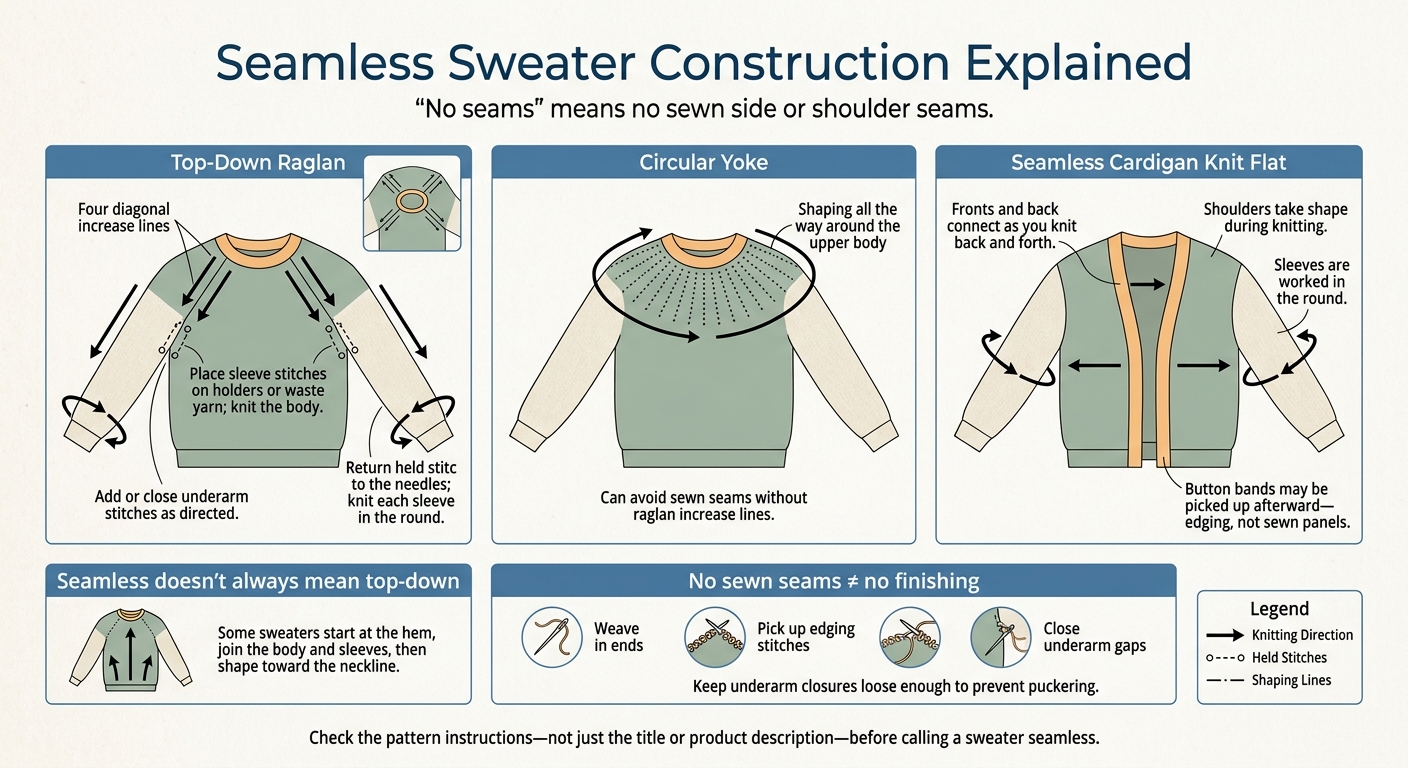
Seamless Sweater Construction Explained
“No seams” means no sewn side or shoulder seams. That’s the standard for comparing the patterns below. Before calling a sweater seamless, check the pattern instructions - not just its title or product description.
You may still need to weave in ends, pick up edging stitches, or close underarm gaps. These are finishing steps, not sewn seams. Keep underarm closures loose enough to prevent puckering.
Top-down raglans shape the shoulders with four diagonal increase lines rather than sewn seams. At the underarms, you place sleeve stitches on holders or waste yarn while knitting the body. Then you return those stitches to the needles and knit each sleeve in the round, adding or closing underarm stitches as directed.
A circular yoke shapes the upper body all the way around instead of along four raglan lines. Both methods can avoid sewn seams, but seamless doesn’t always mean top-down. Some sweaters start at the hem and work bottom-up, joining the body and sleeves before shaping toward the neckline. Check where each pattern starts and how its parts join.
Flat-knit doesn’t mean separate pieces. An open-front cardigan can connect the fronts and back as you knit back and forth. The shoulders take shape during knitting, and the sleeves are worked in the round.
Button bands may be picked up afterward along the front edges. That adds edging rather than sewing panels together. Check the construction details before treating “flat-knit” as seamless.
Child’s Seamless Raglan Sweater by Elaine Phillips begins at the neckline. You shape the neck flat, then join in the round to knit the body and sleeves without seams. It’s a practical first pattern on this list.
The pattern covers sizes 2, 4, 6, 8, 10, 12, 14, and 16 years, but published measurement details don’t agree. Listings confirm the size range without providing a full finished-measurement chart. Check the current pattern instructions before buying yarn.
Yarn listings differ, too. One specifies sport-weight Wendy Guernsey 5 Ply, while another names worsted-weight Elann Peruvian Highland Donegal. Before buying yarn, choose the exact pattern version and check its gauge. The listed gauge is 19 stitches and 26 rows over 4 inches, using US 6 (4.0 mm) needles.
The fit and fabric weight suit school days and layering. You’ll use cast-on, ribbing, stockinette, raglan increases, neckline shaping, joining in the round, and knitting sleeves in the round. The pattern falls in the beginner-to-easy-intermediate range and works for everyday wear or gifts sized with room to grow.
Taiga by Tania Barley is a seamless, top-down colorwork sweater with a round yoke. Its smallest finished chest measurement is 38½ inches, making it best suited to older kids, tweens, and teens. It’s one of the few patterns in this roundup aimed at older children rather than babies or small kids.
Sizes 1–8 have finished chest measurements of 38½ to 68½ inches, with 6–12 inches of positive ease. Compare the child’s chest measurement with the size chart before choosing a size.
Use worsted-weight yarn with a gauge of 16 stitches and 25 rounds per 4 inches. You’ll need 942 to 1,822 yards for the main color and 142 to 295 yards for the contrast color, depending on the size.
Short rows shape the neckline. Pick up the sleeves at the armholes and knit them downward in the round - there are no seams to sew. The bold yoke suits special occasions more than everyday school wear.
This intermediate pattern uses stranded colorwork, short rows, and sleeves knit in the round. Swatch in the round and check your gauge before starting. It’s a good option for a special-occasion gift sweater for an older child.
Sori Baby Pullover by Irina Anikeeva is a top-down raglan for infants and toddlers. Textured stripes add a subtle touch, making it a practical baby gift with a clean finish.
The pattern comes in four sizes, with finished chest circumferences of 19.5–24 inches and about 3.5–5.5 inches of positive ease. Choose a size based on the child’s chest measurement and the amount of room you want, rather than age alone.
| Size | Finished chest circumference |
|---|---|
| 0–3 months | 19.5 inches |
| 3–6 months | 21.5 inches |
| 6–12 months | 23 inches |
| 12–24 months | 24 inches |
Use DK-weight yarn that gives you 21 stitches and 28 rows per 4 inches in stockinette. Garnstudio DROPS Daisy has about 120 yards per 50 grams.
For the four sizes, in the order shown above, you’ll need 30, 45, 65, or 85 grams of the main color. Each contrast color requires 50, 75, 100, or 125 grams. Buy full skeins, and allow extra yarn for your swatch.
Work the yoke on US 6 (4 mm) circular needles, then divide at the underarms. Knit the body and sleeves in the round, using different methods for knitting in the round like double-pointed needles or Magic Loop for the sleeves. The roomy fit slips easily over onesies and tees.
This pattern suits advanced beginner to intermediate knitters who are comfortable with raglan increases and knitting small rounds. If you follow the multicolor sample, you’ll also need to work color changes.
For a gift, choose yarn that keeps the fabric soft and washable, and pick a size for when the child will wear it. For everyday wear, soft, washable DK yarn is a good choice.
For a slightly larger baby size, Top Down Raglan Baby Pullover by Yarnspirations keeps things simple. This neck-down sweater uses stockinette fabric, two colors, and 1×1 ribbed edges for straightforward knitting without sewn seams. Sizes start at 6 months.
Verified sizes are 6, 12, 18, and 24 months, with finished chest circumferences of 21, 22, 24, and 26 inches, respectively.
| Size | Finished chest circumference |
|---|---|
| 6 months | 21 inches |
| 12 months | 22 inches |
| 18 months | 24 inches |
| 24 months | 26 inches |
The pattern calls for Bernat Forever Fleece Finest, supplied in a 9.9 oz (280 g), 888 yd (812 m) package. The gauge is 20 stitches and 26 rows per 4 inches, with recommended needles of US 6 (4 mm) and US 7 (4.5 mm).
Follow the pattern’s gauge, not the yarn label. The listing provides one total yarn amount, so check the PDF for quantities by size and color placement.
Knit the sweater from the neck down in one piece, then separate the sleeves. Finish the body and sleeves in the round, with no side or shoulder seams to sew. You’ll still need to weave in ends and check for small gaps at the underarms.
The listing describes this sweater as a suitable first garment project. You’ll use knit and purl stitches, raglan increases, stitch markers, and a method for knitting small sleeve rounds.
It’s a practical option for gifts or daily wear. If you’re knitting a gift, choose a larger size to allow room for growth. For everyday use, pick a soft, easy-care yarn that meets the pattern’s gauge.
Heart Baby Pullover by SeventhSedge is a top-down raglan baby sweater worked without seams, with a heart motif in a contrast color.
Choose the size by chest measurement, not age, using the chart below.
Sizes range from 0–3 to 12–24 months, with about 3.5–6 inches (9–15 cm) of positive ease at the chest - that’s extra room between the baby’s chest measurement and the finished sweater.
| Size | Finished chest | Body length | Sleeve length |
|---|---|---|---|
| 0–3 months | 19 inches (48 cm) | 10 inches (25 cm) | 10.5 inches (25 cm) |
| 3–6 months | 21 inches (53 cm) | 11.5 inches (29 cm) | 11.5 inches (29 cm) |
| 6–12 months | 23 inches (58 cm) | 12 inches (31 cm) | 12.5 inches (33 cm) |
| 12–24 months | 25 inches (63 cm) | 13.5 inches (35 cm) | 13.5 inches (36 cm) |
Use aran-weight yarn with a gauge of 17 stitches and 25 rows per 4 inches. In size order, you’ll need 50 (70, 90, 110) g of the main color and 20 (30, 40, 50) g of the contrast color.
Knit the raglan yoke from the top down, then separate the body and sleeves and work each in stockinette in the round. To finish, weave in the ends, complete the neckline and cuffs, and block the sweater.
This pattern suits knitters who know the basics of knitting in the round and can work raglan increases, separate sleeve stitches, knit small circumferences, and follow the contrast heart instructions.
Choose soft, washable aran-weight yarn for everyday wear. The heart motif also makes this a sweet gift for a baby shower or first birthday.
Flax is a solid choice for a simple school sweater, especially if you’re new to sweater knitting.
Flax includes seven baby and child sizes. Choose a size based on the child’s chest measurement and desired ease - the extra room in the fit - not age alone.
| Size | Finished chest |
|---|---|
| 0–6 months | 18 inches |
| 6–12 months | 19.5 inches |
| 1–2 years | 20.5 inches |
| 2–4 years | 22 inches |
| 4–6 years | 24 inches |
| 6–8 years | 26 inches |
| 8–10 years | 28 inches |
Use worsted- or aran-weight yarn that gives you 18 stitches and 22 rounds per 4 inches in stockinette stitch. You’ll need about 280 to 850 yards for the child sizes, depending on the size you knit.
Check the current official instructions before buying yarn. Match your yarn to the pattern’s gauge before choosing needles, and wash and block your swatch before measuring it.
Flax is a top-down raglan with garter-stitch sleeve panels. Knit the body and sleeves in the round, then close the underarm gaps, weave in the ends, and block the sweater.
Flax is presented as a simple first sweater for an advanced beginner who’s comfortable knitting in the round. Working from the top down means you can try it on and adjust the body and sleeve lengths before binding off.
It’s best suited to everyday wear and hand-me-downs, and a washable wool blend works well. If you’re knitting it as a gift, include the yarn’s care instructions.
Flax Light is the lighter, finer-gauge version of Flax, made for layering and milder weather.
Flax Light offers seven baby and child sizes. Compare the finished chest measurement with the child’s chest, then choose how much extra room - or ease - you want.
| Size | Finished chest | Approximate yardage |
|---|---|---|
| 0–6 months | 18 inches | 350 yards |
| 6–12 months | 19 inches | 400 yards |
| 1–2 years | 20 inches | 500 yards |
| 2–4 years | 22 inches | 650 yards |
| 4–6 years | 24 inches | 750 yards |
| 6–8 years | 26 inches | 900 yards |
| 8–10 years | 28 inches | 1,000 yards |
Check the current pattern PDF before buying yarn. Allow extra yardage if you plan to add length or make other adjustments.
Use fingering- or sock-weight yarn, with a gauge of 24 stitches and 32 rounds per 4 inches in stockinette stitch. The pattern calls for US 2 (2.75 mm) needles for ribbing and US 5 (3.75 mm) needles for the main fabric. Change needle sizes as needed to get gauge.
This top-down raglan starts with a yoke shaped by raglan increases. You then knit the body and sleeves in the round, keeping Flax’s garter-stitch sleeve panels. There are no side, shoulder, or sleeve seams to sew, but you’ll still weave in ends and close small underarm gaps. Optional short rows add back-neck shaping.
It’s a good fit if you want a familiar raglan shape in a lighter fabric without sewing seams.
Flax Light suits a confident beginner who’s comfortable knitting and purling in the round, working knit-one-purl-one ribbing, making raglan increases, and knitting small circumferences.
The lighter fabric works well for spring and fall layering, whether under a jacket or indoors. For gifts, washable superwash wool or a wool blend makes care simpler. Wash and block your swatch the same way you plan to care for the finished sweater.
After the simpler raglans, Anker’s Sweater adds texture without adding seams.
Anker’s Sweater – Junior covers baby sizes through 10–12 years. Finished chest measurements range from about 20–36¼ inches (51–92 cm), with lengths of about 10¾–20½ inches. Choose the size by chest measurement, allowing 4–6 inches of positive ease.
Use worsted-weight yarn at a gauge of 20 stitches and 28 rows per 4 inches, worked on US 6 (4 mm) needles. Yardage depends on the size and yarn option. Follow the current pattern’s yarn choice rather than converting totals between different ball sizes.
Knit the sweater from the top down in the round, starting with a textured ribbed yoke and using raglan shaping before working the stockinette body. The sleeves come last and are also knit in the round. That leaves just the ends to weave in.
This pattern suits an adventurous beginner or intermediate knitter who’s comfortable with increases and small-circumference knitting. The textured yoke gives it a polished look for gifting, while the seam-free, worsted-weight fabric works well for everyday wear.
Novice Sweater – Junior uses the same top-down construction with no seams, but adds bulkier fabric that knits up faster.
The standard Junior version offers 11 sizes: 1–2, 2–3, 3–4, 4–5, 5–6, 6–7, 7–8, 8–9, 9–10, 10–12, and 12–14 years. Finished bust measurements range from 23½–33½ inches (60–85 cm), with finished lengths of 13½–21¼ inches (34–54 cm). Choose the size by chest measurement, not age.
Use bulky-weight yarn that gives you 16 stitches and 21 rows per 4 inches in stockinette. Before casting on, swatch with the listed US 9 (5.5 mm) and US 10 (6 mm) needles. Expect to need about 328–820 yards, depending on size, and check the pattern PDF for exact yardage.
Begin at the ribbed neckband, then knit the circular yoke from the top down using four evenly distributed increase rounds. Set aside the sleeve stitches and work the body and sleeves in the round.
This top-down approach lets you adjust the body and sleeve lengths before binding off. Finish the cuffs and hem as directed, weave in the ends, and block the sweater.
This beginner-friendly pattern uses knit and purl stitches, increases, held sleeve stitches, and underarm stitches. You’ll also need to feel comfortable knitting in the round and using either Magic Loop or double-pointed needles for smaller circumferences.
The plain stockinette fabric suits everyday wear, school sweaters, and practical gifts. If you’re making it as a gift, choose a soft, washable yarn in a color that works with different outfits, and include care instructions. Use the standard pattern, not the Mohair Edition - the yarn and gauge differ.
The final pattern switches to an open-front cardigan.
Elizabeth Smith’s pattern comes in 3, 6, 12, and 18 months, though older copies may include only three sizes.
| Size | Finished chest | Main-color yarn | Contrast-color yarn |
|---|---|---|---|
| 3 months | 19.5 inches | 180 yards | 100 yards |
| 6 months | 21.5 inches | 215 yards | 130 yards |
| 12 months | 22.25 inches | 250 yards | 160 yards |
| 18 months | 23 inches | 290 yards | 190 yards |
All measurements and yardages come from the pattern.
Choose worsted-weight yarn that gives you 18 stitches and 24 rows per 4 inches in stockinette. For the body, use a US 8 (5 mm), 24-inch circular needle. Work the sleeves with US 8 double-pointed needles or Magic Loop, and use US 7 (4.5 mm) needles for the ribbing. Check the yardage needed for each color, and set aside extra yarn if you plan to add length.
Knit this striped baby cardigan from the top down, using seamless raglan shaping. Work the body back and forth on circular needles and the sleeves in the round. Choose short sleeves for warm weather or long sleeves for cooler months.
To finish, pick up stitches for the front bands, add buttons, weave in the ends, and block the cardigan. Sew the buttons on securely.
This advanced-beginner pattern works well as a first sweater if you’re comfortable with raglan increases, knitting sleeves, and picking up stitches for button bands. The open front makes dressing easier. Knit it in soft, washable yarn for a practical baby gift.
Next, use the size, yarn, and needle guide to match any of these patterns to the child and the yarn you already have.
After comparing patterns, use these three checks to pick the right size, yarn, and needles.
Measure around the fullest part of the child’s chest. Keep the tape level and snug, but not tight. Choose a size based on the finished chest measurement and intended ease, not age. Allow 1–2 inches of ease for a close fit or 3–4 inches for layering, if the pattern permits.
For room to grow, focus on chest fit rather than automatically going up a size. Record torso and sleeve lengths, too. If the instructions allow it, add length before the hem or cuffs. Don’t change the yoke depth or raglan shaping without guidance. Patterns that include length measurements make body and sleeve adjustments easier.
With the size settled, match your yarn and needles to the pattern’s gauge.
Look for softness, stitch definition, and washability, plus enough structure to keep the sweater’s shape after washing. Buy the yardage listed for your chosen size, with extra yarn for any added length.
Knit a swatch at least 4 inches across and wash it the same way you’ll wash the sweater. Once it’s dry, measure it with a firm ruler. Check stitch and row gauge, along with drape and any growth after washing.
For the body, use circular needles with a cable that holds the stitches without stretching them. For sleeves, use double-pointed needles or Magic Loop, if the pattern allows. Choose the needle size that matches the pattern’s gauge after washing.
Weave each yarn tail through nearby stitches on the wrong side, then reverse direction once. Pull it snug before trimming, and avoid bulky knots. Remove waste yarn and stitch markers before gifting.
Next, turn the sweater inside out. Close small underarm gaps with matching yarn, using mattress stitch or duplicate stitch. Draw the edges together without puckering, and check the openings again after blocking.
Follow the yarn label when blocking. For washable wool, soak the sweater in lukewarm water - about 86°F (30°C) - for 10 minutes. Press out the water, roll it in a towel, and lay it flat to dry. Skip heat when blocking acrylic.
Check the neckline for scratchy tails, bulky joins, and a tight bind-off. If possible, make sure the sweater slides easily over the child’s head. Fix any restrictive edge rather than counting on blocking to loosen it. Inspect the cuffs, hems, and button bands as well. Sweaters for babies and toddlers should have no dangling ties or unsecured decorations.
Before gifting, include a gift care card with the sweater’s size, blocked chest circumference, body or sleeve length, fiber content, and yarn brand and colorway so the recipient can find replacement yarn. Copy the washing method, water temperature, drying instructions, and storage notes from the yarn label - not the care instructions for the pattern’s suggested yarn. For knitted wool, specify folded storage rather than hanging. Use these details to help choose the best pattern for the child.
Match the pattern to the child’s age and how they’ll wear it. Pick Sori Baby Pullover or Heart Baby Pullover for baby gifts, Little Coffee Bean Cardigan for easier dressing, Flax Light for lightweight layering, and Flax or Novice Sweater – Junior for cold-weather wear. None requires sewn side or shoulder seams, so there’s less assembly.
For classic raglan shaping and easy changes to body or sleeve length, choose Flax. Prefer a round yoke? Go with Novice Sweater – Junior. Anker’s Sweater – Junior offers a textured, top-down pullover with a relaxed fit.
Before casting on, check the finished chest measurements, ease, gauge, and skill level. Wash your swatch using the care method you plan to use for the sweater. Allow time for weaving in ends, blocking, and any button or underarm finishing, and weigh fit, yarn, and construction alongside age.
Yes, but cotton can be slippery and hold its shape less well, so seamless sweaters may stretch more easily. Seams or faux seam techniques help keep that stretching in check.
Cotton can still work for kids’ sweaters, depending on the pattern and construction. Just expect the fit to change more than it would with wool.
Add structure where the sweater is most likely to stretch. Seams and finishing help keep stretching in check, especially with slippery fibers like alpaca or superwash wool. For the shoulders, avoid finishing methods that provide little support. Kitchener stitch, for example, leaves no stabilizing seam.
Knit and block a gauge swatch exactly as the pattern directs. This helps prevent the finished sweater from turning out larger than intended.
The provided search results don’t explain how to fix uneven raglan increases. For general knitting troubleshooting and technique demonstrations, try the tutorials on the Alpaca Direct YouTube channel.

Comments will be approved before showing up.