Your Cart is Empty


If I want cables to show in alpaca, I keep them small, simple, and spaced out. In most cases, 2-stitch twists and 4-stitch cables look best, 6-stitch cables can work with care, and 8-stitch or larger panels often look soft or flat.
Here’s the short version:
Why? Alpaca has less bounce than merino wool, so cable crosses do not stay as sharp. Add halo, and stitch edges get even softer. That means small motifs keep their shape better, while big panels can lose depth and blend into the fabric.
A few quick numbers from the article’s guidance:
| Cable type | How it tends to look in alpaca | Best use |
|---|---|---|
| 2-stitch twist | Clear and neat | Light texture, drapey items |
| 4-stitch cable | Clean and easy to see | Hats, mittens, sweaters |
| 6-stitch cable | Softened, needs space | Simple panels with plain ground |
| 8+ stitch cable | Blurred or flatter | Usually not the first choice |
My takeaway: if you want alpaca cables that stay visible, go narrow, keep the background plain, and avoid crowded panels.
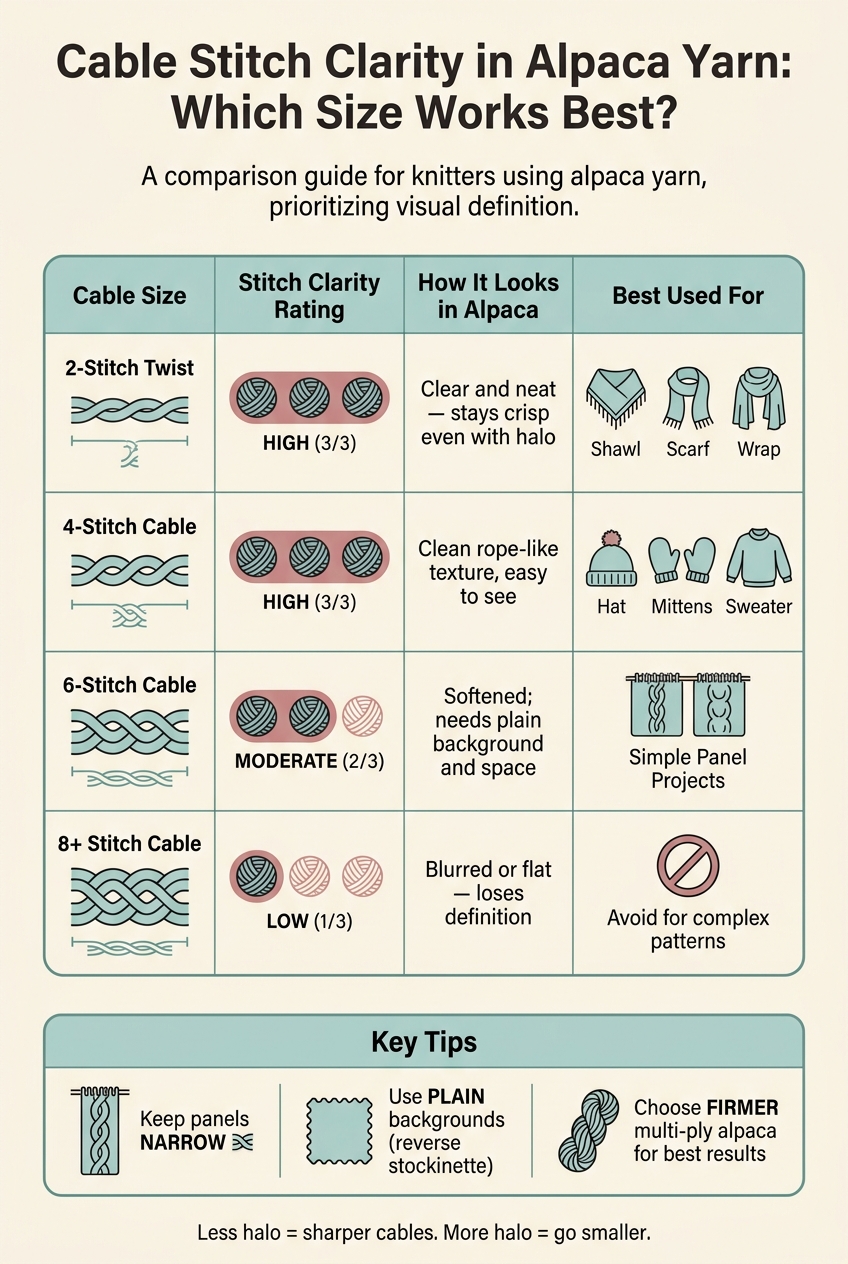
Cable Stitch Clarity in Alpaca Yarn: Which Size Works Best?
Once alpaca softens the fabric, cable width becomes the big constraint. In most cases, 2-stitch twists and 4-stitch cables give you the cleanest result. A 6-stitch cable can work, but only if you keep it fairly restrained.
Smaller crossings stay sharper because they move fewer stitches and put less stress on the fabric. A 2-stitch twist or 4-stitch cable shifts less fabric from side to side, so the knitted surface can handle that movement without getting pulled out of shape.
That matters a lot in alpaca. Since alpaca has less bounce and memory than wool, bigger cables tend to spread out across the fabric instead of sitting up on top of it. So instead of looking bold and carved, they often look softer and flatter.
Once you get to 6 stitches, the result depends much more on spacing and yarn build.
A 6-stitch cable can still work in alpaca if the background stays simple and the cable panel has enough breathing room. Plain surrounding fabric helps a lot. Reverse stockinette is a good choice, and adding extra plain stitches around the cable gives it more contrast so it doesn’t get lost.
Yarn build also plays a big part. A multi-ply alpaca with a firmer spin will hold a 6-stitch cable better than a loose single-ply. As Imperial Yarn notes:
"If the alpaca has significant halo, cables and crisp knit-purl contrasts may soften visually." - Imperial Yarn
If the yarn has a lot of halo, it’s usually smarter to step back down to 4 stitches.
| Cable Size | Readability | Best Use |
|---|---|---|
| 2-Stitch Twist | High | Clear, stays crisp even with halo |
| 4-Stitch Cable | High | Reliable rope-like texture |
| 6-Stitch Cable | Moderate | Good if spaced well; may flatten |
| 8+ Stitch Cable | Low | Likely to blur or flatten |
When even a 4-stitch cable feels too heavy, switch to simple twists. In alpaca, that move often makes more sense when drape matters.
Full cable crosses pull stitches into a tighter horizontal space. That makes the fabric firmer and cuts down on its natural movement. With alpaca, that trade-off often works against the fiber.
Simple twists - like 2-stitch left and right twists - shift fewer stitches and put much less tension on the fabric around them. You get texture without making the fabric stiff. The fabric stays light and flexible, which is a good fit for scarves, shawls, and relaxed sweaters.
There’s another plus: stitch definition. Alpaca’s natural bloom can soften small details, so simpler crossings tend to stay easier to see than rope or braid motifs. Small twists usually read better over time than wider cables. That said, the amount of halo in the yarn still plays a big role.
Pair a left twist with a right twist on either side of a center panel, and you get a cable-like rhythm without the bulk. It adds movement and symmetry in a way that still shows up well in alpaca, even when the yarn has a softer, fuzzier finish.
This works especially well for hats, headbands, and other fitted accessories. Alpaca has low elasticity and tends to relax over time, so mirrored twists add shape without pulling the fabric out of line the way a wide cable panel can.
| Project Type | Best Twist | Why It Works |
|---|---|---|
| Shawls & Wraps | Simple left/right twists | Preserves fluid drape and movement |
| Hats & Headbands | Mirrored twists | Adds shape without bulk or extra weight |
| Relaxed Sweaters | Narrow twists | Adds texture without stiffness |
Wide panels lose detail fastest, which is why panel width matters next.
Once cable size gets bigger, halo becomes the next thing that limits clarity. It's one of the main reasons alpaca cables can lose their sharp look.
Alpaca's smooth fibers let stitches settle and loosen a bit, so crossings look softer and less defined. Instead of holding a sharp ridge, crossed stitches tend to relax, which makes cables look more rounded and slightly wavy instead of crisp and rope-like.
The more halo you have, the less stitch detail you can see. Even neat, clean crosses can start to blur when the yarn bloom gets too heavy. That's why smooth, multi-plied alpaca yarns usually show cable detail better than loosely spun or very fuzzy yarns. If cable clarity matters, yarn construction matters just as much as stitch choice.
Wide cables lose shape faster in alpaca because the fabric doesn't spring back sharply after a cross. In soft alpaca, that can make the panel look sunken, so it reads more like a broad textured area than a clearly outlined motif.
When the cable and the background sit at almost the same visual height, the design loses contrast and can fade into the fabric. That's why narrow panels are usually the safer pick in alpaca.
Wide panels lose definition fast, so the next step is figuring out how much structure your project can carry.
With alpaca, narrow cable panels usually work best. They stay easier to read and let the fabric keep its drape. Narrow rope cables, such as 2/2 crosses, move fewer stitches, so the fabric stays fluid instead of turning stiff or bulky.
Width isn’t the only thing that matters. Spacing plays a big part too. When cable motifs are packed too close together, each crossing gets harder to see. A plain reverse stockinette background is the safest pick because it gives you a clean, smooth field that makes the cable stand out clearly. Textured backgrounds like seed stitch or garter can fight with the cable’s edges and make the panel look less clear.
After you’ve kept the panel narrow, match the cable depth to the way the finished piece needs to wear.
Hats and mittens can take firmer cables. Scarves, wraps, and sweaters usually do better with less structure. 4- to 6-stitch cables work well for hats and mittens because they add the warmth and stability those items need. Using a slightly smaller needle can also keep the fabric denser.
Scarves, wraps, and sweaters usually look better when alpaca’s drape gets to do its job. That’s why reversible cable knitting patterns or narrow rope cables are often the better fit. They add texture without taking away the fabric’s fluid feel. On sweaters in particular, wide panels can behave like stiff vertical ribs, which can make the garment feel more rigid or stretch downward under its own weight.
The main rule is simple: alpaca shows smaller, simpler cables best, making them perfect for alpaca gifts for knitters. Small to medium cable motifs tend to read more cleanly, especially 2-stitch twists and 4-stitch cables. Simple twists are often the clearest option of all, because they add motion and texture without the extra squeeze that comes with wider crosses.
That’s why halo matters just as much as cable width. Alpaca’s halo softens the edges of each stitch, so wide or detailed panels start to blur sooner.
If you want the clearest look, keep the cable panel narrow and the background plain. A narrow panel paired with a simple ground helps the cable stay visible.
Alpaca cables look best when they’re simple, narrow, and set against a clean background.
Choose alpaca yarn for cables based on structure and stitch clarity, not just softness. That part matters more than many knitters expect. A smooth, multi-plied yarn with a firmer spin will usually give you the sharpest definition, so the cables don’t blur into the fabric.
If you’re knitting more detailed cable patterns, an alpaca-wool or alpaca-silk blend often works better than pure alpaca. It tends to hold its shape better and gives the motif more bounce. And before you commit to a whole project, knit a swatch. It’s the simplest way to check whether the yarn keeps the cable pattern clean and readable.
Wide cables can be tricky in 100% alpaca. Unlike wool, alpaca has less bounce and stretch. It also has low memory and a heavier drape, so wide cable panels can sag, pull inward, or lose definition over time.
If you want a better result, go with a firmer multi-ply alpaca yarn or an alpaca blend that holds its shape better. Wooden or bamboo needles can help too, since they give you a bit more grip.
Cable stitches in alpaca shine in projects where you want a soft, luxe finish instead of a crisp, sculpted look. Alpaca has lovely drape and plenty of warmth, which makes it a great fit for throws, cushion covers, and shawls.
For sweaters, a wool-alpaca blend usually works better. The wool helps the cables hold their shape and stay more defined over time.

Comments will be approved before showing up.